
White evangelicals were quick to repent of racism in the civil rights era. That doesn’t mean they’ll embrace critical race theory today.
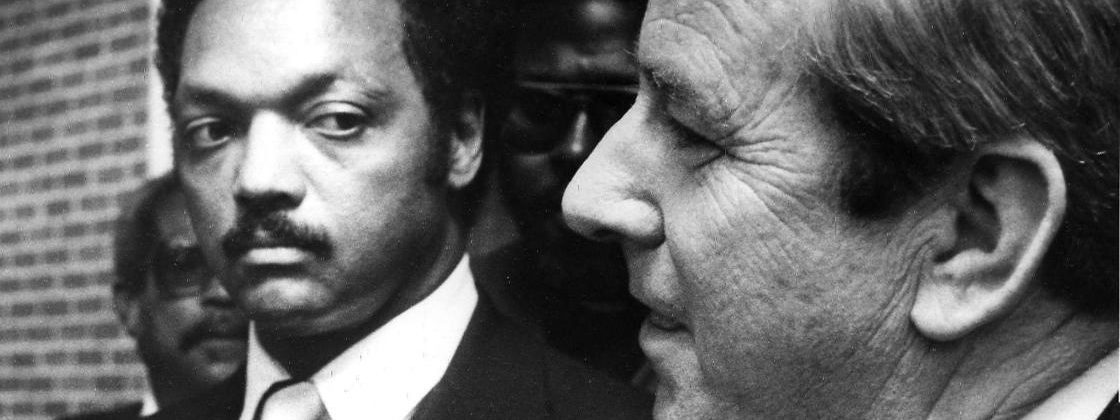
Jerry Falwell Sr., the Lynchburg, Virginia, Baptist pastor who founded the Moral Majority and was a leading architect of the Religious Right during the Reagan era, devoted an entire chapter of his autobiography to his conversion from racism. “I never once considered myself a racist,” he wrote. “Yet, looking back, I have to admit that I was one.”
In the 1950s, Falwell had preached a sermon denouncing Brown v. Board of Education and offering purported biblical support for racial segregation. He condemned ministerial involvement in the civil rights movement. But in retrospect, he said, “the Scriptures had been perfectly clear about the equality of all men and women, about loving all people equally, about fighting injustice, and about obeying God and standing against the immoral and dehumanizing traditions of man.” And so in 1968, a few weeks after Martin Luther King Jr.’s assassination, Falwell baptized his first Black convert.
Now, more than fifty years later, Southern Baptists are again debating racial justice. Will those who today oppose critical race theory one day tell a story of conversion to racial enlightenment, just as Falwell did?
Unfortunately, the answer is probably no. If we understand the nature of white southern conservative evangelicals’ first conversion from racism—that is, the one that occurred in the late 1960s, when Falwell changed his mind on race—we’ll begin to see why so many of them now oppose critical race theory—and why they’re unlikely to experience a second conversion on this issue.
Like most other white southern conservative evangelicals who changed their attitudes on race in the late 1960s, Falwell experienced a conversion that was entirely personal. He did not change his partisan allegiances. He did not join a civil rights march. He did not begin advocating for racial justice in housing, schools, or the legal system. Instead, he embraced “color-blind” conservatism—that is, the view that both the law and social practices should be race-neutral, without any special privileges accorded to any particular race. His conversion was complete, he thought, when he welcomed Blacks into his church and professed love for them in his heart.
The vast majority of white southern evangelicals who lived through the civil rights era can recount similar conversions. Although they might have once been segregationists, they were delighted when the “Whites Only” and “Colored” signs came down, they claim. And although it may have taken a little longer, nearly all came to accept interracial marriage and invite Blacks into their homes and to their social activities. In reality, they probably misunderstood King’s message (King was much more concerned about structural racial and economic inequality than most white conservative evangelicals realize), but, at least in their own view, they had fully accepted the tenets of the civil rights movement when they repented of personal racism.
Why did white conservative evangelicals who had once been segregationists experience a mass conversion to color-blind conservatism a half-century ago?
To some of their critics, the answer is obvious: Color-blind conservatism preserves racial inequality. Conservative white evangelicals like Falwell found it easy to exchange overt segregationist thinking for color-blind conservatism because they never really changed their racist views, and they found color-blind ideology a convenient fig leaf to cover their continued advocacy of white privilege.
I think such a view misunderstands the values of the evangelical culture of which Falwell was a part. Evangelicals in general—and white Appalachian evangelicals in particular—have long been democratically-minded egalitarians. With their suspicion of hierarchical ecclesiastical structures and their proclamation of individual Christians’ ability to both interpret the Bible for themselves and find salvation not through a church but through the direct intervention of the Holy Spirit, evangelicals of the eighteenth and nineteenth centuries pioneered an individualist theology that appealed to both Black and white Americans, especially on the southern frontier. Southern white evangelicals rejected the antislavery campaigns and social activism of their northern counterparts, but they preserved the movement’s emphasis on the equality of all believers. Although continuing to accept the racial prejudices of their society—and sometimes appealing to Scripture to support those prejudices—they nevertheless remained open to interracial mission and the principle that people of all races needed to hear the gospel and be saved through faith in Christ. On the impoverished margins of southern evangelicalism, the early Pentecostals even engaged in interracial worship.
For most white southern evangelicals, the principles of fairness and individualistic-minded equality of opportunity are as deeply engrained as the belief that God loves people of every race and culture. When the civil rights movement developed, they opposed it as long as they thought that it was the work of “northern agitators,” but when segregation laws were repealed, they quickly made peace with the new reality. This was partly because evangelical leaders whom they respected (such as Billy Graham) endorsed racial integration and partly because it accorded with their own egalitarian impulses, which they believed came directly from Scripture. The idea that everyone should be treated equally, regardless of skin color, was so obviously true to most evangelicals that most quickly embraced it at the end of the 1960s or shortly thereafter, even if they also called for policies of “law and order” that exacerbated racial inequality.
Today a large majority of predominantly white evangelical institutions are racially integrated, with an appeal to African Americans, Hispanics, and other racial minorities that often exceeds that of white mainline denominations. In 2020, fifty-eight percent of American megachurches (almost all of which are evangelical) were categorized as multiracial, which means that at least 20 percent of their members or attendees are racial minorities. Falwell’s Liberty University has a student population that is fifteen percent Black—a higher percentage than any Ivy League or flagship state university in the United States. Because of Liberty University’s size (an enrollment of over 100,000), there are more African American students at Liberty than there are at Howard University or any other historically black college or university. And some white evangelical universities enroll an even higher percentage of African Americans than Liberty University. Blacks comprise nearly thirty-three percent of the student population at Pat Robertson’s Regent University in Virginia Beach. When it comes to color-blind conservatism, white evangelicals generally practice what they preach: They welcome Blacks into their churches and ministries and treat them as full human beings.
But they show no interest in changing the structures of society that perpetuate racial inequality. When white evangelicals exchanged segregationist thinking for color-blind conservatism, they did not change their biblical hermeneutic. Instead, they became more consistent practitioners of an egalitarian ethos that they had at some level already believed. The idea that sin is structural as well as individual, however, or that ostensibly race-neutral laws and practices are in reality racially biased, is so far removed from traditional white southern evangelical theology that many white conservative evangelicals view these ideas as heretical.
And so, instead of seeking further racial justice, many white conservative evangelicals find consolation in their own conversions from personal racism. They have already been “born again” on this issue, they believe, and they’re not seeking a second conversion.
Daniel K. Williams is a professor of history at the University of West Georgia and the author of several books on religion and American politics, including God’s Own Party: The Making of the Christian Right and The Politics of the Cross: A Christian Alternative to Partisanship.

Daniel K. Williams is Senior Fellow and Director of Teacher Programs at the Ashbrook Center at Ashland University in Ohio and is the author of several books on religion and American politics, including God’s Own Party: The Making of the Christian Right and The Politics of the Cross: A Christian Alternative to Partisanship.