• Skip to main content
  • Current
  • Home
  • About
    • About Current
    • Masthead
  • Podcasts
  • Blogs
    • The Way of Improvement Leads Home
    • The Arena
  • Reviews
  • 🔎

What Trillions Can’t Buy

Daniel K. Williams   |  April 12, 2021

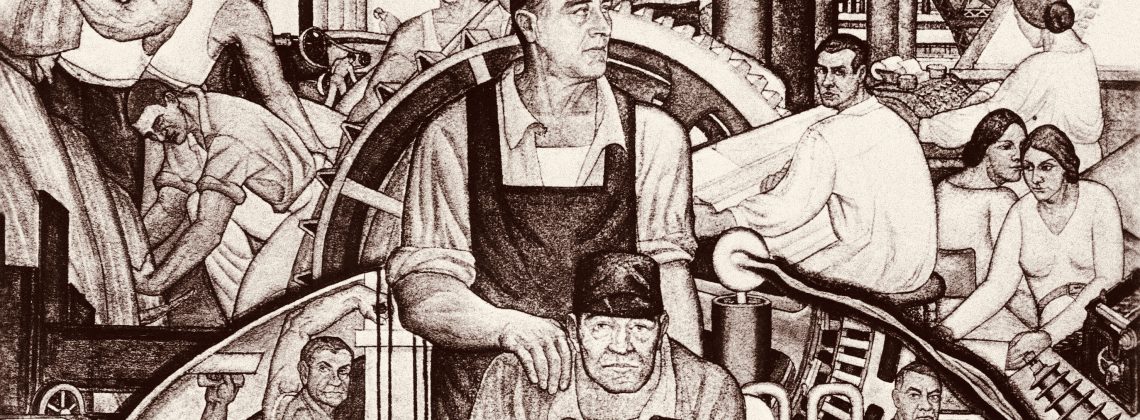
The New Deal, mural dedicated to President Roosevelt, by Conrad A. Albrizio, 1934
(The New Deal, mural dedicated to President Roosevelt, by Conrad A. Albrizio, 1934/Flickr)

The success of the American Rescue Plan hinges on a consensus we appear to lack

Is the recently enacted $1.9 trillion COVID relief bill “one of the most important pieces of legislation of our lifetimes,” as David Brooks declared? If measured strictly by its price tag, it may be, at least for the moment. The American Rescue Plan Act is currently the second most expensive economic stimulus package in American history, mere billions behind the bipartisan $2.2 trillion CARES Act that President Donald Trump signed into law last year. The Biden administration’s three trillion-dollar infrastructure spending proposal could well dwarf both. But if importance is measured not in dollars but lasting transformations of federal policy, the American Rescue Plan Act may not prove so significant.

This is not because the relief bill is unnecessary. It will undoubtedly help millions of Americans who are struggling financially. But it does not offer a blueprint for lasting change, as the New Deal or the Marshall Plan did. Perhaps this is because in a deeply divided nation we no longer share values widely enough to make truly transformative legislation—along the lines of Franklin Roosevelt’s Social Security Act or Lyndon Johnson’s civil rights bills—possible. 

Transformative policy never occurs without a national consensus in values to support it. The New Deal would never have happened without a widespread belief—shaped by two generations of Catholic, Protestant, and Jewish advocates of a social ethic—that the government should not let people starve. Likewise, the Marshall Plan, which promised thirteen billion dollars for rebuilding Western Europe after World War II, would never have been adopted without the emergent national consensus that the United States should promote freedom, democracy, and economic security around the world—a commitment President Truman grounded in Christian principles. Similarly, the Civil Rights Act of 1964 and the Voting Rights Act of 1965 occurred only because of a shift in national thinking among white liberals about the rights of African Americans—a shift that resulted from the rights-conscious messages of religious and educational institutions, the news media, federal courts, and above all African American civil rights activists.

Every one of these transformative pieces of legislation established a new role for the federal government that continued for decades. The New Deal created a mandate for the federal government to intervene in the economy to help the less fortunate, so that even after the 1930s a federally orchestrated social safety net continued—through Republican and Democratic administrations alike. The Marshall Plan created the precedent for future American foreign aid programs that were closely linked to the nation’s Cold War mission. The civil rights legislation of the 1960s gave the federal government sweeping new powers to stamp out discrimination in employment, housing, education, and voting, and established the principle that the federal government would continue to enforce equality in the private sector. 

These transformative pieces of legislation were costly, which was why they could not have been enacted without the shared values that make Americans willing to bear the costs. The Social Security Act—which included not only retirement benefits but also unemployment insurance and Aid to Families with Dependent Children—established a program that now costs one trillion dollars per year. The Cold War commitment to American international intervention would likewise result in trillions of dollars of new federal spending over the next few decades. And the civil rights legislation of the 1960s created real costs for private businesses and educational institutions. 

Since American voters are not willing, presumably, to bear such costs unless the programs accord with their values, one might assume that in a deeply polarized nation Americans would fail to unite around transformative legislation with a multi-trillion-dollar price tag. Why, then, do seventy percent of American adults support the $1.9 trillion relief bill, according to a Pew Research poll conducted in early March? Does this represent a new national consensus around the value of helping low-income families?

It does not. In fact, the strong support for the COVID relief bill probably reflects a belief that it won’t cost the average American anything—a belief that in turn may indicate an absence of shared values about helping the poor. Instead of creating new programs to transform society and address structural inequities, the American Rescue Plan Act provides a one-time transfer of money—a lot of money, to be sure, but money given on a very temporary basis and not always discriminately or strategically. 

In the 1960s, the few people who advocated direct cash transfers as a replacement for welfare programs were conservatives (like Milton Friedman and later, Richard Nixon) who wanted to find a replacement for the liberal social uplift programs of Johnson’s War on Poverty. The fact that the best a new Democratic administration can offer today is a one-time cash transfer program that vaguely resembles parts of Friedman’s proposal is a sign of how far we have moved from the shared values that undergirded the New Deal and the Great Society. We no longer agree on how to fight structural poverty or expand access to education—or even whether we should. Instead, we agree only that cash grants to the vast majority of American households and an infusion of capital to small businesses are good ideas.

Unfortunately, Americans’ sudden support of these cash transfers probably comes not from a deep commitment to help the less fortunate but instead from a new belief that high federal deficits will not affect most Americans. For decades a majority of Americans have worried about the deficit because they believed that high rates of government borrowing would result in higher taxes, inflation, or a weaker economy. But public opinion polls have shown that over the past year concerns about the deficit have rapidly declined, and today only a minority of Americans say that they are concerned about the steadily increasing federal debt. After decades of high federal deficit spending, taxes for most Americans have not gone up and inflation has remained low. Giving away a couple trillion dollars of borrowed federal money doesn’t seem like it will cost anything. It’s a cheap solution to a more systemic problem than short-term aid can fix.

While many lower-income Americans are no doubt delighted to receive money that will help them pay their rent, repair their car, or put food on the table, I wonder what they will do next month, after their $1400 check is spent. Without more strategic, longer-term commitments to structural economic relief—such as a minimum wage increase, debt forgiveness, or initiatives to make healthcare and higher education universally accessible and affordable—the American Rescue Plan Act’s effects will be short-lived. 

Long-term structural reforms will require greater collective sacrifice. And that will depend on a national consensus that currently does not exist. Until we rediscover those shared values, whatever policies we agree to are unlikely to be transformative, despite all of the Biden administration’s efforts.

Daniel K. Williams is a professor of history at the University of West Georgia and the author of several books on religion and American politics, including God’s Own Party: The Making of the Christian Right and The Politics of the Cross: A Christian Alternative to Partisanship.

Daniel K. Williams
+ postsBio

Daniel K. Williams is Senior Fellow and Director of Teacher Programs at the Ashbrook Center at Ashland University in Ohio and is the author of several books on religion and American politics, including God’s Own Party: The Making of the Christian Right and The Politics of the Cross: A Christian Alternative to Partisanship.

  • Daniel K. Williams
    The Internationalist Vision that Persuaded “America First” Isolationists
  • Daniel K. Williams
    How Should Christians Respond to an Anti-Institutional Presidency?
  • Daniel K. Williams
    Some of our favorite things III: Current writers and editors reflect on 2024 (conclusion)
  • Daniel K. Williams
    Review: Christian anti-liberals
  • Daniel K. Williams
    FORUM: Election 2024, Part IV
  • Daniel K. Williams
    How the 2024 election will change American politics
  • Daniel K. Williams
    What I’ll be watching for tonight
  • Daniel K. Williams
    This Election Will Not End Our Polarization
  • Daniel K. Williams
    Six parties may not be enough
  • Daniel K. Williams
    Abortion and prohibition: will the 2024 election be like 1932?
  • Daniel K. Williams
    Rating Republican Presidents on Their Pro-Life Bona Fides
  • Daniel K. Williams
    Jimmy Carter’s Evangelical Faith
  • Daniel K. Williams
    Will we accept the results of this presidential election?
  • Daniel K. Williams
    American Christian voters and third parties: a historical overview
  • Daniel K. Williams
    What the Decline of the Black Church Means for Politics
  • Daniel K. Williams
    REVIEW: Shepherds for Sale?
  • Daniel K. Williams
    The Challenges of Assessing Presidential Candidates’ Character
  • Daniel K. Williams
    REVIEW: Richard Nixon’s Graceless Religion
  • Daniel K. Williams
    FORUM: Fiftieth Anniversary of Nixon’s Resignation, Day One
  • Daniel K. Williams
    The Catholic conversion of J. D. Vance
  • Daniel K. Williams
    The Dems’ Biggest Problem Isn’t Biden’s Age
  • Daniel K. Williams
    The End of Roe: Two Years Later
  • Daniel K. Williams
    Daniel K. Williams reviews “Two Visions for an Evangelical Reformation” in Christian Scholar’s Review
  • Daniel K. Williams
    Interview: Miles Smith’s Religion and Republic: Christian America from the Founding to the Civil War
  • Daniel K. Williams
    PREVIEW: The Politics of the Cross
  • Daniel K. Williams
    Interview with Dan Williams on Politics of the Cross, paperback release
  • Daniel K. Williams
    A “just peace” for both Israel and the Palestinians
  • Daniel K. Williams
    Needed: A New History of Rural Working-Class Conservatism
  • Daniel K. Williams
    The lost social justice ethic of the temperance movement
  • Daniel K. Williams
    Atonement
  • Daniel K. Williams
    How can we end the semiannual time changes?
  • Daniel K. Williams
    Civil religion is different from Christian Nationalism
  • Daniel K. Williams
    REVIEW: We Need a Political Realignment
  • Daniel K. Williams
    Presidents’ Day celebration menu
  • Daniel K. Williams
    Do young “breakthrough scholars” in US history still exist?
  • Daniel K. Williams
    2024 and The Politics of Class
  • Daniel K. Williams
    Can an authoritarian political regime happen here?
  • Daniel K. Williams
    The GOP’s new culture war is not about the evangelicals
  • Daniel K. Williams
    The Iowa caucuses told us what we already know
  • Daniel K. Williams
    Martin Luther King Jr.’s Christian apologetics
  • Daniel K. Williams
    Was Martin Luther King Jr. a Christian Nationalist?
  • Daniel K. Williams
    The source of hope in a violent year
  • Daniel K. Williams
    Henry Kissinger: a lover of power and stability
  • Daniel K. Williams
    The philosophical assumptions behind historical criticism of the Gospels
  • Daniel K. Williams
    Rosalynn Carter’s political partnership
  • Daniel K. Williams
    What If AI Had Written the Gettysburg Address?
  • Daniel K. Williams
    Pro-lifers’ needless defeat in Ohio shows the dangers of refusing to listen
  • Daniel K. Williams
    The Vice Presidency: Not a Reliable Ticket to the White House
  • Daniel K. Williams
    American secularization hasn’t followed the script that secularization theory would predict
  • Daniel K. Williams
    Abortion and Pro-Life Politics: A Conversation, Part II
  • Daniel K. Williams
    Abortion and Pro-Life Politics: A Conversation, Part I
  • Daniel K. Williams
    Review: Why we still need Jonathan Edwards
  • Daniel K. Williams
    Why did Jonathan Edwards think that slavery was morally right?
  • Daniel K. Williams
    The Danger of Making Impeachment a Partisan Tool
  • Daniel K. Williams
    FORUM: What Does Higher Education Need Now? Part One
  • Daniel K. Williams
    Historicism vs. Darwinism: which was more dangerous?
  • Daniel K. Williams
    Ohio’s Issue 1: Pro-Lifers v. Democracy
  • Daniel K. Williams
    Ranking the Presidents
  • Daniel K. Williams
    Lincoln’s model for reflective, humble patriotism
  • Daniel K. Williams
    The Unexpected Complications of the Abortion Debate
  • Daniel K. Williams
    Juneteenth: letters from free people
  • Daniel K. Williams
    Why does the US have such a large national debt?
  • Daniel K. Williams
    Cultivating humility: reflections after the death of Tim Keller
  • Daniel K. Williams
    Are local family ties worth the sacrifice of a career dream? Maybe so.
  • Daniel K. Williams
    A gift guide for graduates
  • Daniel K. Williams
    Evangelicals didn’t always champion gun rights – and mainline Protestants didn’t always oppose guns
  • Daniel K. Williams
    Dropping out of College: A Crisis We Must Address
  • Daniel K. Williams
    Praise God for suffering? Reformed evangelicals say yes
  • Daniel K. Williams
    The fragmentation of evangelical politics
  • Daniel K. Williams
    Josh Butler’s TGC article was a failure for cultural apologetics — but it doesn’t have to be the last word
  • Daniel K. Williams
    The moral consciousness of a chatbot
  • Daniel K. Williams
    REVIEW: What Would Adam Smith Do?
  • Daniel K. Williams
    Studying history with nuance and context: some advice to graduate students
  • Daniel K. Williams
    For Today’s College Students, the Future Is Healthcare – But What Is Our Country’s Future?
  • Daniel K. Williams
    Equity and Justice at a Harvard Abortion Conference
  • Daniel K. Williams
    White Evangelicals and the Civil Rights Movement
  • Daniel K. Williams
    How to Avert a Partisan Civil War
  • Daniel K. Williams
    Dropping out of College: A Crisis We Must Address
  • Daniel K. Williams
    Should the Supreme Court Protect Abortion Laws from Democracy?
  • Daniel K. Williams
    FORUM: The End of Roe, Day Three
  • Daniel K. Williams
    Pro-Life and Pro-Guns?
  • Daniel K. Williams
    What If Pro-Choice Politicians Acknowledged That Abortion Is a Moral Problem?
  • Daniel K. Williams
    A Pro-Life Strategy for the Blue States
  • Daniel K. Williams
    How to Train Students to Speak Freely
  • Daniel K. Williams
    How Did the Establishment Party Become the Party of Insurrection?
  • Daniel K. Williams
    “The Preacher Must Be an Amos”
  • Daniel K. Williams
    Cynical Political Moves Are Not the Best Way to Overturn Roe v. Wade
  • Daniel K. Williams
    Why It Took a Pro-Choice Politician to Remind Pro-Lifers of “Human Dignity and Value”
  • Daniel K. Williams
    Evangelical Churches and the Care of the Poor
  • Daniel K. Williams
    How the Party of the College Educated Became the Party Opposed to College
  • Daniel K. Williams
    “Worldview”: No Substitute for Facts
  • Daniel K. Williams
    Abortion and the Class Divide
  • Daniel K. Williams
    Systemic Failure: White Evangelicals and Critical Race Theory
  • Daniel K. Williams
    Texas and Massachusetts: A Tale of Two States
  • Daniel K. Williams
    When Liberals Championed Religious Liberty

Filed Under: Current