
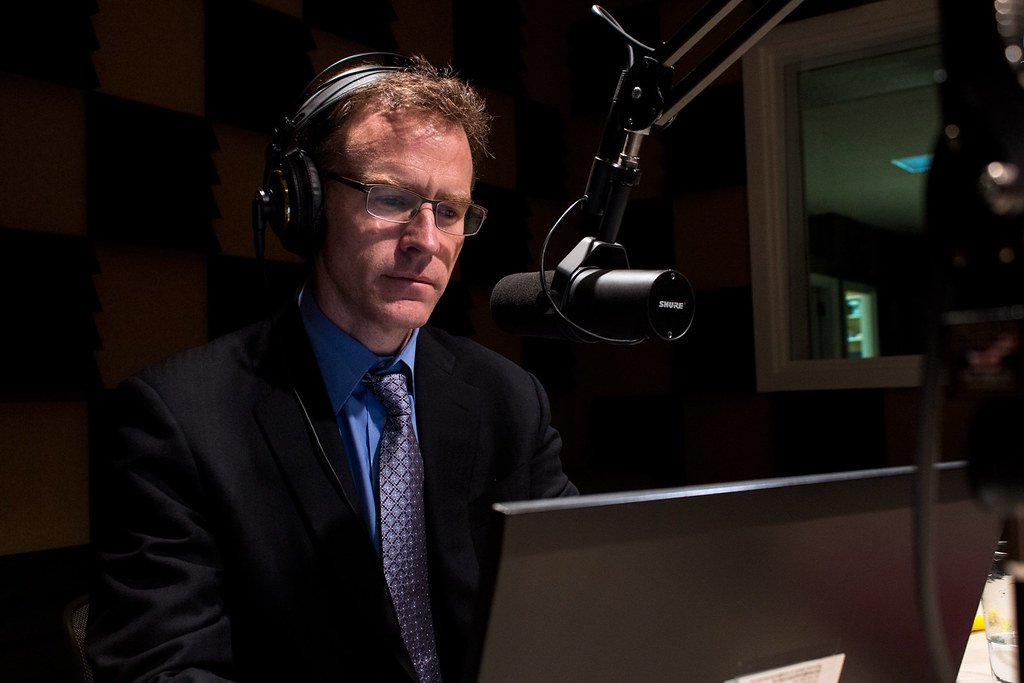
Last week we posted on Uri Berliner’s piece at the Free Press. The NPR business editor argued that “the network lost its way when it started telling listeners how to think.” Get up to speed here.
Today Steve Inskeep responded to Berliner’s piece. Inskeep is the host of NPR”s “Morning Edition” and the author of books about American history. His Substack piece is titled, “How my NPR colleague failed at ‘viewpoint diversity’.”
Here is a taste:
Above all, Uri calls for “viewpoint diversity” but did not seem to embrace it for this article. He didn’t seek comment from anyone or otherwise engage anyone who had a different point of view. The failure to vet the story may explain why the errors and omissions all go in one direction, toward confirming the writer’s pre-existing opinions.
A little vetting would have been good for the writer and his cause. This is especially true in the article’s lengthy attack on NPR’s diversity efforts.
If you conducted a confidential survey, you would hear a lot of “viewpoint diversity” within NPR about those efforts! And opinion would not break down entirely on racial lines. But Uri’s lengthy attack on those efforts had a particular effect on readers. One perceptive reader was Kenya Young of WNYC, a public radio station executive in New York. She is former senior manager at NPR, and widely respected. “The entire long diatribe,” she wrote on Facebook, “actually did not need to be included at all to make his points (some of which I believe to be valid), so the fact this it was shows me exactly where he’s coming from and (disappointingly) how he feels about the much needed changes that had to happen at NPR.”
Here is a prominent member of the community Uri says he wants to influence. He has her attention! And she is receptive to what he has to say! Then he loses his audience through an irrelevant “long diatribe.” The story is written in a way that is probably satisfying to the people who already believe it, and unpersuasive to anyone else—a mirror image of his critique of NPR.
Read the rest here.
I don’t know what to make of all this. Progressives will think Inskeep’s piece is a take-down of Berliner. Conservatives will roll their eyes at Inskeep’s piece. This is the political world in which live. I am guessing there is a complex story here that will probably never be revealed. In the end, most people who listen to NPR will still listen to NPR. Those who don’t listen to NPR will have another reason not to listen.
I read the Berliner piece and a response from another NPR editor defending the DEI work (but not sure I saw it here so forgive me if I go over old ground). I think that the focus on DEI was a distraction from Berliner’s main…maybe I should say, solid…point: that NPR in its reporting moved into the territory of taking positions on the issues they covered (telling people what to think, or smugly assuming that all reasonable audience members already thought that way).
That was an important and, in my view, accurate critique.
But the commitment to DEI seems to me to parallel an issue that I’ve spent a lot of time on: the nature and purpose of colleges and universities. Because the thing is this: these institutions, whether educational or journalistic, have a professional job to do, and that job involves an attempt at distance or neutrality or objectivity in the pursuit of truth. But at the same time, they are organizations that are subject to standards of justice in their actions etc. So universities have to conduct inquiry into, say, labor practices, and all the standards of inquiry apply. But at the same time universities are employers, and responsible conduct themselves justly in that role.
Those are two different agenda that must be simultaneously lived out; I think it is possible to do so, but it takes some careful and nuanced work to do it. These days everybody seems to want it all one way or the other (free inquiry means anything goes in organizational practice, or, the responsibility to live justly means compromising academic [or journalistic] professional integrity). It doesn’t have to be that way.
I value NPR, donate to my local station regularly (keep up the good work, WBEZ – Chicago!), and am rooting for it. But I can’t believe how bad its response has been to this situation.
They need to grasp that Berliner is a whistleblower. He tried to go through channels and got nowhere. It is unbelievably chilling for NPR to say that you need to “secure approval” in advance to be a whistleblower. It is like the military saying you had to go through the chain of command to report sexual harassment which every journalist could see was wrong. If someone at NPR had complained that LBGTQ+ people were not being treated fairly – however flimsy the evidence they provided – everyone would have said how “brave” they were to speak out and how we “can and must do better” and so on. The urge to shoot the messenger and ignore the message which has been the overwhelming NPR response to Berliner is so disappointing. I have witnessed numerous examples of what Berliner is referring to just as a listener. For instance, when Roe vs. Wade was overturned NPR reporting referred standardly to the side that would call themselves pro-life as “anti-abortion rights activists.” I get how hard finding appropriate nomenclature for all this is. Yet in the immediate days before that decision NPR had been covering efforts at gun control legislation. Never once did they refer to its proponents as “anti-gun rights activists.” This is just one example of the kind of thing that is baked into their reporting.
I have been a regular listener to NPR for many years. Several stories and interviews have been terrific. I continue to listen, but not typically to hear solid, balanced, and insightful reporting. I can pretty much guess how the topic will go when the topic is first broached. It’s decidedly left of center with no thoughtful counters. My ability to guess is akin to my nearly 100 % ability to guess when right-wing radio broaches a story.
NPR needs to listen to their growing chorus of critics. William Deresiewicz’s thirty-year love of NPR (detailed in his piece in UnHerd) is one example of the discontent with NPR. And it is from a scholar that is hardly aligned with conservatives.
Like many others, I listened to NPR faithfully for decades. I was a mug and tote bag sort of supporter! I found it a source of diverse, thoughtful, deeply reported stories from various perspectives. I always knew it to be “liberal” but found its reporting and commentary open, curious, and generally impartial. In short, they were doing JOURNALISM. I can’t put my finger on when it happened, but they stopped being any of those things along the way. Most of what I hear there now strikes me as ideologically captured, predictable, preachy, and activist. Not the least bit curious. Worse. They seem incapable of curiosity!
When I read Uri Berliner’s piece and heard him interviewed on Bari Weiss’s podcast, I CHEERED. The only thing that seems out-of-place to me now is Berliner’s expectation that NPR has within itself a capacity for reform. I’m just not sure they do.
I hate that this episode has allowed the Christopher Rufos of the world the chance to crow. But NPR has unfortunately become such a self-parody that (and it pains me to say this) I sadly think Rufo is right on this one.
There is no situation or circumstance where Christopher Rufo is “right.” He is merely a troll, though one with a wide audience. And now, Berliner has quit, apparently miffed that NPR did not fire him over his rant. Good riddance, I say. Inskeep very politely sliced Berliner and his argument into tiny little pieces, then handed him the knife.
I’ve responded to someone who replied to these remarks of mine on Steve Inkeep’s site, so I am adding my response here as well for my highly valued _Current_ community:
Many thanks for this thoughtful reply. I was not saying that they should have used the term “pro-life”. I was pointing out that it is a tell of what you are for when you frame an issue as opposing a “right”. The logic of your argument seems to lead to suggesting the term “pro-abortion control”. Some years back NPR’s morning news reported on the March for Life by referring to it throughout as “the so-called March for Life.” I wrote to them and asked why they don’t speak of “the so-called Pride Parade.” To their great credit, they wrote back acknowledging my point and saying they had put out an internal directive not to use “so-called”. That is the NPR I love and long for. I’m not that worried that its employees overwhelmingly have a liberal bias. I am worried that they have gone so far into a mutually reinforcing silo of the likeminded that they can no longer even see an instance of it when it is pointed out.