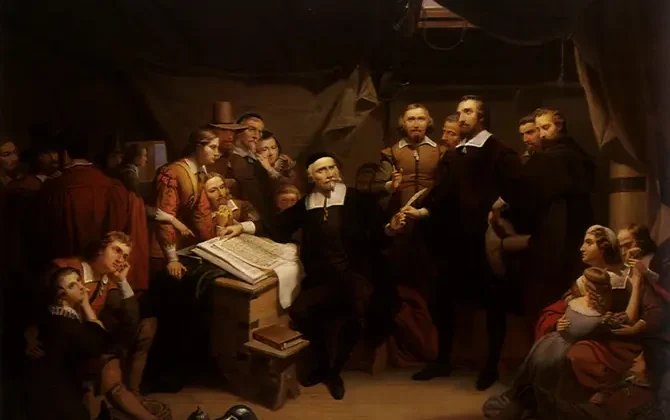
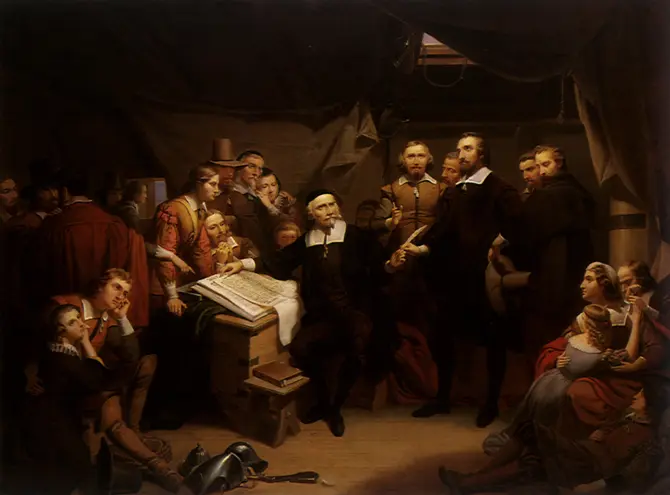
The Pilgrims would not recognize themselves in the rhetoric of so-called Christian patriots. Here is a taste of Wheaton College historian Tracy McKenzie‘s piece at Religion News Service:
Certainly, the English Christians we call the Pilgrims were searching for an earthly location where they could worship in the manner they believed the Bible commanded. But to the degree that the Pilgrims thought of themselves as “pilgrims,” they meant that they were temporary travelers in a world that was not their home — much less a nation.
This is clear from the context in which William Bradford famously used the term in his history “Of Plymouth Plantation.” The Pilgrims’ governor movingly described the departure from Holland, where they had first moved to escape discrimination in England. With “an abundance of tears,” those in the Leiden congregation who were headed for New England left “that goodly and pleasant city which had been their resting place near twelve years; but they knew they were pilgrims, and looked not much on those things, but lift up their eyes to the heavens, their dearest country, and quieted their spirits.”
As he penned these words, Bradford was almost certainly thinking of the 11th chapter of the Bible’s Book of Hebrews, that great survey of Old Testament heroes of the faith. There, we read that these men and women “confessed that they were strangers and pilgrims on earth.” The biblical writer goes on to explain that any “that say such things [i.e., think of themselves as pilgrims], declare plainly, that they seek a country,” but the country sought is a “heavenly” one.
In a much less known passage, the Pilgrim Deacon Robert Cushman employed similar imagery. In an essay published in 1622, Cushman reviewed the argument for “removing out of England into the parts of America.” He emphasized that God no longer gave particular lands to particular peoples, as he once had given Canaan to the nation of Israel. “But now we are all in all places strangers and pilgrims, travelers and sojourners,” Cushman observed, “having no dwelling but in this earthen tabernacle.”
Echoing the Apostle Paul’s Letter to the Corinthians, the deacon elaborated, “Our dwelling is but a wandering, and our abiding but as a fleeting, and in a word our home is nowhere, but in the heavens, in that house not made with hands, whose maker and builder is God, and to which all ascend that love the coming of our Lord Jesus.”
It is possible for Christians in the United States today to remember the Pilgrims as our spiritual ancestors and still preserve their understanding of “pilgrimage.” But when we remember them as our national ancestors — as key figures in the founding of America — we refashion that sense of pilgrimage into something they would neither recognize nor espouse.
Read the entire piece here.
Thanks for these references. Not only do they connect to crucial biblical themes for thinking about the life of Christians among the nations, but they link to people and movements that that are known and respected by those brothers and sisters of ours who have become captive to idolatrous forms of nationalism. Finding shared values and connections is one way to renew our fellowship–or to try–and to find a way forward for the testimony of the gospel in the US.
McKenzie’s book, The First Thanksgiving, is an outstanding example of doing history as a Christian.
Indeed it is. If I remember correctly, this piece draws from that book.