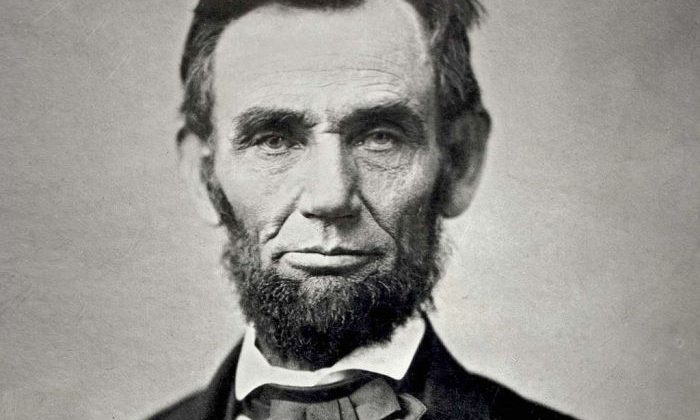

Harvard law professor Noah Feldman believes that he did, and it had little to do with his support of the 13th, 14th, and 15th amendment. Here is a taste of his recent piece at The New York Times:
In April 1861, when the Civil War began, Lincoln was thoroughly committed to the compromise Constitution, which he had endorsed and embraced for his whole political life. Indeed, the month before, in his first Inaugural Address, Lincoln promised to preserve slavery as a constitutionally mandated permanent reality.
“I have no purpose, directly or indirectly, to interfere with the institution of slavery in the states where it exists,” he said, vowing never to defy what was “plainly written” in the Constitution. “I believe I have no lawful right to do so, and I have no inclination to do so.”
But in the 18 months that followed, Lincoln violated the Constitution as it was then broadly understood three separate times.
First, he waged war on the Confederacy. He did this even though his predecessor, James Buchanan, and Buchanan’s attorney general, Jeremiah Black, had concluded that neither the president nor Congress had the lawful authority to coerce the citizens of seceding states to stay in the Union without their democratic consent. Coercive war, they had argued, repudiated the idea of consent of the governed on which the Constitution was based.
Second, Lincoln suspended habeas corpus unilaterally, without Congress, arresting thousands of political opponents and suppressing the free press and free speech to a degree unmatched in U.S. history before or since. When Chief Justice Roger Taney of the Supreme Court held that the suspension was unconstitutional, Lincoln ignored him.
Lincoln justified both of these constitutional violations by a doubtful theory of wartime necessity: that as chief executive and commander in chief, he possessed the inherent authority to use whatever means necessary to preserve the Union.
Third, and most fatefully, Lincoln came to believe that he also possessed the power to proclaim an end to slavery in the Southern states. When he finally did so, issuing the Emancipation Proclamation in January 1863, he eliminated any possibility of returning to the compromise Constitution as it had existed before the war.
Unlike his first two violations of the Constitution, which came quickly, Lincoln’s movement toward emancipation was agonized and slow, precisely because he knew that emancipation would have the effect of destroying the core of the constitutional compromise he had pledged to uphold.
As Lincoln explained in a letter to Senator Orville Browning of Illinois in September 1861, emancipation would be “itself the surrender of the government” he was trying to save. “Can it be pretended that it is any longer the government of the U.S. — any government of Constitution and laws,” Lincoln asked, if a general or a president were able to “make permanent rules of property by proclamation?”
In the end, Lincoln’s decision to issue the Emancipation Proclamation turned on his realization that the war could not be won as he had originally hoped — namely, by inducing the Southern states to rejoin the Union on compromise terms similar to the status quo before the war. To proclaim the enslaved people of the South as emancipated was to announce that there was no going back. The original compromise Constitution would no longer be on offer, even if the South gave up and rejoined the Union.
Contemporary observers, even those unsympathetic to slavery, understood that the Emancipation Proclamation left the original Constitution in tatters. The retired Supreme Court justice Benjamin Curtis, who had dissented from the notorious 1857 decision in Dred Scott v. Sandford (in which the court held that Americans of African descent could not be citizens), said as much in a pamphlet condemning Lincoln’s declaration as a repudiation of the constitutional rule of law.
Read the entire piece here. Feldman concludes:
Today, when the United States is engaged in a national reckoning about the legacies of slavery and institutional racism, the story of Lincoln’s breaking of the Constitution of 1787 is instructive. It teaches us not only that the original Constitution was deeply compromised, morally and functionally, by its enshrining of slavery, but also that the original Constitution was shattered, remade and supplanted by a project genuinely worthy of reverence.