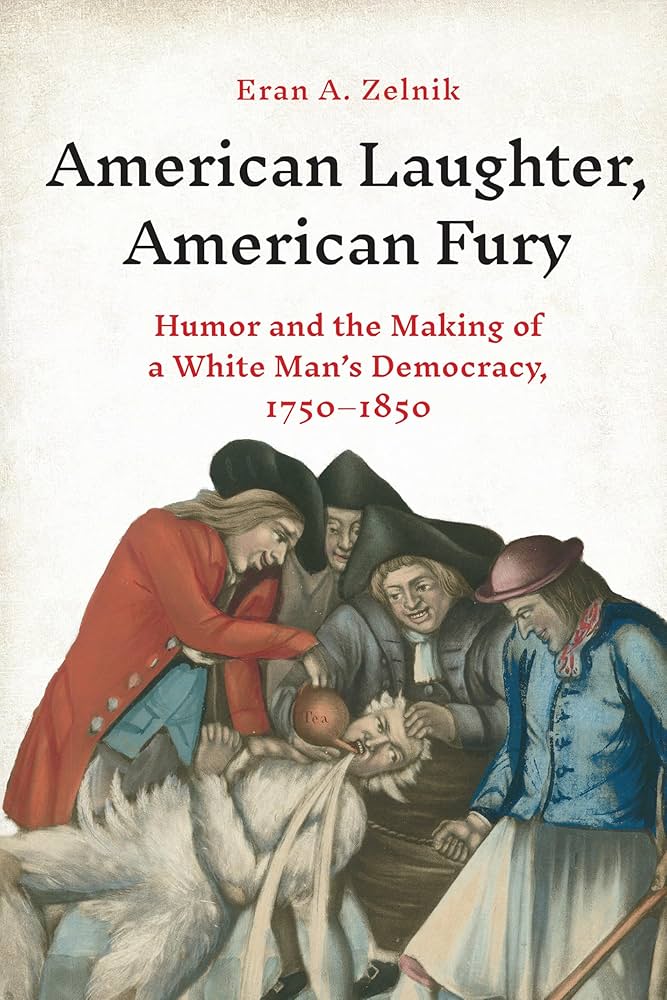
Eran A. Zelnik is a Lecturer in the Department of History at California State University, Chico. This interview is based on his new book, American Laughter, American Fury: Humor and the Making of a White Man’s Democracy, 1750–1850 (Johns Hopkins University Press, 2025).
JF: What led you to write American Laughter, American Fury?
EZ: I came to graduate school with a very vague notion of what I wanted to do. I’ve always found cultural history to be the most rewarding approach to history—that to me seemed to hold significant explanatory power, and I wanted to write scholarship in that vein. I also knew that I wanted to better understand the contradictions of the early United States, but not much else. I started looking for a research topic by immersing myself in newspapers from the early decades of the nineteenth century and quickly found that there was a lot of humor there. That humor often seemed to be low-brow and suggested a way to explain the growing commitment to democracy in early America. I also started to realize that there is a lot of racist humor that was also very low-brow and that seemed to be somehow of a piece with the anti-authoritarian and leveling humor sensibilities of Americans.
One of the biggest turning points occurred once I started to understand that I have a whole set of insights, based on my upbringing in Israel, that I can bring to early America. It became apparent to me that there are many parallels between the United States and Israel: both settler colonial societies whose cultural production has so effectively erased within its own population any real sense that they are settlers occupying indigenous land. In the case of the United States, humor, I quickly realized, was an important vehicle for Americans to render themselves “indigenous” to America. As in Israel, settlers in America, especially white men, genuinely view themselves as the most entitled group of people who should never feel inhibited in “their” God given land. And so, American Laughter, American Fury also became a personal journey for me to come to grips with my own settler colonial hangups and assumptions.
JF: In 2 sentences, what is the argument of American Laughter, American Fury?
EZ: Casting humor in the early United States as a broad sensibility that also includes play, mimicry, tall tales, and riotous behavior, American Laughter, American Fury relates a narrative of democratization gone awry. In America humor helped establish commoners as fully entitled members of the national community, but at the same time it also ensured that only white men got to feel fully comfortable in their own skin—including when masquerading in the skins of others.
JF: Why do we need to read American Laughter, American Fury?
EZ: I believe that the book delivers important new insights on the troubling intersection of race, masculinity, and nationalism in the early United States that proved formative and lasting. Perhaps most pertinent for understanding the distressing times we are in today, the book helps us come to grips with why white men feel so aggrieved in the United States, even though they still enjoy immense privileges. Accustomed to view the American landscape as a place for merry unimpeded escapades, white men in America experience any attempt to inhibit them, for example by regulating their right to tote guns or delight in offensive language, as a severe loss of freedom.
American Laughter, American Fury also connects the dots on various phenomena in early America, making sense of them as partaking together in the work of defining the national community and its borders. Revolutionary era riot and revelry, blackface minstrelsy, antebellum print culture, and the militia experience all worked in tandem to forge the national community in American imagination as a white man’s democracy. These sensibilities and convictions are still with us to this day.
JF: Why and when did you become an American historian?
EZ: I first tried my hand at teaching history at a high school, which as a leftist, I thought would be the place where I could do really important work. But after two years of that I realized that I really missed academia, and that far too much of the challenge of high school was class management, while too little offered intellectual stimulation.
As a history major in undergrad, I was most fascinated with the contradictions of the early US—this democracy that was also a slave society and the place where inequality through capitalism took hold so deeply.
So, at the age of 30 I decided to start graduate school in the United States, thinking to focus on the marriage of democracy and capitalism, yet found myself discovering settler colonialism as an even more compelling line of inquiry. I still view K-12 public education as a loftier and in many ways more meaningful contribution to society, but I decided that I need to be an academic to find fulfillment.
JF: What is your next project?
EZ: I have started conducting research both in Hebrew and in English for a comparative analysis of the nineteenth century United States and early Zionist notions of settlement. I intend to take a deeper look at race and what I call magical thinking in settler societies, especially how they came to imagine their interactions and impact on non-white populations as benevolent despite plenty of evidence to the contrary. It will explore such phenomena as the “civilization” of indigenous Americans, the attempted colonization of Black Americans in Africa, the settlement of Jews in Palestine, and more.
JF: Thanks, Eran!