
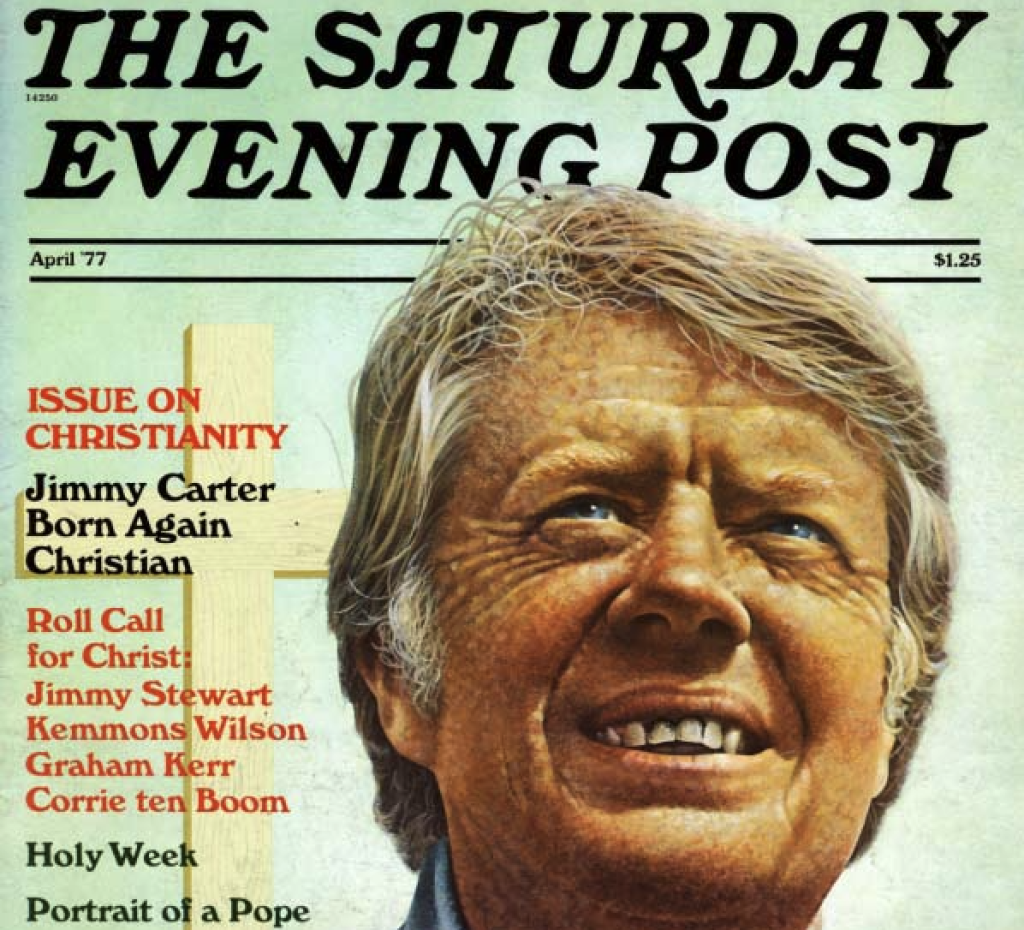
Back In December, a podcaster asked Albert Mohler, the president of the Southern Baptist Theological Seminary in Louisville, if Jimmy Carter was a “born-again Christian.” Jimmy Carter always said he was a born-again Christian, but the podcaster’s question seemed to imply Mohler might have better insight to Carter’s spiritual condition than Carter himself.
Here is the way Baptist News Global handled the story:
Toward the end of the nearly three-hour interview with Sean DeMars, lead pastor at Sixth Ave Church in Decatur, Ala., Mohler responded to a listener question: “Do you think that Jimmy Carter is a born-again Christian?”
Carter, a former Southern Baptist, is by all measures the most devout and churchgoing president in modern history. But Mohler couldn’t say for sure whether the 100-year-old is “born again.”
“I have to hope and pray,” he replied. “So I’ve had some personal engagements with the former president. He has mentioned me in four books. Negatively. … He’s not a fan of the conservative resurgence in the SBC. And remember, I got into the thickest controversy early in my life in Georgia where I was editor of the paper, which guess what? Jimmy Carter’s in Georgia and cares a lot about Georgia.”
Mohler described Carter as “like your typical SBC deacon in a more liberal church.”
Here is what I wrote at the time:
One might argue that Mohler is saying, as a Calvinist, that on this side of eternity no one can be truly sure who is saved and who is not saved. That’s a fair position. But I am not sure this is what Mohler meant when he was referring to Carter. I wonder if he would question the salvation of people in his own circle in the same way that he questions the faith commitment of the former president.
In Matthew 7, Jesus told his disciples how to identity a false prophet: “Wherefore by their fruits ye shall known them.” Anyone who has followed Jimmy Carter’s life and career knows that he has: 1. Said that he was “born again.” 2. Displayed the “fruits” of a follower of Jesus. That’s good enough for me.
Of course if one defined a true “born-again Christian” by whether or not a person conforms to Mohler’s views about the inerrancy of scripture, complementarianism, Calvinism, and Christian nationalism, Carter might fall short.
I can’t help but think Christianity Today editor-in-chief Russell Moore had Mohler, his former mentor, in mind as he wrote his recent piece, “Jimmy Carter at the Judgment Seat.” Here is a taste:
Those outside of the evangelical Christianity subculture might not be aware that on some matters, we have developed unwritten rules of Jesuitical complexity to enable us to disobey certain clear directives of Jesus without having to admit to doing so. The elderly women in my home church would never approve of bragging about themselves, but doing so is made alright by adding the words “if I do say so myself” right before or after the boast.
Similarly, it might be hard to justify questioning the eternal destiny of a professing Christian, given Jesus’ command not to judge one another. All one need do, though, is add some caveats such as “No one knows the heart” and “God is the judge, but …” and “We can only hope” (with an implied shake of the head and shrug of the shoulders). Then one is allowed without penalty to say of one’s just-dead enemy what secularists can say more directly but never as literally: “Go to hell.”
And this:
Carter said he personally opposed abortion and thought it should not be government funded, but he thought the state should allow it. I think he was gravely wrong on that. Carter also believed that Jesus’ principles of nonretaliation and opposition to the taking of life meant that capital punishment is always immoral. I disagree.
Before the abortion debate became what it was in the mid- to late-1970s (largely due to the advocacy and public education work of mostly Roman Catholic pro-life thinkers and activists), not a few very conservative evangelical Christians, such as Southern Baptist conservative patriarch W. A. Criswell and Christianity Today’s founding editor in chief Carl F. H. Henry, were in the same camp as Carter—personally disapproving of abortion but believing it should be legal in many cases. I’m glad they changed their minds.
The question is, though, after they changed their minds, should they have sought baptism? In other words, were they non-Christians when they had the wrong view? Would they have gone to heaven if they had died five minutes before they came to the right view?
Many have noted that virtually no one who question Carter’s personal salvation—given his positions on justice issues for unborn children (in addition to other, much less important, social and political matters)—questions the personal salvation of 18th- and 19th-century professing Christians who opposed the abolition of a system that kidnapped, bought, and sold people as chattel property, separated families, exploited their labor, and systematically raped those made in the image of God.
And most of those who would question whether Carter was “really saved” also defend those who deny historic, creedal, and doctrinal non-negotiables on matters such as the doctrine of God and the Trinity. They defend such people not just as Christians but as Christian teachers and leaders, so long as they are in-bounds on what really matters: support of the right politicians and opposition to the wrong ones. That’s what the old “fundamentalists” would have called “modernism.”
That kind of Christianity is easier than both the true gospel of grace and the false gospel of works. To hold to a true works righteousness, after all, one would have to at least pretend to obey the moral demands of God—both in pursuit of public justice and in fidelity to personal virtues. We all fall short, though, of the glory of God. So to pretend to be justified by such things requires deception of others (Rom. 2:17–24) or of self (1 John 1:8).
American Christianity has found a much easier form of works righteousness—one that doesn’t require, well, work. One can be in a horrible marriage, filled with envy or rage or pride, piling up wealth for oneself while disregarding neighbor, but be justified as a “real” Christian by pontificating all the right political and social positions.
Read the entire piece here.