
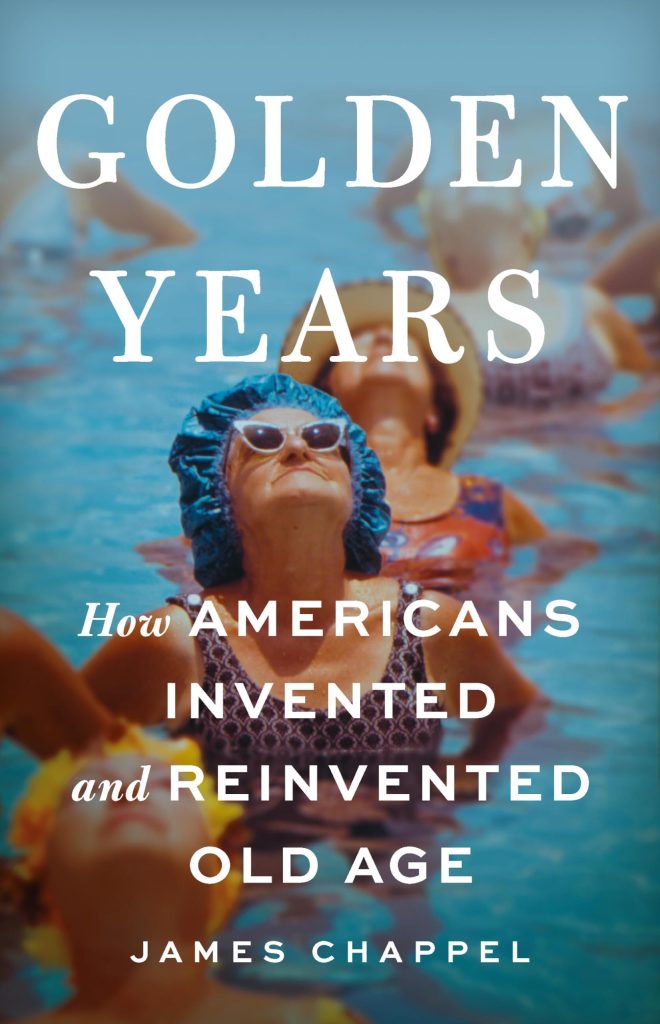
James Chappel is Gilhuly Family Associate Professor of History at Duke University. This interview is based on his new book, Golden Years: How Americans Invented and Reinvented Old Age (Basic Books, 2024).
JF: What led you to write Golden Years?
JC: I’m from Central Florida, so thinking about older people and retirement has been part of my life from the beginning. And when I turned forty myself, as a historian, I wanted to think historically about my own aging: What is old age for? What am I supposed to do with all of this extra time I was granted? I was surprised at how little historical work had been done on this question, at least for the 20th century.
JF: In 2 sentences, what is the argument of Golden Years?
JC: Old age has a history: we have to be taught how to age, both by culture and by institutions. Over the past century, America has had several distinct ideologies of aging, each of which has had its benefits and its drawbacks, and each of which has been exclusionary of various communities (notably people of color and those with disabilities).
JF: Why do we need to read Golden Years?
JC: Well, nobody needs to read anything! But I think there is some benefit to reading a book like this. Aging is something that can seem very private: an affair between you and your family, or your doctor. But it’s not; everything about the way we age is historically constructed. And as our population gets older every year, it’s important that we understand this, so that we can continue to change and improve the situation for older Americans.
JF: Why and when did you become an American historian?
JC: I’m not sure I ever did become an American historian: I was trained as a European historian, and my first book was about Europe (my next will likely be, as well). I think it’s a mistake, though, to think about historians as people who are primarily expert in a particular geographical region. What we really learn is a particular method, and it’s one that we can apply anywhere, so long as we are willing to put in the time and, if necessary, learn the languages. Luckily, my English was already pretty good before I started working on US history.
JF: What is your next project?
JC: My real interest is in the history of ethics, broadly understood: how have people thought about the big social challenges of their day, and why? That’s what unites my first book on Catholicism and my second on aging. I’ve started a book now on C.S. Lewis: an author who has perhaps impacted more people than any other in the twentieth century, but on whom the historical scholarship is surprisingly thin. It’s a bit like aging: an enormous amount has been written on him, but it has been from other disciplines. The specifically historical approach has seldom been taken, and as with aging too, I think there’s a lot to learn from it.
JF: Thanks, James!