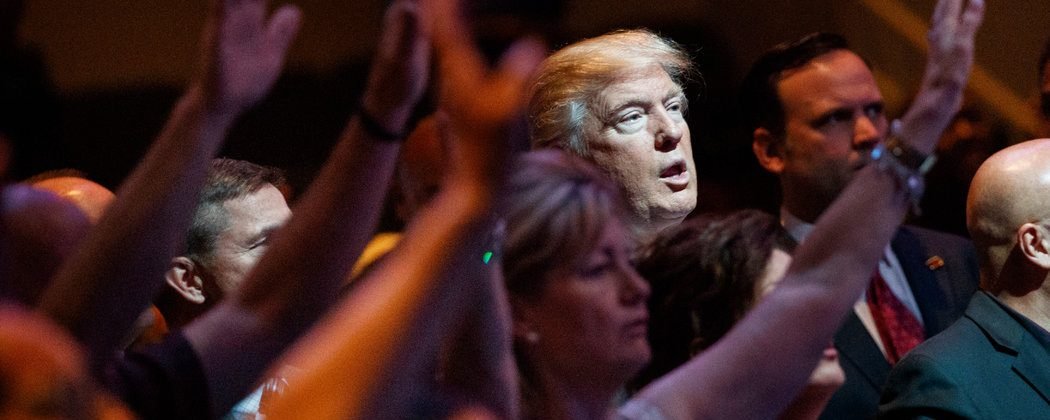

At Baptist News Global, Robert Jones discusses the recent post-election findings from the Public Religion Research Institute.
There is no evidence to support what I have identified as two “zombie myths” (because they just won’t die despite lack of evidence) about white evangelical voters: 1) that they were reluctant Trump voters; or 2) that Trump’s strongest supporters in this group were Christians-in-name-only, or CINO.
- White evangelical Protestants were not “holding their nose” while voting for Trump. Heading into the 2024 election, Trump’s favorability among white evangelical voters was 73% — far above even other Trump-supporting groups such as white nonevangelical Protestants (53%) and white Catholics (51%). And two-thirds (64%) of white evangelical voters also strongly supported Trump’s most racist and even Nazi-echoing statements, such as his assertion that immigrants living in the country illegally were “poisoning the blood” of the nation.
- Among white evangelicals, those most closely connected with churches were more likely, not less likely, to support Trump. While solid majorities of white evangelical Protestants overwhelmingly supported Trump across all levels of church attendance, weekly church attenders report voting for Trump at significantly higher levels (88%) than those who seldom or never attend church (77%). In other words, it is churchgoing white evangelicals, not their less churched kin, who are the most supportive of Trump and the MAGA movement.
- Notably, the opposite church attendance pattern appears among white Mainline/nonevangelical Protestants and among African American Protestants. In these Christian groups, more frequent church attendance is correlated with lower support for Trump.
It seems like Jones is making conclusions about evangelical Trump voters that don’t consider the larger political context of the 2024 election. When he says that 73% of evangelical voters found Trump “favorable,” does he mean “favorable” in a vacuum (they would always support Trump, no matter the context) or “favorable” in comparison to Kamala Harris? When Jones says that church goers were more likely to support Trump, does he mean they embrace a full-throated MAGA philosophy or voted for him in this specific race against Kamala Harris? I am not sure I am ready to bury the “hold your nose thesis” quite yet.
The fact that 64% of white evangelicals supported Trump’s comments on racism, Nazism, and immigration is disturbing. It seems high to me. Or at least does not reflect the sentiments of the evangelical communities in which I live here in pro-Trump central Pennsylvania. I am willing to accept the data on this point, but as a humanist (not a social scientist) I want to dig deeper into these statistics. For example, I want to know how the survey defines “Christian nationalism.” (The definition is contested–I am currently part of a project run by the Boisi Center at Boston College that is playing a role in that contestation.) I want to know the way the questions were framed (I can’t find a link to the questions anywhere in the survey results.) I want to know how these results compared with the 2020 election when Trump was not running against Kamala Harris. I think one needs to ask these kinds of questions before media and political narratives–either about evangelicals or the election itself– are framed based on this data.
Read the entire piece here.