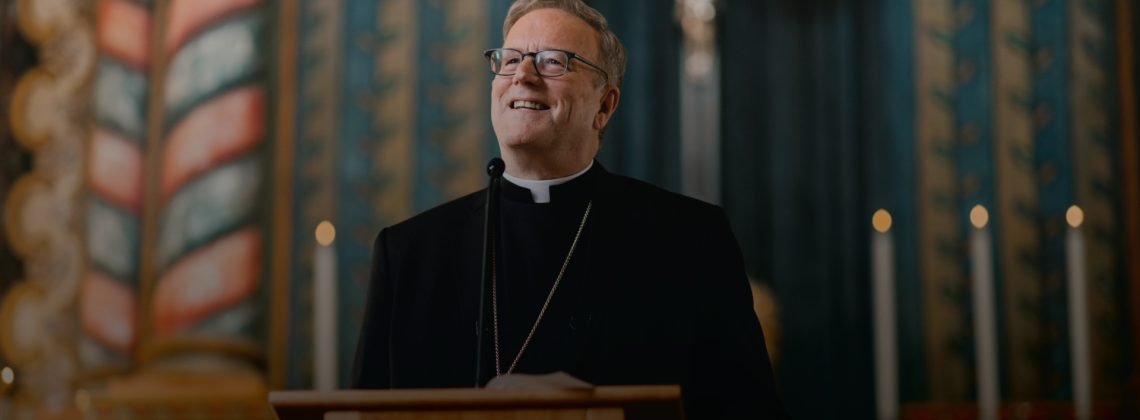
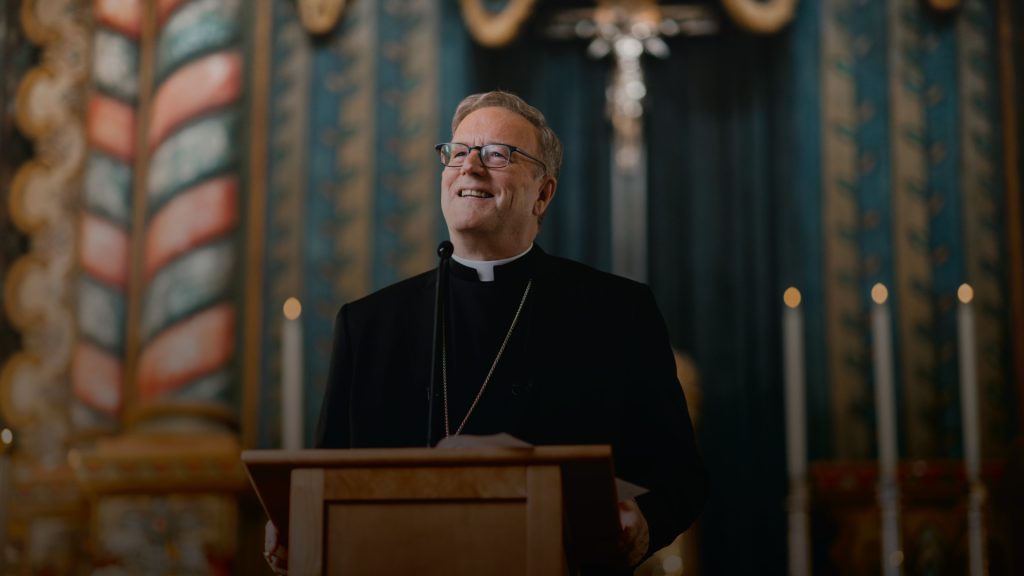
Check out Molly Worthen’s fascinating piece on Robert Barron, the bishop of Winona-Rochester (MN) and founder of Word on Fire Catholic Ministries.
Here is a taste:
Now is an unlikely time for a Catholic ministry to grow. Fewer and fewer Americans embrace any religion, and the U.S. Catholic Church is shrinking. Yet Word on Fire continues to expand. When I visited its headquarters in Rochester earlier this fall, Barron told me that he senses an “extraordinary hunger for God” in America, but “beige Catholicism” won’t satisfy it. That’s his term for the Church that many American Catholics have known in the 60 years since Vatican II: simplistic and relevant homilies, felt banners, acoustic guitars—all meant to make the 2,000-year-old faith fit in with contemporary Western culture.
Barron, who is always in clerical dress and ready to quote the ancient Church fathers, has no interest in fitting in. His uncompromising presentation of the Christian story—and his willingness to discuss it with polarizing figures such as Jordan Peterson and Ben Shapiro—resonates especially among young men. To fans, Barron is convincing a new generation that Christianity is not the faded wallpaper of the West but a compelling, countercultural message. To critics, he has forged a cult of personality and cozied up to culture warriors for the sake of clicks.
The bishop’s ambitions extend far beyond YouTube. He wants to build a real-life network—priests and laity gathering in Word on Fire centers around the country. More than that, he is scouting a future for Christianity: a Church that embraces the internet as an evangelizing tool, refuses to assimilate to mainstream culture, and welcomes the young men who are beginning to outnumber women in the pews. Driving this mission is a simple but risky bet: that many seekers don’t want a faith that is easy and accessible. They want something difficult and strange.
And this:
The early years of Barron’s media ministry coincided with the heyday of the new atheists, who won over many young men with books such as Christopher Hitchens’s God Is Not Great and Sam Harris’s The End of Faith. But they also inspired a renaissance among the faith’s defenders. Like Barron, many took to YouTube with a cerebral, confident style that appealed to men. Justin Brierley, a Protestant podcaster who has been a professional apologist for almost two decades, noticed that the crowds at apologetics conferences “did not look like the population in church on Sundays. Eighty or 90 percent were male,” he told me. “In a funny way, the new atheists helped bring men back to church, because the Church had to respond.”
On YouTube, according to Word on Fire’s data, more than 60 percent of Barron’s viewers are men. YouTube users in general skew male, and his followers on Facebook and Instagram are more evenly split between men and women, but YouTube is the heart of his ministry. “The Millennial male who is listening to Joe Rogan, Jordan Peterson, all those podcasts and YouTube channels—now, through Bishop Barron, they are being exposed to a fresh take,” Brierley said. “The era of them just listening to Sam Harris’s take on religion is over.”
Read the entire piece here.