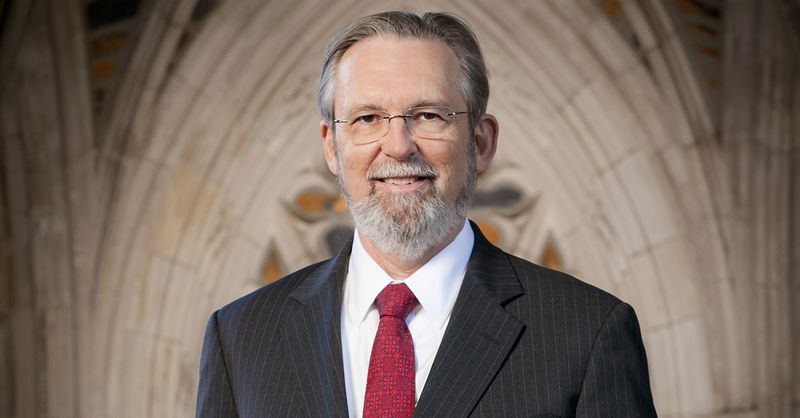
One rarely sees this kind of conversation in the pages of The New York Times. Peter Wehner interviews Duke Divinity School professor Richard Hays about why he changed his mind on gay marriage. Here is a taste of the interview:
Peter Wehner: You now hold an affirming view, the belief that gay relationships are not sinful and that sexual orientation and gender identity are not justification for exclusion from church membership or leadership. You had a very different view in 1996 when you wrote “The Moral Vision of the New Testament.” What do you see now that you didn’t see in 1996, and what would Richard Hays circa 2024 say to his younger self?
Richard Hays: What I see now has been over the last 10 to 15 years, the experience of having gay and lesbian students in my classes, when I was still teaching, who were very clearly committed to the church and to Christian faith and who were seeking conscientiously how best to serve going forward. That couldn’t help but make an impression on me.
And the other thing closely related to that is that in my own experience in the church, I saw church members who were not theological students or anything like that but who were exercising roles of gracious and meaningful leadership.
The other thing that I’ve seen is that in the conservative evangelical churches, there was a kind of smug hostility toward gay and lesbian people, and the attitudes that I was encountering there didn’t seem to me consonant with the New Testament’s portrayal of what people seeking to follow Jesus should be like. That they should be patient, kind, generous. And I didn’t see that.
I saw ugly condescension in those churches where that was the strongly held view. And the most dismaying thing about that is that people who were manifesting those attitudes were appealing to my book as a justification, which I actually think means they didn’t read my book very carefully. Because back in 1996, at the time when gay marriage was illegal in the United States and forbidden in just about every church, with maybe one or two exceptions, I saw that chapter as, in part, making an appeal for people to be graciously accepting of gay folks.
I even wrote in that 1996 chapter that if gay people are not welcome in the church, then I will have to walk out the door with them and leave in the sanctuary only those entitled to throw the first stone. But I combined that with the opinion that if they’re going to be in the church, they should remain celibate. And I didn’t think that there was any warrant biblically for same-sex unions. But just over time, my opinion on that eroded.
So what would I say to myself from 1996? I would say, first of all, look around you and see the evidence of experience that the spirit is at work in people with a same-sex orientation. And second, I would say that the way I was appealing to the Bible or the way I was interpreting the Bible was too narrowly focused on the few texts in Scripture that do say something explicitly about homosexual relationships. The dictum in Leviticus is that for a man to lie with a man as with a woman is an abomination. And those texts had a certain impact on my opinion. But I think I was I was far too narrow in the way I thought about how the Bible speaks to issues like this.
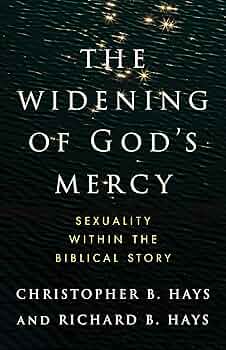
What I came to think over time is that what the Bible shows is not some isolated proof texts or isolated statements of law, but it shows us a much bigger picture of God as a God who continually surprises us, continually surprises his people with the scope of generosity and grace and mercy. And that bigger picture is the context in which we ought to think about same-sex relationships in our time.
Wehner: Let me home in a little bit on the verses, because that’s obviously an important issue for a lot of people of faith. So in the past, in “The Moral Vision of the New Testament,” you seem to believe that Paul’s condemnation of homosexuality applied to all gay relationships. Is your view now that Paul’s condemnation of homosexuality excluded loving, monogamous gay relationships? Or do you think, as the theologian William Loader has argued, that to truly honor Scripture and respect Paul, we should respectfully acknowledge that we should see Paul’s understanding of human sexuality as no longer adequate, that the Christian faith does not commit us to first-century views about sexuality, which Paul and others assumed? To put it another way, do you think what Paul wrote about gay relationships was wrong, or do you think that many evangelical Christians today misunderstand what Paul was saying?
Hays: I think I would say that they don’t misunderstand what Paul wrote. I think Paul, as a faithful Jew who had been formed and well trained in the interpretation of Torah, thought that homosexual relationships were wrong, full stop. What he says in Romans 1, he rolls it out as an example of what happens in paganism, where people have not received the teachings that come from God. He thinks that it produces a distorted set of relationships. He sees homosexuality as evidence of the fallenness of human beings. It’s certainly not the only example.
And at the end of Romans 1, he gives a whole list of other behaviors that are evidence of God’s judgment, of people who don’t acknowledge the one God. So when you put the question the way you did, I would say that Paul was formed by his Jewish tradition to have an unqualified condemnation of homosexual activity. He, of course, had no notion of what we today call sexual orientation. He thought that homosexuality is simply a choice of rebellion against God. So in that sense, I think I would agree with the quote you gave from Loader that Paul’s understanding at that specific point is not adequate to what we would understand today.
And I would say that on other points as well. Paul, on the question of slavery, writes that slaves should obey their masters, and he doesn’t challenge the institution of slavery. He thinks that masters should be nice to their slaves. And he thinks that slaves should be obedient to the masters. And I think we would agree — most Christians, I hope, would agree — that that understanding of the institution of slavery is not an adequate one.
So this has big implications for how we think about how the Bible is authoritative. One of the most amazing passages in the New Testament is in First Corinthians seven. Paul brings up a question which apparently the Corinthians themselves have posed to him — two things, really, in 1 Corinthians 7. One is on the question of divorce. And he says to the married, “I give this command — not I, but the Lord: that the wife should not separate from her husband, and the husband should not divorce his wife.” And then he says, “I say — I and not the Lord: that if any believer has a wife who is an unbeliever and she consents to live with him, he should not divorce her.” So he quotes Jesus saying divorce is categorically forbidden and then immediately turns around and says: Well, however, in the present situation, here’s what I think, which is that it’s a frontal rejection or modification of what he cites as the teaching of Jesus.
And then as the thing goes on and he is talking about the unmarried, he says, “Now, concerning virgins, I have no command of the Lord, but I give my opinion as one who by the Lord’s mercy is trustworthy.” What does it mean to say that this is a text that we now as Christians say: Well, this is sacred Scripture? It’s in the Bible. And what he says in the Bible is: I don’t have a command of the Lord. I’ll tell you my opinion. And I think that creates a kind of freedom. It suggests a freedom for us to discern and engage in serious reflection when circumstances may have changed and we need to say something different.
Read the rest here. The timing of Wehner’s piece is worth noting. I am sure scholars and academics are talking about this piece today in San Diego. The city is currently hosting the annual meeting of the American Academy of Religion and Society of Biblical Literature.