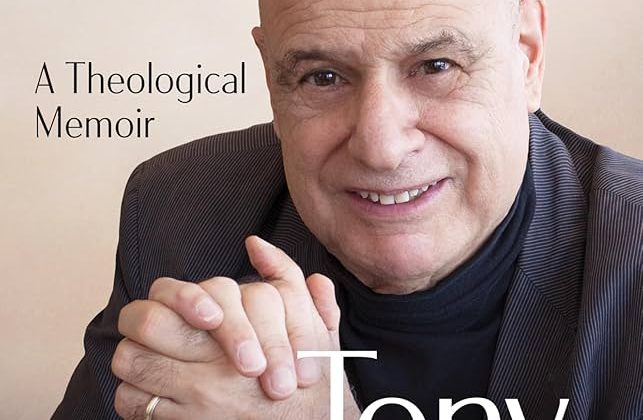
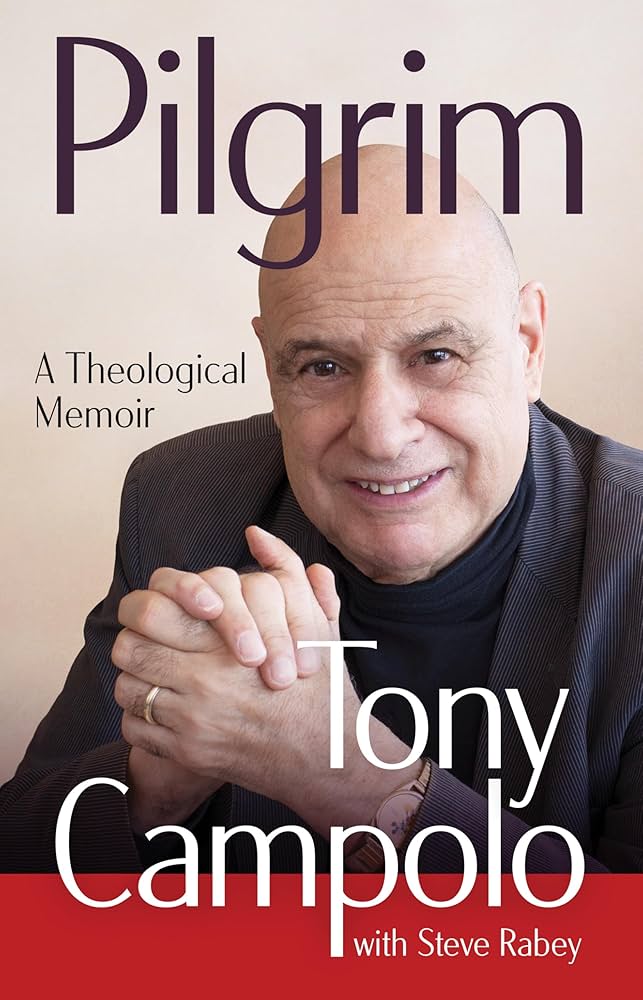
“Sunday came for Tony Campolo.” Steve Rabey helped Campolo write his memoir. It is coming out in February with Eerdmans. Here is a taste of Rabey’s piece on Campolo at Baptist News Global:
Tony Campolo, an influential Christian pastor, professor, author, speaker, social activist and adviser to President Bill Clinton, died Tuesday, Nov. 19 at age 89.
He was surrounded by family at Beaumont at Bryn Mawr, the Philadelphia retirement community where he and his wife, Peggy, lived since 2006, following a debilitating 2020 stroke that abruptly ended his speaking career.
Campolo will miss next February’s planned combo celebration of his 90th birthday, the 10th graduating class from the Campolo Center for Ministry at Eastern University, the 100th anniversary of Eastern, where he taught for decades, and the publication of his 50th book, Pilgrim: A Theological Memoir, which I helped him write over the past three years.
***
Randall Balmer explains the long evangelical road to Donald Trump. Here is a taste of his piece which originally appeared in The Los Angeles Times:
And so too with Trump. The bigoted “birther” nonsense directed against President Barack Obama, the nation’s first Black president, in itself should have prompted white evangelical leaders to sound the alarm against him, not to mention Trump’s recognition of “some very fine people” at a white supremacist rally or the torrent of insults directed against African Americans, especially Black women, and immigrants. Instead, they have enthusiastically supported Trump in all three of his campaigns for the White House.
Does that mean that every “Bible-believing” Christian who voted for Trump is racist? No, not at all. But there’s a link between the origins of the religious right in defense of racial segregation and the overwhelming white evangelical support for a candidate who traffics in racialized rhetoric.
And so too with Trump. The bigoted “birther” nonsense directed against President Barack Obama, the nation’s first Black president, in itself should have prompted white evangelical leaders to sound the alarm against him, not to mention Trump’s recognition of “some very fine people” at a white supremacist rally or the torrent of insults directed against African Americans, especially Black women, and immigrants. Instead, they have enthusiastically supported Trump in all three of his campaigns for the White House.
Does that mean that every “Bible-believing” Christian who voted for Trump is racist? No, not at all. But there’s a link between the origins of the religious right in defense of racial segregation and the overwhelming white evangelical support for a candidate who traffics in racialized rhetoric.
I am not sure white supremacy or racism explains the evangelical support for Trump this time around. I am still waiting to see the overlap between Trump evangelicals and all working class Trump voters.
***
Over at Baptist News Global, Rick Piddock covers a recent event called “Faith and Democracy.” It was held at St. Luke’s Episcopal Church in Atlanta and featured Diana Butler Bass, Kristin Kobes Du Mez, Robert Jones, and Jemar Tisby.
Here is Piddock:
In October, Du Mez told BNG: “When I travel around the country, I love meeting people at events. But so many people feel alone, isolated. Doing this work publicly has its downsides, but one benefit is that we are connected to others doing the work. This is so important. One of our goals is to work to connect people with each other in their local communities. There are so many incredible people doing incredible things. We need to find ways to connect these people to each other. I don’t think we’ve cracked this code yet, but this tour is one attempt to do just that.”
Who are these lonely people Du Mez is talking about when she “travels around the country?” They are obviously a specific demographic–people who come to her events.
But there are a lot of evangelicals today who are not lonely. They are finding solidarity and community in the Trump victory. Who is engaging them? Who is trying to win their hearts and minds? Who is helping the pastors who minister to these Trump evangelicals?
This traveling group of progressive Christians are searching for communities of like-minded people. But I wonder how much their efforts–speaking to the choir–will really strengthen democracy?
More Riddick:
“I’ve struggled all week leading up to tonight because I’m coming to you with a tank that’s nearly empty,” Tisby shared with a broken voice. “And it’s not because of just the past three or four months of the campaign. It’s because I’ve been Black my whole life. And I appreciate the Black folks who came out tonight because you’re staying at the table in the midst of what I’m sure is exhaustion.”…Tisby added, “It feels like Black people have carried America on our shoulders as far as we can without the help of a minority of some white folks.”
Tisby is right. A lot of Black people have carried a unique burden in the United States. But I am wondering what Tisby might say about the inroads Trump made among people of color, including Black men and Hispanics. Perhaps this election was not as much about race as Tisby would like it to be. Perhaps the economy is the great equalizer–it sucks for everyone.
Diana Butler Bass talks about “risk”:
“People who are in a slightly safer position themselves are simply going to have to invest themselves in risk,” Bass agreed. “It would be helpful if you start thinking about what that’s going to look like in advance, not to negatively anticipate, but to realistically think about what people are already feeling, what people are already experiencing. And then to ask yourself, ‘What can I do to alleviate the suffering and the pain and the loss of hope that these people are having? And is there something that I can do if those people are physically in danger?’”
Here is another way of thinking about risk: To what extent should scholars and others take the risk of finding common ground with Trump voters? This might require crossing class lines. Now that might be really risky. And let me be clear. I am not talking about the hard core MAGA crowd and the New Apostolic Reformation crowd. I am talking about the ordinary evangelical or working class person who thought twice before voting for Trump. These people exist. I’ve talked four or five of them this week.
After reading this, I am not sure this group is particularly interested in building bridges or finding common ground:
“What will not work is coming together to bridge divides. We have to come together over a shared mission, over a shared goal,” Tisby proposed. “What brings together a team? It’s not the fact that we’re all different. It’s the fact that we have a shared goal. We have a mission. And in order to achieve that mission, we need different people on the team who bring different skills and gifts and talents and perspectives.”
***
Let’s see what is happening on X:
Matthew Soerens of World Relief is thinking about what “mass deportation” might mean:
Ralph Reed says nothing about the Gaetz appointment. But he likes Bondi:
Lance thinks Gaetz may have been targeted by the devil:
This is why Lance prays:
Charlie is not happy Gaetz got derailed:
Lance thinks Gaetz’s main character traits are “risk taker” and ‘fighter”:
Ideological blow torches. Why doesn’t Lance say “Ideological blowtorches with histories of sexual assault”:
Evangelicals utilizing a “bad law” to advance their political agenda. Macchiavelli is smiling in his grave:
Paula pays her respect:
Trump will be the savior!:
Encouraging:
“You were lied to”:
A Planned Parenthood leader is not worthy of a Medal of Freedom:
Tom Buck is excited:
God is using two billionaires: