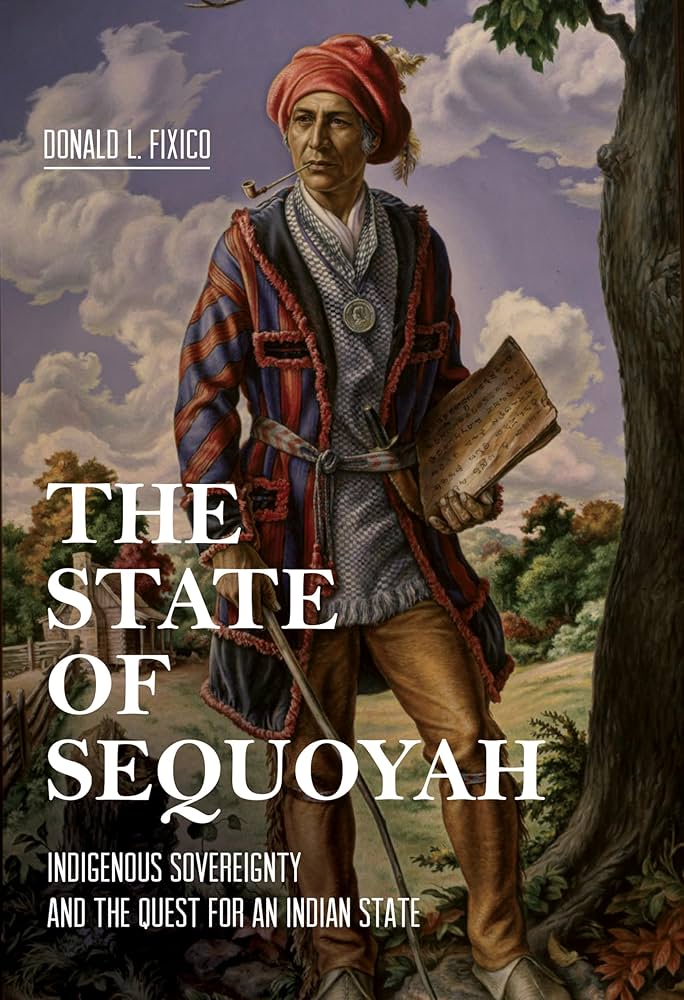
Donald L. Fixico is Regents and Distinguished Foundation Professor of History at Arizona State University. This interview is based on his new book, The State of Sequoyah: Indigenous Sovereignty and the Quest for an Indian State (University of Oklahoma Press, 2024).
JF: What led you to write The State of Sequoyah?
DF: Much of my research as a historian of American Indian history focuses on Indian treaties, federal Indian laws, and federal Indian policy making. In one of its provisions, the first U.S.-Indian treaty with the Delawares offered statehood to the Delaware tribe in the new United States in 1778. During the last several years, this fact led me to connecting the dots of other treaties and several federal laws that supported tribal sovereignty, including court cases. Two very early books have been written on the State of Sequoyah movement, but I was convinced that there was a much bigger story that I discovered was charged with intense politics at the tribal, territorial, federal, and presidential levels in the late 1800s and early twentieth century.
JF: In 2 sentences, what is the argument of The State of Sequoyah?
DF: What if? What almost happened in 1905 with the Cherokee Nation, Chickasaw Nation, Choctaw Nation, Muscogee Nation, and Seminole Nation almost becoming a state of the United States could happen today. In the book, I demonstrate how the idea of an Indian state and tribal sovereignty has been presented at least a dozen times in the history of U.S.-Indian treaties and in federal Indian laws, especially in the context of the late 1800s when ten new territories produced six new states.
JF: Why do we need to read The State of Sequoyah?
DF: Since the introduction of Indian Self-Determination as a new federal Indian policy in 1975, many tribal governments have made tremendous progress, especially the Five Nations, (Cherokee, Chickasaw, Choctaw, Muscogee, and Seminole) in the twenty first century. With the help of the Indian gaming industry and other business ventures, these five tribes have developed successful economies on their five reservations covering 31,000 square miles, an area larger than ten states in the U.S. Together, they were once called Indian Territory in the early nineteen century, and especially in 1905 when they held a constitution convention for statehood in Muskogee, in the Muscogee Nation. In the McGirt v. Oklahoma case (2020), the Supreme Court ruled that the 1866 boundaries of the Muscogee Nation are still intact. Based on the Muscogee treaty of 1866, there is a legal possibility for the Five Tribes to become a state today. All Five Tribes signed treaties in 1866 with the similar provisions that established their reservations with the same geographic boundaries that exist at the present. Wouldn’t it be interesting to have an American Indian state today in the United States that was earlier promised to the Delaware tribe in the Fort Pitt Treaty in 1778?
JF: Why and when did you become an American historian?
DF: I earned a Ph.D. in history at the University of Oklahoma. The history department there has national reputations in the American West and in Native History. For example, my mentor, Arrell Gibson wrote about twenty books in these two areas. I became a historian to help produce a better understanding of American Indians and our histories and cultures. With this book, I have written and edited seventeen books. I hope that my work will help enlighten future generations of readers at all levels and in other parts of the world.
JF: What is your next project?
DF: My next book project is forthcoming, Chitto Harjo: Native Patriotism and the Medicine Way, with Yale University Press in April 2025. Harjo led the Crazy Snake Rebellion against the federal government allotting individual parcels of reservation land to assimilate Native people. My main point is that Chitto Harjo was patriotically fighting to save the traditional Medicine Way of life, and this was Native patriotism, not a rebellion. Since this project is done, I am currently revising a book manuscript, “The Lighthorse in Indian Territory: Traditional Sovereignty and Justice.” This a history of lighthorse tribal police versus outlaws starting with the Cherokee lighthorse in the late 1790s including the lighthorse for Choctaws, Chickasaw lighthorse, Muscogee lighthorse and Seminole lighthorse to the present in Oklahoma.
JF: Thanks, Donald!