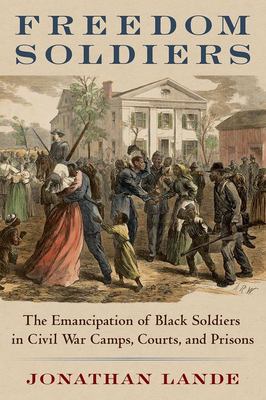
Jonathan Lande is Assistant Professor of History at Purdue University. This interview is based on his new book, Freedom Soldiers: The Emancipation of Black Soldiers in Civil War Camps, Courts, and Prisons (Oxford University Press, 2024).
JF: What led you to write Freedom Soldiers?
JL: Growing up, I loved watching Glory. I thought the film of Black soldiers fighting for freedom a film like few others. It is a story of the heroism of thousands seeking justice while engaged in an uncompromising fight for freedom. Reading about the men’s struggle in college, I grew more fascinated. I realized how exceptional and brave the nearly 180,000 Black men who served were—especially after their enemies threaten to kill or enslave any Black soldier captured. Then during graduate school I discovered the court-martial testimony of John Mitchell, a formerly enslaved Mississippian who deserted. He explained that he left because the captain of his company beat him mercilessly. To escape the beatings, he fled camp and worked aboard a riverboat. After a few months, the army captured, tried, and executed Mitchell as a deserter. I became curious whether there were more soldiers like Mitchell. I wondered: how common was it for formerly enslaved men to leave the US Army? Were there others who gave up the chance for glory? If so, why? Looking for the answers, I traveled to the National Archives in Washington and reviewed other courts-martial cases. I learned that Mitchell was just one of thousands of formerly enslaved soldiers who left the US Army. Many found military discipline reminiscent of slavery and left permanently. Others took momentary breaks from military service to see family or recover from wounds. Their stories and their pursuit of freedom and justice in the military courts and prisons became the foundation of Freedom Soldiers.
JF: In 2 sentences, what is the argument of Freedom Soldiers?
JL: In Freedom Soldiers, I argue that, although military service provided enslaved men the chance to courageously battle their former enslavers, emancipation within the ranks was an ongoing process. During this protracted process of emancipation, the formerly enslaved soldiers chose not to relinquish their struggle to make freedom meaningful but instead decamped to secure liberties they deemed essential to liberation and defended their actions in military courts and prisons.
JF: Why do we need to read Freedom Soldiers?
JL: Freedom Soldiers is essential for understanding the human experiences of war as lived by formerly enslaved soldiers pursuing freedom. Accounts of Black soldiers’ valiant fight for freedom written by previous scholars and vividly depicted in Glory capture the gallantry the men undoubtedly showed at Port Hudson, Milliken’s Bend, and Battery Wagner. But not all soldiers considered themselves free—even after subduing enslavers in combat. To the men, the struggle for freedom was not confined to suiting up in Union uniforms, following orders, or assaulting Confederate positions. Freedom Soldiers is therefore a necessary read for those wishing to more fully understand the soldiers’ fight for freedom. It sheds light on the complexity of the men, the difficulties of emancipation, and the nature of the Civil War battles for liberation.
JF: Why and when did you become an American historian?
JL: I decided to become a historian because the hunt for unknown knowledge thrills me and because, at their best, historians supply knowledge helpful for humanity to understand itself. I received my PhD in history in 2018.
JF: What is your next project?
JL: I am currently working on two projects. The first explores the many facets of manhood among formerly enslaved soldiers. It examines Black Civil War soldiers who fought, deserted, mutinied, and occupied the wartime South and their families who were often trapped in bondage while the men served. A portion of this project appeared in the December 2022 issue of the Journal of American History. The second project looks at the wartime alliance forged between Abraham Lincoln and Black soldiers. In it, I show how that alliance led Lincoln and many Black troopers to believe the nation could become a multiracial democracy. A portion of this project is forthcoming in Spring 2025 issue of The Journal of the Abraham Lincoln Association.
JF: Thanks, Jonathan!