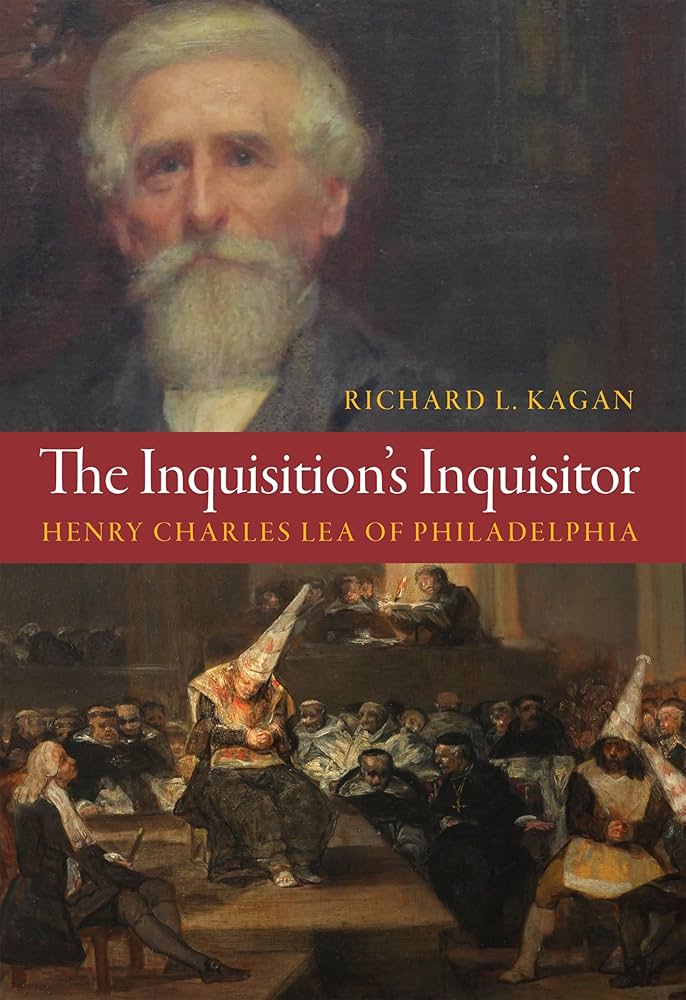
Richard L. Kagan is Arthur O. Lovejoy Professor Emeritus and Academy Professor of History at Johns Hopkins University. This interview is based on his new book, The Inquisition’s Inquisitor: Henry Charles Lea of Philadelphia (University of Pennsylvania Press, 2024).
JF: What led you to write The Inquisition’s Inquisitor?
RK: Curiosity about the life and career of a historian the AHA in 1984 designated one of the six most important US historians no longer alive. I soon discovered that Lea’s only biography — commissioned by son Arthur Lea and published in 1931 — had little to say about his scholarship on the history of the Inquisition, let alone other aspects of his life as a a publisher of medical books, property owner, philanthropist, and political reformer who styled himself the “original Mugwump.”
JF: In 2 sentences, what is the argument of The Inquisition’s Inquisitor?
RK: Apart from offering new and original insights into Lea’s personal life, the book highlights the extent to which Lea’s pioneering, archival-based histories of the medieval and Spanish inquisitions, in addition to initiating the start of a “golden age of inquisitorial scholarship,” contributed to the start of what was generally known as “scientific” history in the United States. Yet it also examines the extent to which Lea’s personal prejudices and suppositions relating to the history of the Catholic Church colored his supposedly objective, “fact-based” methodology.
JF: Why do we need to read The Inquisition’s Inquisitor?
RK: I am not sure that we need to read it, but if you are interested in the history of nineteenth-century Philadelphia, the history of historiography during the 19th Century, and especially historiography relating to the Inquisition, you are certain to find something new in this book.
JF: Why and when did you become an American historian?
RK: To be honest, I am not a card-carrying “American” (that is, “North American” ) historian. Rather, I identify – and certainly most of my colleagues identify me as – a historian of Spain and the broader Hispanic world. It was my interest in Spanish history, and that of Spanish historians in particular, that led me to Lea.
JF: What is your next project?
RK: I actually have two: one on the history and evolution of “Hispanism” as practiced in the US, and the other on “la Famosa Filadelfia,” which examines Philadelphia’s contributions to the revolutionary movements in Spanish America at the start of the nineteenth century.
JF: Thanks, Richard!