
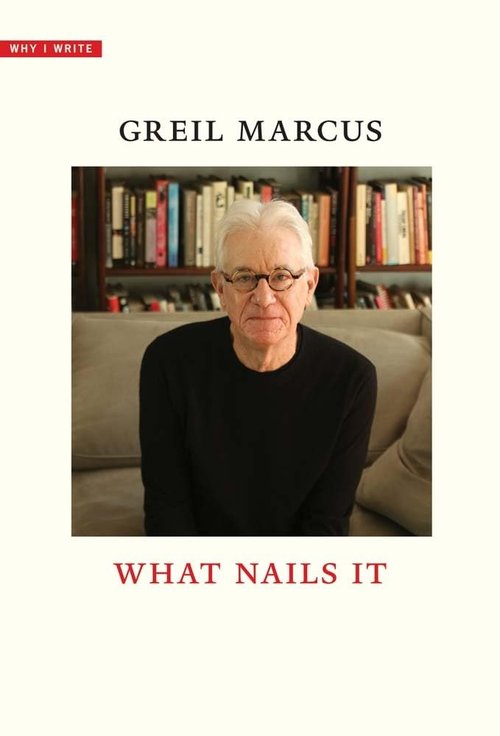
Check out Mitch Therieau‘s recent review of Greil Marcus’s What Nails It.
Therieau writes:
We don’t always nail it. Sometimes the writing overstretches, sometimes it manhandles its objects or produces a phantom version of them virtually unrecognizable to anyone who doesn’t have our specific brain. These are necessary risks. At his best, Marcus gives us coordinates for a kind of writing that does not know it all in advance, that refuses the flatness of the research summary and the bland superiority of the generic-midcentury-New York Review of Books-contributor voice many of us find ourselves falling into, perhaps betraying our wish to turn back the clock to a time when critics could claim authority by fiat and shore it up with a pose of lordly disdain. “It comes down,” as he writes, “to the falsity of knowing, as a critic… what’s best for people, to know that some people are of the best and some are worthless, the urge to separate the good from the bad and praise oneself, to decide what books people ought to read, what songs people ought to be moved by, what art they ought to make.” As scholars, we know plenty of things — but not those. We need to write to figure them out.
And this:
When Marcus dropped out of grad school to write rock criticism in the 70s, he must have seemed like an apostate to his professors. Today, though, academic and journalistic criticism are harder to separate. At mainstream culture magazines like The New Yorker and The New Republic in recent years, half the bylines in the back of the book seem to be Ph.D.s, or working toward one. Institutions have taken notice. Humanities departments now regularly offer workshops on public-facing writing for their graduate students. The old advice to keep such writing off one’s academic CV — at least until one has secured tenure — has reversed polarity. Today’s Ph.D. candidates feel pressured to crank out “public scholarship,” alongside peer-reviewed articles, to make themselves more competitive on the academic job market. The public voice that Marcus figured out as he went is becoming an all but mandatory requirement of graduate education in the humanities.
And yet, in most of its contemporary iterations, the institutional idea of “public scholarship” could not be more different from the vision of criticism Marcus lays out in What Nails It. A recent academic self-help volume captures this attitude succinctly: “What matters about writing for mainstream publications is the ability to translate work for a nonspecialist audience in a way that is compelling.” Administrative authorities and dispensers of career advice sound this note over and over: Writing for a general audience is at bottom an act of translation where the expert makes specialized knowledge intelligible to the masses. The scholar already has the knowledge; the writing is just a tool for packaging and transmitting it. Writing produced under this framework may be socially useful, as with policy briefs or pieces that contextualize current events. But it is not likely to prompt the question Marcus asks about his mentor, the great film critic Pauline Kael: “What would it feel like to write like that — to care that much?”
Maybe this is the key to understanding the difference between public scholarship and criticism. Public scholarship claims authority through credentials: a gesture which the dreaded words “Historian here!” — portents of incoming truth bombs — reduce to its barest form. Criticism, by contrast, claims authority through style. The unnamed teenager who interrupted The Pirates of Blood River was just some kid, and yet through his bombastic performance, he claimed the right to pronounce judgment and “nominate” the movie for its ignominious prize. Stylish criticism, like good art, gives sensible form to feelings we didn’t think or realize we had. Or, as Marcus says of an overwhelming encounter with Titian’s Assumption of the Virgin, which temporarily short-circuited his belief that popular culture contains expressions of the human condition equally significant to those in classical high culture: “What art does, maybe what it does most completely, is to tell us, make us feel, that what we think we know we don’t.” Criticism gives us concepts for understanding these alien feelings, their sources, their consequences.
Read the rest at The Chronicle of Higher Education.
I’ve been a fan of Marcus’s work for more than fifty years now, since I first read him in Rolling Stone. What distinguishes him (and in this he’s very much like Pauline Kael) is that he really cares about the promise of art (or culture, or whatever you want to call it). Even if he wasn’t a writer, he’d be thinking these things and talking about them–he’s not just trying to create “content” as a means to advance his career as a “writer,” like most of these people. His passion is there on every page, his belief that art is about something much bigger, and infinitely important, than mere entertainment; that it’s about taking us to places we didn’t know we needed to go, and he’s not just disappointed when it fails to do so, he’s morally offended. He is, in short, a believer. That can’t be faked.