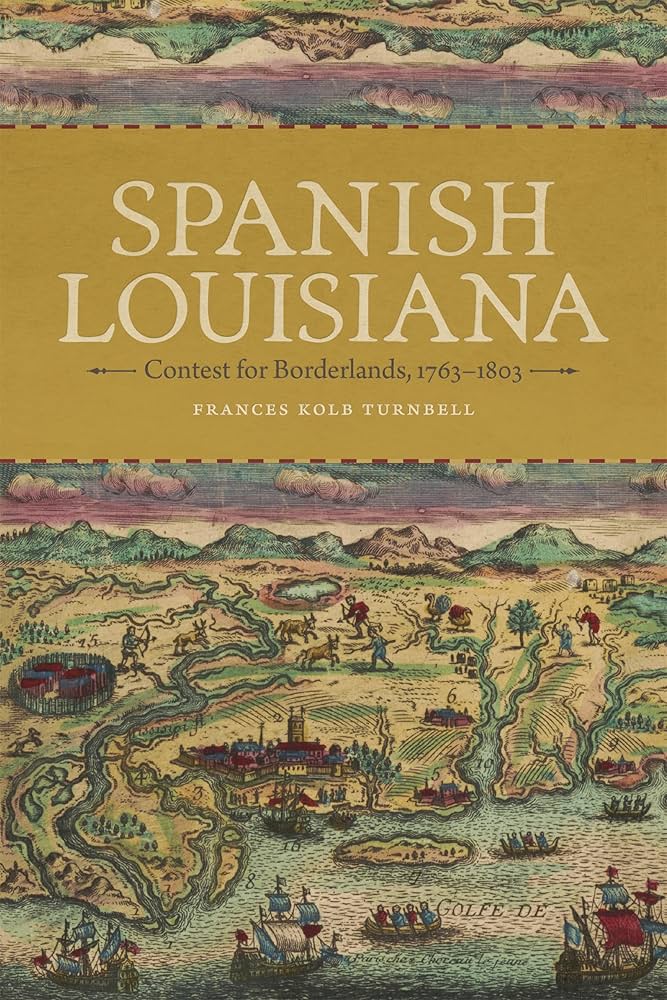
Frances Kolb Turnbell is Instructor of History at the University of North Alabama and editor of the Tennessee Historical Quarterly. This interview is based on her new book, Spanish Louisiana: Contest for Borderlands, 1763–1803 (LSU Press, 2024).
JF: What led you to write Spanish Louisiana?
FT: My interest in colonial Louisiana really began with an investigation in the Acadian migration to colonial Louisiana. I was interested in these ancestors of the Cajuns of today. My family is from South Louisiana, so I’d seen different historical markers, parks, etc and just wondered. Looking into the questions of how the Acadians reached Louisiana and why they settled where they did introduced me to the dynamic and nebulous world of the post-Seven-Years’-War Mississippi Valley. The more I was drawn into the competing empires, migrating peoples, revolts and rebellions, diverse peoples of the time and place, the more I became aware that there wasn’t yet a history of Spanish Louisiana that brought together the rich literature of all of these related but mostly yet unlinked topics.
JF: In 2 sentences, what is the argument of Spanish Louisiana?
FT: Spain held Louisiana for purposes of empire—in short to protect its more lucrative holdings—and sought to shape the colony to serve the empire not only through policy but also through courting the loyalty of the various and diverse sectors of Louisiana’s society; The groups, in turn, in seeking their own interests and security, held onto local networks and practices that often conflicted with empire. It was in the tension between Spain’s wooing and the inhabitants’ seeking their own futures that the legacies of Spanish Louisiana were worked out, and not surprisingly Spain was most successful in its own policy pursuits when they overlapped most with the interests of Louisiana’s inhabitants.
JF: Why do we need to read Spanish Louisiana?
FT: Spain was a real player in North America in the Mississippi Valley and Gulf Coast. My book, Spanish Louisiana, offers an opportunity to really consider what that meant for the uncertainties facing the peoples who lived in North America during the Revolutionary Age. The success of the new United States wasn’t a foregone conclusion, and, here, you’ll really get a sense of how volatile the Lower Mississippi Valley was and how important both Spain and the inhabitants of Louisiana were to the story. Additionally, there has been so much great research, fantastic archival research, over the years related to Spanish Louisiana, but as of yet, it really hasn’t been brought together into a cohesive story, which is something by book attempts to do. Finally—and related to my first point—the American Revolution was a conflict that occurred in places well beyond the thirteen colonies. Spain’s role in the American Revolution is too often unsung and underappreciated, as is the role of the diverse peoples who called Spanish Louisiana home. This book also highlights the contributions of Spain and Louisiana’s inhabitants to the American Revolution.
JF: Why and when did you become an American historian?
FT: I fell in love with American history in fifth grade and knew I wanted to teach it. In seventh grade, I took Texas history and became fascinated by colonial Texas. In college, I wrote my senior thesis on the Acadian migration to Louisiana. As part of that project, I read Dan Usner’s Indians, Settlers, and Slaves in a Frontier Exchange Economy, which changed my understanding of what history was. After that, I was hooked. In grad school, I was lucky enough to get to study with Dan Usner who advised my initial investigation into Spanish Louisiana.
JF: What is your next project?
FT: I’d like to take a look at a little known episode in Natchez—known as the Natchez Rebellion of 1781.
JF: Thanks, Frances!