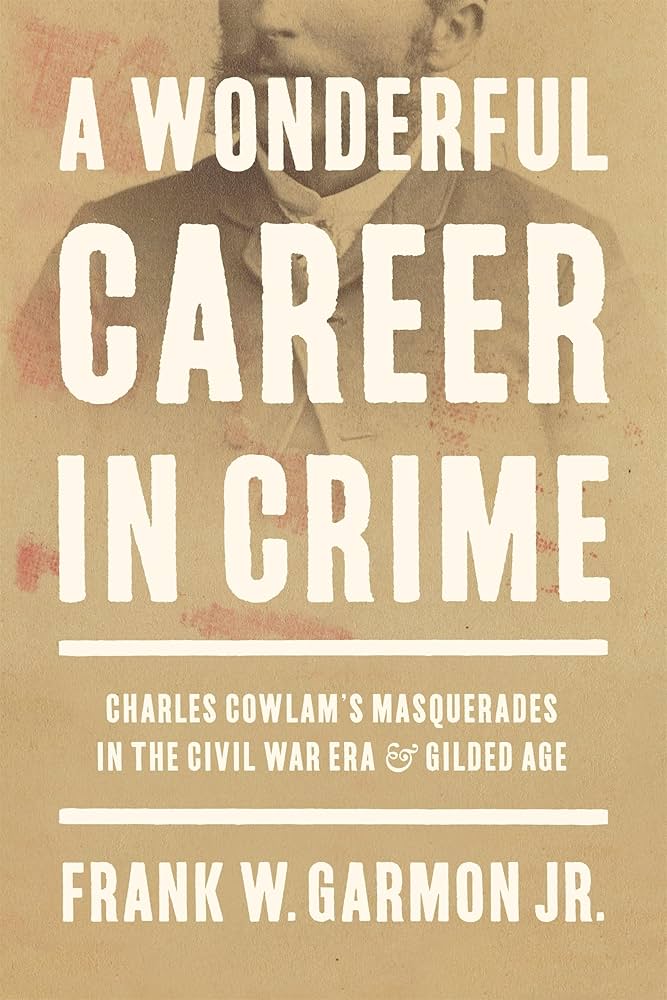
Frank W. Garmon Jr. is Assistant Professor in the Department of Leadership and American Studies at Christopher Newport University. This interview is based on his new book, A Wonderful Career in Crime: Charles Cowlam’s Masquerades in the Civil War Era and Gilded Age (LSU Press, 2024).
JF: What led you to write A Wonderful Career in Crime?
FG: The book began in the middle of the pandemic. Initially I had planned to work on a short article with a student using the digitized pardon records sent to Abraham Lincoln. One of my students, Nate Hotes, discovered the initial letter from the pardon clerk summarizing Charles Cowlam’s case. We quickly realized that there was a lot more to the story, and what began as a small side project grew into a book.
JF: In 2 sentences, what is the argument of A Wonderful Career in Crime?
FG: Although historians have written extensively about con artists in American business, this book follows the story of a gilded age swindler who repeatedly conned officials in the highest levels of government. Charles Cowlam was the only person to receive presidential pardons from both Abraham Lincoln and Jefferson Davis during the Civil War.
JF: Why do we need to read A Wonderful Career in Crime?
FG: A Wonderful Career in Crime changes the way we look at the stories Americans told after the Civil War. Charles Cowlam was an extraordinary storyteller, and a brilliant liar, but the tales he told can tell us a lot about Americans’ values and expectations, how they built trust amidst the anonymity and transience of gilded age cities, and how patronage worked in the nineteenth century.
JF: Why and when did you become an American historian?
FG: I decided to become a professional historian while studying abroad at Harris Manchester College, Oxford University the summer after my freshman year of college. That summer was the first time I had conducted independent research, and I was awestruck with the life that scholars lead. I spent the next three years working toward the goal of applying to Ph.D. programs. I completed my graduate studies at the University of Virginia, where I worked with Mark Thomas and specialized in American economic and business history.
JF: What is your next project?
FG: Right now, I am working on several articles, including one looking at John Tyler Jr. and the 1872 election in Florida, another analyzing the economic consequences of Shays’ Rebellion, and a third comparing Union and Confederate monument construction and school naming patterns.
JF: Thanks, Frank!