Barack Obama is speaking at tonight’s Democratic National Convention. Twenty years ago, as a candidate for U.S. Senate, Obama delivered his breakout speech at the DNC in Boston.
About three weeks before the 2004 convention, Obama was driving between Springfield and Chicago. This was a trip he made regularly as an Illinois state senator. Kerry’s campaign manager Mary Beth Cahill called to ask Obama if he would deliver the keynote address at the 2004 Democratic Convention in Boston. After he hung up with Cahill, Obama turned to his driver Mike Signator and said, “I guess this is pretty big.” Signator replied, “You could say that.”
A few days later, Obama was sitting in a Springfield hotel room, watching a basketball game, and jotting down notes for the biggest speech of his life. He wanted to talk about health care, education, and the war in Iraq, but most of all he wanted to give voice to the people he had met on the campaign trail in the land of Lincoln. He would later write, “It wasn’t the struggles of these men and women that had moved me. Rather, it was their determination, their self-reliance, a relentless optimism in the face of hardship. It brought to mind a phrase that my pastor, Rev. Jeremiah Wright Jr. once used in a sermon: The audacity of hope. That was the best of the American spirit I thought–having the audacity to believe that despite all the evidence to the contrary that we could restore a sense of community to a nation torn by conflict, the gall to believe that despite personal setbacks, the loss of a job or an illness in the family, or a childhood mired in poverty, we have some control–and therefore responsibility–over our own fate. It was that audacity, I thought, that joined us as one people. It was the pervasive spirit of hope that tied my own family’s story to the larger American story, and my own story to those of the voters I sought to represent.” Though he probably didn’t realize it at the time, Obama was crafting the doctrines of a civil religion that would serve him well in the coming years.
Obama arrived in Boston to much fanfare. The press wanted to know more about this virtually unknown Senate candidate from Illinois who the Democratic leadership tapped to deliver the convention’s third most important speech behind presidential nominee Kerry and vice-presidential nominee John Edwards.
Obama did not need this national platform to help him in his campaign for the Senate because at the time of the convention he did not have a Republican opponent. Investment banker Jack Ryan had won the Republican primary, but had withdrawn from the race when files related to the custody battle for his nine-year-old son were made public and the people of Illinois learned that he had tried to force his wife, actress Jeri Ryan of Star Track Voyager Fame, into public sex acts in adult clubs in the United States and Paris. Obama insisted that the Ryans’ custody records not be introduced into the campaign, but it was too late. Ryan shut down his campaign days after the records were released and on July 29, 2004, two days after Obama’s speech at the convention. Ryan formally withdrew from the race, leaving the Illinois Republican Party scrambling for a candidate to replace him.
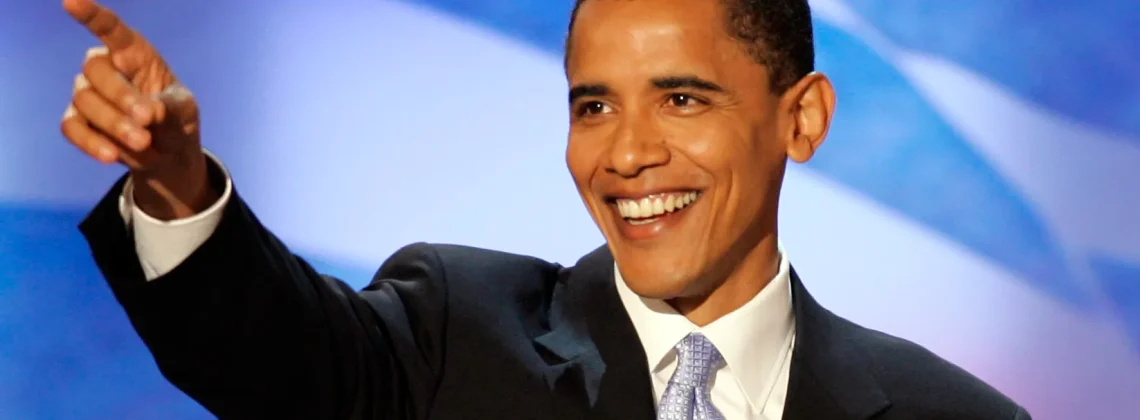
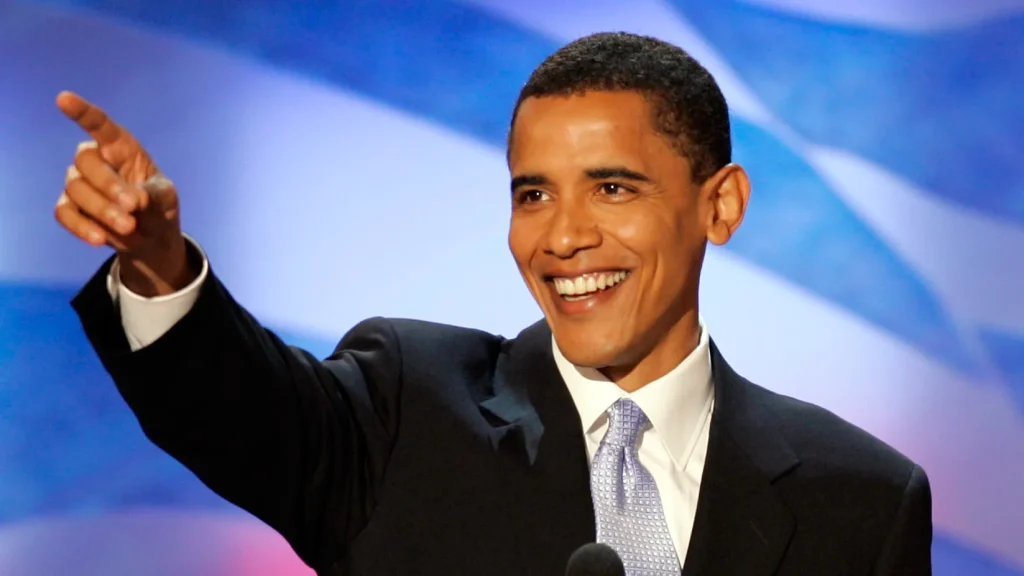
On the evening of the speech, Obama wore a black suit, a white shirt, and a tie he borrowed from his communications director Robert Gibbs about ten minutes before he went on stage. (Apparently Michelle didn’t like any of the ties her husband brought with him to Boston). As he walked on stage he said a little prayer, asking God to help him tell the stories of the people he wanted the nation to hear about. Obama came out to the sound of Curtis Mayfield & the Impressions civil rights-era song “Keep on Pushing,” which included the lyric: “Now maybe some day, I’ll reach that higher goal, I know I can make it, With just a little bit of soul, Cause I’ve got my strength.” Obama looked out over the cheering delegates waving hundreds of blue and white Obama signs that campaign workers had trucked from Illinois for the speech.
Over the course of the next sixteen minutes or so, Obama preached an American sermon. He started with his testimony–referencing his Kenyan father’s desire to study in that “magical place” called “America.” He spoke of his mother growing-up as the daughter of a World War II veteran in the American heartland of Kansas. And he explained the meaning of his name, Barack, the Hebrew word for blessed one.” (Later his Chicago political rival Bobby Rush would say that “you don’t fool with” a guy whose name means “the one who God favors’).
Then Obama quoted what historian Pauline Maier has called “American Scripture”: “We hold these truths to be self-evident that all men are created equal, that they are endowed by their Creator with certain inalienable rights, that among these are Life, Liberty, and the pursuit of Happiness.”
He talked about FAITH in “simple dreams.” He talked about “small miracles,” such as tucking kids in bed at night without worrying about their safety or lack of food. He explained about how the American creed was lived, extolling the practices that sustained such a faith: hard work, education, and ambition. It was the job of America’s political leaders to make sure such faith could be practiced freely, without the impediments of race or poverty getting in the way.
By this point in the speech, Obama was flying high. He now began balancing American individualism with social obligation. “Alongside our famous individualism,” he said, “there’s another ingredient in the American saga. A belief that we’re all connected as one people. If there is a child on the south side of Chicago who can’t read, that matters to me, even if it’s not my child. If there’s a senior citizen somewhere who can’t pay for their prescription drugs, and has to choose between medicine and the rent, that makes my life poorer, even if it’s not my grandparent. If there’s an Arab American family being rounded up without benefit of an attorney or due process, that threatens my civil liberties. It is that fundamental belief, it is that fundamental belief, I am my brother’s keeper, I am my sister’s keeper, that makes this country work. It’s what allows us to pursue our individual dreams and yet still come together as one American family.”
The reference to “my brother’s keeper” came from Genesis 4:9, when God asked Cain, “Where is your brother Abel?” Cain, after killing Abel, responded, “Am I my brother’s keeper?” The implication, of course, was that Cain WAS his brother’s keeper and because he failed in his responsibility he would receive God’s curse, work ground that would not yield crops, and live the life of a restless wanderer. For Obama, brother and sister-keeping was an essential part of American civil religion. Some of you may recall Georgia senator Raphael Warnock say something similar last night in Chicago.
Any good sermon, of course, must mention the ever-present threats to the community of believers. “Now even as we speak,” Obama continued, “there are those who are preparing to divide us, the spin masters, the negative ad peddlers who embrace the politics of anything goes.” As Obama biographer David Remnick wrote, “The speech served a progressive message in a way that sounded deeply patriotic even to people who might consider themselves Republicans or independents. The speech seemed to many a long-awaited rebuke to the sneering moralism on display at earlier Republican Conventions when figures like Pat Robertson and Pat Buchanan tool the stage.”
Those who tried to divide the country did not understand the meaning of America:
There is not a liberal America and a conservative America–there is the United States of America. There is not a Black America and a White America and Latino America and Asian America — there’s the United States of America. The pundits…like to slice-and-dice our country into Red States and Blue States; Red States for Republicans, Blue States for Democrats. But I’ve got news for them, too. We worship an awesome God in the Blue States, and we don’t like federal agents poking around in our libraries in the Red States. We coach Little League in the Blue States and yes, we’ve got some gay friends in the Red States. There are patriots who opposed the war in Iraq and there are patriots who supported the war in Iraq. We are one people, all of us pledging allegiance to the stars and stripes, all of us defending the United States of America. In the end, that’s what this election is about. Do we participate in a politics of cynicism or do we participate in a politics of hope?”
Obama was not expected to carry the majority of the evangelical vote–that would go to Bush. But by referring to the worship of an “awesome God,” Obama was making a direct appeal to this voting bloc. The phrase was lifted from a worship song by Christian contemporary artist Rich Mullins that anyone who attended an evangelical congregation, youth group, or Christian school had sung at one time or another. By referencing Mullin’s song “Our God is An Awesome God,” Obama was sending a message to those evangelicals listening that they were also part of the tapestry of America–this great religious congregation defined by all the things he had referenced in the speech thus far.
And to conclude, he made sure his listeners knew that America was also defined by hope. Obama said that “hope” was something different than “blind optimism” or the “willful ignorance that thinks unemployment will go away if we just don’t think about it, or the health care crisis will solve itself if we just ignore it.” Instead, he described hope as slaves sitting around a fire singing freedom songs and immigrants setting out for distant shores.
And then he brought hope to the present political moment when he talked about “the hope of a young naval lieutenant bravely patrolling the Mekong Delta”–a reference to Kerry. “The hope of a millworker’s son who dares to defy the odds”–a reference to Edwards. And “the hope of a skinny kid with a funny name who believes that America has a place for him, too.” He finished strong: “Hope in the face of difficulty. Hope in the face of uncertainty. The audacity of hope! In the end, that is God’s greatest gift to us, the bedrock of this nation. A belief in things not seen. A belief that there are better days ahead.”
He was paying homage to Jeremiah Wright’s sermon. But he was also secularizing the sermon, or at least baptizing it in the waters of American civil religion. Wright’s “hope” was rooted, ultimately, in the Kingdom of God. It was rooted in the glimpses of a coming Kingdom they received in their day to day struggle for justice in this world. Obama, on the other hand, found his source of hope in the American experience and the values upon which the country was built. Wright preached in church and offered a “vision of things not seen” rooted in Christian eschatology. Obama preached at a political convention and offered a “vision of things not seen” rooted in Enlightenment progress. Wright casted a vision for God’s people gathered in prayer and worship. Obama casted a vision for America.
In the end, the 42-year-old U.S. Senate candidate hit a homerun. It was a career-launching speech. Barack Obama was now a household name. His life would never be the same again.
The praise came rolling-in. The St. Louis Dispatch wrote that “Not since Roy Hobbs first pinch-hit for the New York Knights in The Natural has any rookie made an entry like the one Barack Obama made Tuesday night at the Democratic Convention,” adding “It was the most powerful convention speech since the Rev. Jesse Jackson’s ‘common ground’ address in 1988.”
The Associated Press reported that convention delegates and other observers were “tossing around some heavy-weight words” such as “the sky’s the limit” and “even the p-word: president.” A popular blogger wrote “You know how good this speech is? It will be on rap albums next year, during the tracks that are trying to be socially conscious.” A John Kerry adviser said that Obama could be America’s first black president: “He isn’t a shooting star, but a flaming comet certain to light up our skies for years to come.” A letter to the editor of the Des Moines Register put it succinctly: “I just saw the future of the Democratic Party. His name is Barack Obama.”
One would be hard pressed to find a Christian Right or evangelical organization that had anything–negative or positive– to say about Obama’s speech. This, of course, doesn’t mean they did not comment on the Democratic Convention. But rather than critiquing Obama’s keynote address, they chose to focus on the place of abortion in the Democratic Platform, the number of homosexual delegates at the convention, and speeches made in support of stem-cell research.
Much of the conservative pushback against Obama’s speech came from the Claremont Institute and The National Review. Ken Masugi, a senior fellow at Claremomt, said Obama was “just a well-educated yuppie if you take race off the table.” He added that the Kerry campaign’s choice of Obama as the keynote speaker was a “very puzzling choice” and there was “no reason someone else shouldn’t have been chosen.” This, he said, was “typical unimaginative Democratic Party ethnic pandering” and Masugi was convinced that it “would not work.”
Over at The National Review, John Leo wrote: “Rub your eyes. Did we just see a Democratic convention brimming with flag-waiving patriotism, respect for the military, and reference to God and values? Why yes, I believe we did. Barack Obama, the impressive new African-American star of the Democratic Party, told us how blue-state Americans ‘worship an awesome God,’ the implication being that Democrats generally are deeply committed to religion and overcome by the power and majesty of God. Even semi-alert people who follow politics with one eye shut know this isn’t really the case.” Leo went on to describe the Democratic Party as the “secular” and “nonbelieving party.” He said that Americans could expect the Democrats to be “strongly religious”–right up until election day.
Whatever one thought about Obama’s speech and its references to religion–both Christianity and American civil religion–one thing was clear: the candidate for U.S. Senate in Illinois knew how to speak to people of faith. And there would be more to come.