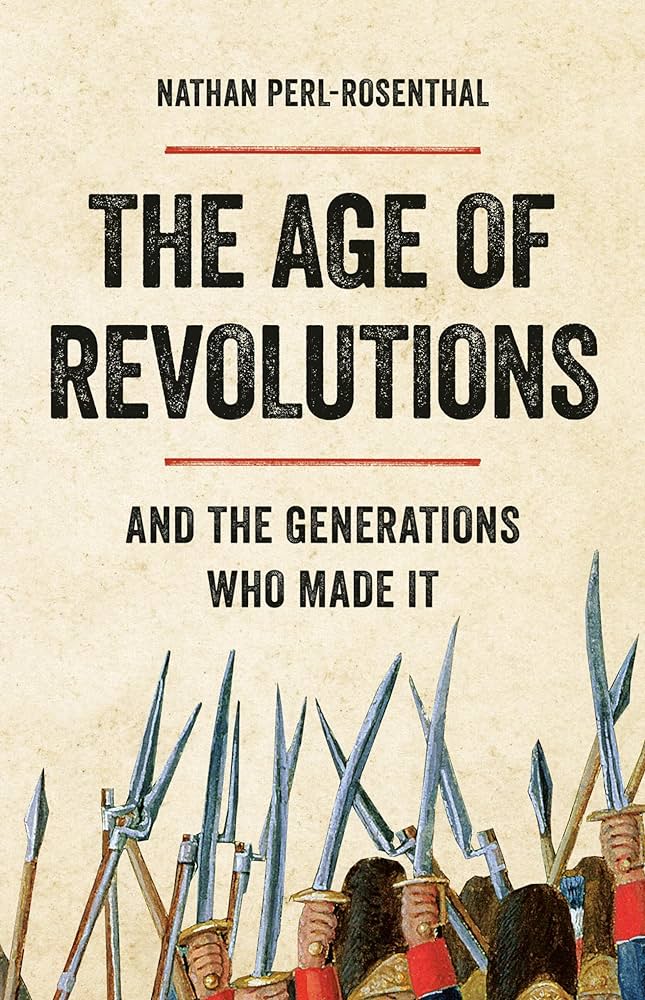
Nathan Perl-Rosenthal is Professor of History, French and Italian, and Law at the University of Southern California. This interview is based on his new book, The Age of Revolutions: And the Generations Who Made It (Basic Books, 2024).
JF: What led you to write The Age of Revolutions?
NP: Since I became a historian, I have been fascinated by the contradictory, connected tangle of revolutions that marked the late eighteenth and early nineteenth centuries. For all that we know about the individual revolutions—and we know a lot about each one!—there is a paucity of recent work that thinks about them together. It has been over sixty years since the publication of the two most influential studies, R.R. Palmer’s The Age of the Democratic Revolution (1959-1964) and Eric Hobsbawm’s The Age of Revolution (1962). Both are magnificent books. But there is so much that has changed since they were published: huge swathes of scholarship on Haiti, on slavery, on the history of Spanish American independence, among others. We need to revisit the arguments that Palmer and Hobsbawm made—we need to rework the way we understand the Atlantic age of revolutions. That’s what I try to do in this book.
JF: In 2 sentences, what is the argument of The Age of Revolutions?
NP: The Atlantic revolutions of the end of the eighteenth and early nineteenth century, which created the mold of modern politics, were the work of two distinct generations. The first generation, dominant from the 1770s through the 1790s, shattered the Atlantic world’s old regimes, and the second generation, rising to power after 1800, created the first sustained mass political movements across lines of class and race.
JF: Why do we need to read The Age of Revolutions?
NP: First, for the stories. I narrate the age of revolutions in part through about half a dozen lives that are woven through the book. They’re mostly people who are not already well known—the exception is the Adamses (John and John Quincy)—but their journeys are all fascinating. My personal favorite is probably Madre Maria Rivadeneyra: a cloistered nun who was also a tough-as-nails political actor in the era of the Tupac Amaru revolt/revolution. Come for her story, stick around for the lives of Marie Bunel and Louis-Augustin Bosc! Second, for what it can tell you about the present. If you’re interested in modern politics, you need to understand the Atlantic age of revolutions. Not everything about modern politics can be traced back to this period, but a hell of a lot about today’s political world, for both good and ill, took shape in that period. This book sheds light on how modern democratic-republican politics came to be so fraught—committed to equality and liberation but perpetually falling back into forms of domination and hierarchy.
JF: Why and when did you become an American historian?
NP: My intellectual path was somewhat winding—and still is. I got interested in being a professional historian in college; until then, I was pretty sure I wanted to be a scientist. The age of revolutions interested me from the get-go—for all of the reasons I mentioned above—but my interests were as much in the French Revolution as in the American. My dissertation was jointly advised by a U.S. and a French historian, and my archival work and scholarly reading has always straddled the Atlantic. I have always been very committed to the idea that the American experience, while distinctive (as every history is) was not exceptional. So…perhaps that means that I’m still in the process of becoming an American historian…?
JF: What is your next project?
NP: I’m working on two projects, both under contract with Basic Books. The first is a short book, drawing primarily on Fourth of July orations, which argues that North Americans regarded the Revolution as an ongoing process well into the nineteenth century. That book will be for 2026, to coincide with the 250th anniversary of American independence. The one after that will be a study of how maritime prize law—the law governing captures of enemy ships and cargoes at sea in wartime—shaped the rise and fall of the first European global empires, circa 1600 to 1850. I’m plowing through huge amounts of archival materials for that project this year. There are lots of incredible stories and a real untold history.
JF: Thanks, Nathan!