
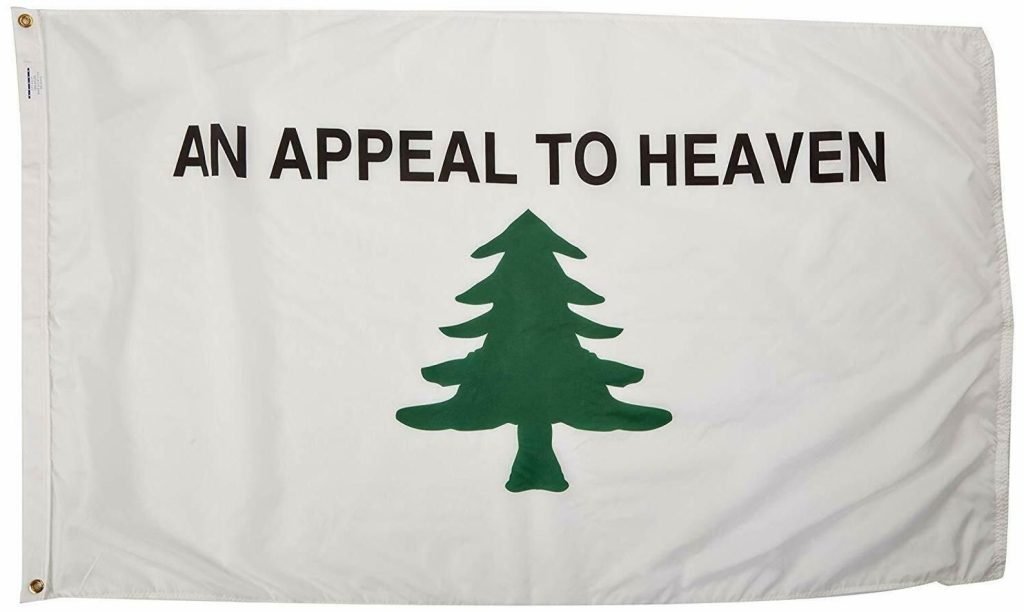
Not familiar with the Samuel Alito “Appeal to Heaven” flag controversy? Get up to speed here.
I am seeing a lot of tweets like this:
What Reed and Pence fail to recognize is that symbols like the Pine Tree Flag can take on different meanings in different eras. In the 18th-century, the flag was a symbol of revolution. After January 6 it became a symbol of Christian nationalism. Contra Reed, I would argue that it is “ahistorical” to fail to recognize this. (Reed should know better–he has a Ph.D in history.)
We have plenty of evidence to suggest that Christian nationalists are using this flag to promote Christian nationalism. For example, it is very popular among Seven Mountain Dominionists today. Future historians will thus call attention to the flag’s 18th-century meaning and its 21st-century meaning. This is what historical thinkers call “change over time.”
Of course future historians will also recognize that men and women waving this flag at the U.S. Capitol on January 6, 2021, and the Seven Mountain Dominionists parading the flag today, see continuity between its 18th century meaning and its 21st century meaning. So here’s the question: Should we think about the flag in terms of change over time or continuity? Now that would make for a stimulating discussion and contribute to another important historical thinking skill: complexity.
One more thing, the Sarah Jones’s New York Magazine piece in the above tweet pays virtually no intention to the revolutionary-era roots of the flag and is thus equally ahistorical. The task of historian is to intellectually move between past and present. The real story of this flag is how it has been interpreted in different contexts throughout American history and how its meaning may or may not have changed over time. A political interpretation of this controversy has no interest in such questions.