
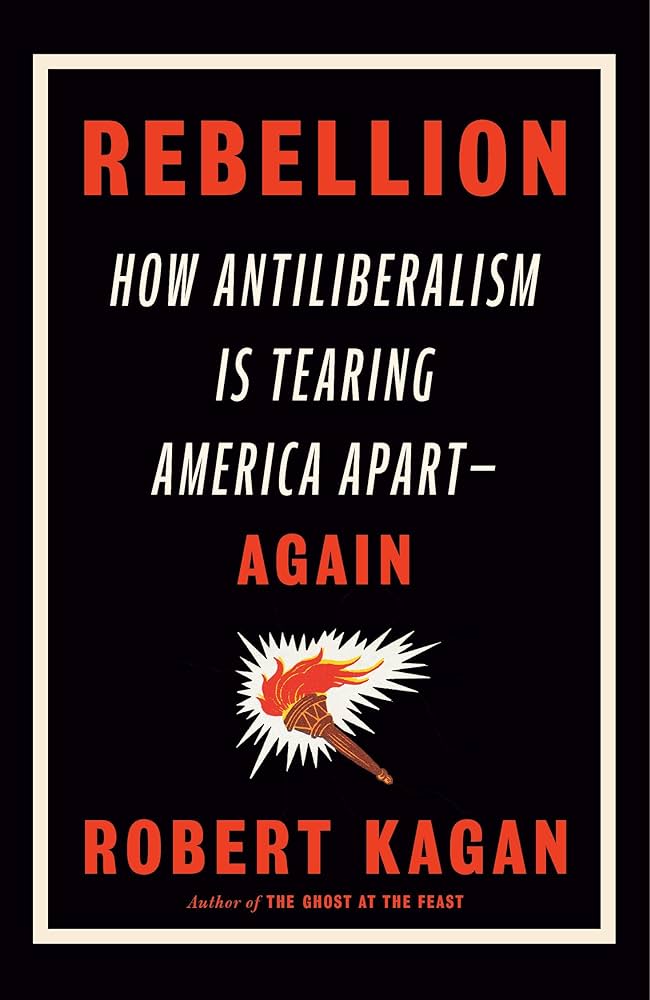
Here is an excerpt from Kagan’s book Rebellion: How Antiliberalism is Tearing America Apart. The excerpt is published today at The Washington Post:
Trump not only acknowledges his goals, past and present; he promises to do it again if he loses this year. For the third straight election, he is claiming that if he loses, then the vote will have been fraudulent. He has warned of uprisings, of “bedlam” and a “bloodbath” and he has made clear that he will again be the promoter of this violence, just as he was on Jan. 6, 2021. Trump explicitly warned in 2020 that he would not accept the election results if he lost, and he didn’t. This year he is saying it again. Were there no other charges against him, no other reason to be concerned about his return to the presidency, this alone would be sufficient to oppose him. He does not respect and has never pledged to abide by the democratic processes established by the Constitution. On the contrary, he has explicitly promised to violate the Constitution when he deems it necessary. That by itself makes him a unique candidate in American history and should be disqualifying.
This kind of open challenge to our democracy was never meant to be addressed by the courts. As the Founders well understood, you don’t serve a subpoena to a would-be tyrant and tell him to lawyer up. Nor was it meant to be addressed by the normal processes of democratic elections. They knew, and feared, that a demagogue could capture the allegiance of enough voters to overthrow the system. That was why they gave Congress, and particularly the Senate, supposedly more immune from popular pressures, the power to impeach and remove presidents and to deny them the opportunity to run again — and not simply because they violated some law but because they posed a clear and present danger to the republic. After Trump’s attempt to overthrow the government in 2020, Congress had a chance to use the method prescribed by the Founders in precisely the circumstances they envisioned. But Senate Republicans, out of a combination of ambition and cowardice, refused to play the vital role the Founders envisioned for them. The result is that the nightmare feared by the Founders is one election away from becoming reality.
The problem with Trump is not that he has some carefully thought-out plan for seizing power, much less an elaborate ideological justification for doing so. (Others do have such plans and such justifications, including many of those who will populate his administration — more on that in a moment.) With Trump, everything is about him and his immediate needs. He will run roughshod over the laws and Constitution simply to get what he wants for himself, his family and his business interests. Americans know that if he is elected, he would abuse the justice system to go after his opponents. They know this because he says so. “I am your retribution!” he declares, and by “your” he means “my.” Americans know he would use his power as president to try to solve his financial problems. He did it as president and is doing it now as a presidential candidate. They know he would not respect the results of fair elections if he loses, which is the very definition of a tyrant.
And this:
Six decades ago, people like Rushdoony were responding not to “woke” corporations or Black Lives Matter but to civil rights legislation. Today, anti-liberal conservatives complain about school curriculums that acknowledge the racism that has shaped America’s history, but even five decades ago, before the invention of “critical race theory,” anti-liberal White people such as Rushdoony insisted that the “white man” was being “systematically indoctrinated into believing he is guilty of enslaving and abusing the Negro.” Nor is it new that many White people feel that the demands of minority groups for both rights and respect have “gone too far” and it is they, the White people of America, who are suffering the worst discrimination. In the 1960s, surveys taken by the New York Times showed that majorities of White people believed even then that the civil rights movement had “gone too far,” that Blacks were receiving “everything on a silver platter” and the government was practicing “reverse discrimination” against White people. Liberalism is always going too far for many Americans — and certainly for anti-liberals. Anti-liberals these days complain about wokeness, therefore, but it is the liberal system of government bequeathed by the Founders, and the accompanying egalitarian spirit, that they are really objecting to, just as anti-liberals have since the founding of the nation. Many of Trump’s core supporters insist they are patriots, but whether they realize it or not, their allegiance is not to the Founders’ America but to an ethnoreligious definition of the nation that the Founders explicitly rejected.
Some do realize it. The smartest and most honest of them know that if people truly want a “Christian America,” it can only come through “regime change,” by which they mean the “regime” created by the Founders. The Founders’ legacy is a “dead end,” writes Glenn Ellmers, a scholar at the Claremont Institute. The Constitution is a “Potemkin village.” According to Deneen and Harvard Law School’s Adrian Vermeule, the system established by the Founders to protect individual rights needs to be replaced with an alternative form of government. What they have in mind is a Christian commonwealth: a “culture that preserves and encourages order and continuity, and support for religious belief and institutions,” with legislation to “promote public morality, and forbid its intentional corruption,” a “forthright acknowledgment and renewal of the Christian roots of our civilization,” “public opportunities for prayers,” and a “revitalization of our public spaces to reflect a deeper belief that we are called to erect imitations of the beauty that awaits us in another Kingdom.”
These anti-liberal conservatives know that bringing such a commonwealth into being means jettisoning the Founders’ obsession with individual rights. The influential advocate of “conservative nationalism,” Yoram Hazony, wants Americans to abandon the Declaration in favor of a nationhood built on Protestantism and the Bible. America is a “revolutionary nation,” Sen. Josh Hawley (R-Mo.) insists, not because of the principles of the Declaration and not even because of the American Revolution itself, but “because we are the heirs of the revolution of the Bible” that began with “the founding of the nation of Israel.” There could hardly be a statement more at odds with the American Founders’ liberal, ecumenical vision.
Expressing a belief in God is no threat to the Founders’ system, but reshaping society in accord with Christian teachings is. To build the nation Hawley and Hazony imagine would require jettisoning not only the Declaration but also the Constitution, which was designed to protect the Declaration’s principles. The Christian commonwealth would not and could not be a democracy because the majority of people can’t be trusted to choose correctly. According to the Claremont Institute’s Ellmers, “most people living in the United States today — certainly more than half — are not Americans in any meaningful sense of the term.” They are a “zombie” or “human rodent” who lives “a shadow-life of timid conformity.” Only “the 75 million people who voted in the last election” for Trump are true Americans. Instead of trying to compete with Democrats in elections that don’t reflect the will of the people, Ellmers writes, “Why not just cut to the chase and skip the empty, meaningless process?” The “only road forward” is “overturning the existing post-American order.”
For these intellectuals, Trump is an imperfect if essential vehicle for the counterrevolution. A “deeply flawed narcissist” suffering from a “bombastic vanity,” as Deneen and Ellmers note, he has “lacked the discipline to target his creative/destructive tendencies effectively.” But this can be remedied. If Trump failed to accomplish the desired overthrow in his first term, Deneen argues, it was because he lacked “a capable leadership class.” Things will be different in his next term. What is needed, according to Deneen, is a “self-conscious aristoi,” a class of thinkers who understand “both the disease afflicting the nation, and the revolutionary medicine required for the cure,” who know how to turn populist “resentments into sustained policy.” Members of Deneen’s would-be new elite will, like Vladimir Lenin, place themselves at the vanguard of a populist revolution, acting “on behalf of the broad working class” while raising the consciousness of the “untutored” masses. Indeed, according to Harvard’s Vermeule, it will be necessary to impose the common good even against the people’s “own perceptions of what is best for them” — a most Leninist concept indeed.
Read the entire piece here.