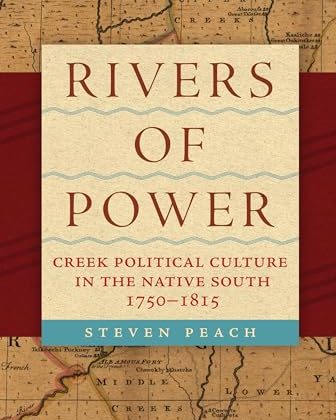
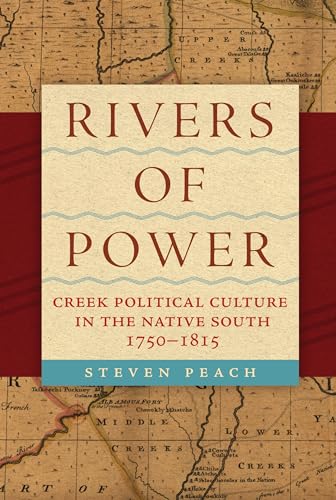
Steven Peach is Associate Professor of History at Tarleton State University. This interview is based on his new book, Rivers of Power: Creek Political Culture in the Native South, 1750–1815 (University of Oklahoma Press, 2024).
JF: What led you to write Rivers of Power?
SP: I wrote this book for both academic and personal reasons. As a child, I frequently visited my grandparents’ home on the sovereign lands of the Menominee Nation of Wisconsin. I didn’t know who those Native people were, but I did know that their government leased land to whites like my grandma and grandpa. (I, too, am white.) I began thinking more seriously about Native people in the United States when, as an undergraduate, I learned that numerous historians dedicate their lives to studying Native peoples and investigating how they shaped the larger story of America. Soon, I envisioned myself participating in scholarly conversations about Indigenous peoples, especially in the field of early America. After I read such influential books as Daniel Richter’s Facing East from Indian Country and Richard White’s Middle Ground, there was no turning back.
I also wrote this book as a love letter of sorts to what is called “ethnohistory.” Ethnohistory is a lot of things. It’s a field. It’s a method. And it’s even an organization and journal. Fundamentally, it asks researchers to blend history and anthropology to trace the past from Native peoples’ own perspectives. The “rivers” in my book title captures this approach, for example, because the Creeks believed that rivers were the conceptual basis of politics and leadership in their world. When I was a graduate student, I began presenting some of this research at the annual meeting of the American Society for Ethnohistory. I loved (and still love) it there. It hosts exciting discussions about Indigenous peoples, and it enmeshes like-minded individuals in professional webs that will surely last a lifetime. Writing a book about the Creeks, then, honors an organization that has been instrumental to my career.
JF: In 2 sentences, what is the argument of Rivers of Power?
SP: My book argues that the Creeks of present-day Georgia and Alabama rejected Western political concepts, such as the nation-state, in favor of a shared power arrangement between high-profile leaders and local communities. In doing so, the Creeks invested in sub-regional provinces that they likened to the rivers that flowed through Creek country, and that nourished the plants, animals, spirits, and humans who lived there.
JF: Why do we need to read Rivers of Power?
SP: Just as the genesis of my interests in Indigenous history is a long story, so it took me years to decide why my book is important and why people need to read it. One reason is that my book takes a unique and textured bottom-up approach to Native American history by looking at women, children, warriors, and other local actors who did so much to influence leaders or “headmen.” Local people were the anchor of matrilineal clans, small-scale towns (italwa), and community life. As a result, they exercised a lot of control over leaders’ decision-making in diplomacy, war, and trade. These community actors do not always receive the attention they deserve from ethnohistorians and other scholars. Sure, we always knew that women and warriors were important to Native history, but I uncover the myriad ways in which these people shaped Native governance, the Native South, and the broader story of early America.
I also think it’s crucial for Native and non-Native people in today’s world to understand that there have always been political alternatives to the “nation-state.” Although we live in a world of nations and nationalism, I think we should stop to think about how historical actors, especially North America’s Indigenous populations, conceived of power, government, and leadership. For the Creeks, power sprung from water. While they called (and call) themselves Muscogees, their Anglicized name derives from English traders who found “Creek” communities living along the region’s many watercourses. Water was the wellspring of life. It nourished the cornfields that women and their maternal relatives tended, it nourished the animals that men hunted, and it nourished a world of spirits that stoked awe and fear in the Creeks. These people took inspiration from rivers like the Tallapoosa, Coosa, and Chattahooche to envision, build, and deploy provincial coalitions that united communities across far-flung spaces. It was intra- and inter-provincial coalitions that gave shape to the Creek government, and that confirmed the political relevance of local peoples who inhabited the various provinces.
Finally, my book steps into an emerging trend in the Native American scholarship: that of intertribal/pan-Indian/inter-Indigenous history. The Creeks faced numerous dangers from colonial powers like the British Empire and United States, but their primary adversaries (and allies) were other Indigenous groups, such as the Cherokees, Choctaws, Chickasaws, and Seminoles. (These five groups were later called the “Five Civilized Tribes,” although historians have rejected that term for its racist insensitivities.) The Creek-Cherokee War, the Creek-Choctaw War, and the Creek-Chickasaw War occupied the political energies of headmen and local people alike. By the early nineteenth century, the Creeks fell into civil war, in what was an intra-Indigenous conflict known as the Creek War. Those of us educated in the United States have been taught so much about “Indian-white” affairs that we miss what has always been in the historical archive. That is, numerous instances of Native people sharing in each other’s history and deciding that their true enemies and friends were one another.
JF: Why and when did you become an American historian?
SP: Again, this is a long story, but I will try to condense it. I enrolled in my community college with the intention of majoring in mathematics because of a gifted high school math teacher. And I didn’t possess sufficient writing skills; indeed, I had to take a college prep course to learn the fundamentals of grammar. Those two things changed after excelling in courses on American history, European history, and World history. I read and wrote voraciously, learning that the humanities occupies an intellectual and analytical gray area. There isn’t necessarily “one” answer or a “right” or “wrong” answer. Rather, truth and knowledge are constructed, debated, and defended with the available evidence at hand.
But why U.S. history specifically? I want to tell new stories about the past. I’d grown up absorbing a ton of information about the Founding Fathers, the American Revolution, and the Civil War. But it was the same stuff again and again. When I did a research project in my M.A. program at Northern Illinois University, I started finding Native people in the primary sources I was using for other purposes. I asked myself: who were they, where did they live, how did they structure their cultures, and, really, how does putting them at the center of a narrative alter the way we understand U.S. history?
My career is dedicated to answering those questions and sharing the results with my peers and my students. American history looks far darker, bloodier, and sadder than my younger self understood. And yet Native people have always been resilient, able to adapt to the many situations imposed by colonialism. The Muscogee Creeks are still here. Many of them live in Oklahoma, where they, like the Menominee people, exercise rights and power as a sovereign nation. Fans of the hit Hulu show, Reservation Dogs, may recall that much of that story is set on sovereign Muscogee Creek land.
JF: What is your next project?
SP: Even before my dissertation defense in 2016, I’d already had a second book project in mind. It is a study of Creek and Seminole women in nineteenth-century Indian Territory, which became the State of Oklahoma in 1907. Essentially my research follows Native Southerners to the land they were banished to after the U.S. Indian Removal Act. Primarily I’m interested in how these women rebuilt their homes, communities, and kin networks after the devastation wrought by ethnic expulsion. While historians still use the term “Indian Removal,” those like me find it too safe and sanitized. The Creeks, Cherokees, and other Native people weren’t merely removed from their homelands. Instead, they were forcibly and violently expelled from it, literally at gunpoint, by U.S. and state authorities. I hope this project can shed further light on how Native people adapted to such a dark and violent history and how, of course, this research can challenge and rewrite larger narratives about American exceptionalism.
JF: Thanks, Steven!