
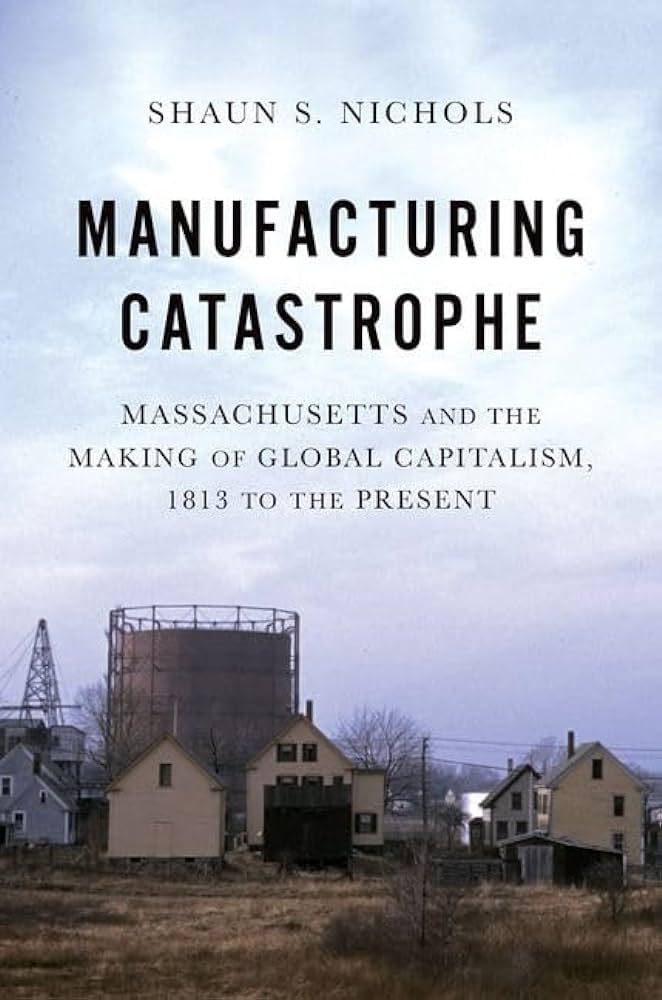
Shaun S. Nichols is Assistant Professor of History at Boise State University. This interview is based on his new book, Manufacturing Catastrophe: Massachusetts and the Making of Global Capitalism, 1813 to the Present (Oxford University Press, 2024).
JF: What led you to write Manufacturing Catastrophe?
SN: Growing up as a working-class kid in New Bedford, Massachusetts, there was an omnipresent sense that we lived in a city in crisis: a city caught in the grinding gears of “deindustrialization.” We couldn’t escape it: seemingly empty factories and snaking unemployment lines served as a constant reminder. I would imagine that these are familiar memories for a lot of folks who grew up in the so-called Rust Belt.
As I moved towards graduate school, I discovered that New England is often employed as an example of how the roots of deindustrialization reach much farther back than these popular images of late-century decline. For New England, I learned, deindustrialization’s origin story dated more to the 1880s than the 1980s. This left me puzzled: my own family’s New England origin story mostly dated to the early twentieth century (when the bulk of my French Canadian ancestry immigrated) and to the late 1960s, when my Azorean grandparents made their way to the factories of Southeastern Massachusetts. Why would immigrants in search of opportunity venture to such an apparently inopportune place? Why would my ancestors seek a new life in an area that had supposedly been locked in the throes of industrial collapse for nearly a century? I began to suspect that there was something amiss about how both historians and the American public understood “deindustrialization,” and I sought to find some answers.
JF: In 2 sentences, what is the argument of Manufacturing Catastrophe?
SN: From the perspective of Massachusetts, deindustrialization was less a secular trend than a centuries-long cycle of destruction and re-creation, leaving workers, policymakers, and business leaders in the lurch, attempting to constantly rebuild shattered local economies. But, by using the appeals of economic crisis—cheap labor, low taxes, and generous manufacturing subsidies―to pull in migrant labor and mobile capital to Massachusetts, these efforts brought economic growth precisely because they so often sacrificed popular prosperity.
JF: Why do we need to read Manufacturing Catastrophe?
SN: It is rare that a State of the Union speech or political campaign fails to mention some plan to bring industrial jobs back to America’s shores. In some sense, Donald Trump’s entire presidency was founded on just these sorts of promises. Cities, states, and nations—whether liberals or conservatives have been at the helm—are constantly throwing public money at industrial promoters, precisely because they think it is their job to use public power to push back against the forces of industrial decline. This is a fool’s errand. As Manufacturing Catastrophe shows, using the lure of crisis or generous government handouts to seduce mobile capital can indeed attract jobs, but it rarely brings stable prosperity. As angry Massachusetts workers repeatedly reminded policymakers over and over again throughout my book—the need is not for more jobs, the need is for more good jobs. In Massachusetts, it was rare that policymakers heeded these warnings. As a result, these business handouts have generally served to draw in those looking to profit on desperation with little to offer in return, trapping these industrial cities in endless cycles of collapse, reconstruction, and compounding inequality.
JF: Why and when did you become an American historian?
SN: My early years growing up poor—and my family’s subsequent upward social (and geographic) mobility—certainly played a role in fostering my interests in the topics of class, inequality, and capitalism. But, my turn to history was a product of a much more specific ordeal. Like many of my generation, the 2008 crisis was the defining event of my college career. On an ideological level, the experience of watching the economy crash in such a spectacular fashion—and the string of truly crappy jobs I was forced to take in the wake of that crash—inspired in me all sorts of questions about the innerworkings (and inner dysfunctions) of the American economy and its evolution. On a material level, the implosion of the job market also ensured that the idea of going to graduate school to get a History Ph.D. seemed less like a ridiculous career risk and more like a smart way to hide out in the safety of a five-year paid gig!
JF: What is your next project?
SN: Manufacturing Catastrophe is in many ways defined by my conviction that the typical “decade-to-half-century” time-span covered in the standard historical monograph can often miss the larger, longue-durée forces at work. Right now, I am in the beginning stages of a book that will apply that same insight to the history of “American economic thought.” It is an analysis of the life and death of a particular tradition of economic thinking that was markedly American in its underlying questions, assumptions, and aims. Many of the most important thinkers of this tradition are almost completely lost to today’s economists and reformers, but I am convinced that they still have much to offer. After all, these thinkers largely stuck to the advice of our nation’s founders: they believed that we should use the tools of politics to fashion an economy that serves our higher goals. Today, we too often do the exact opposite: politics has become the servant of economics and economic gain. The result has been the impoverishment of both average Americans and our common good.
JF: Thanks, Shaun!