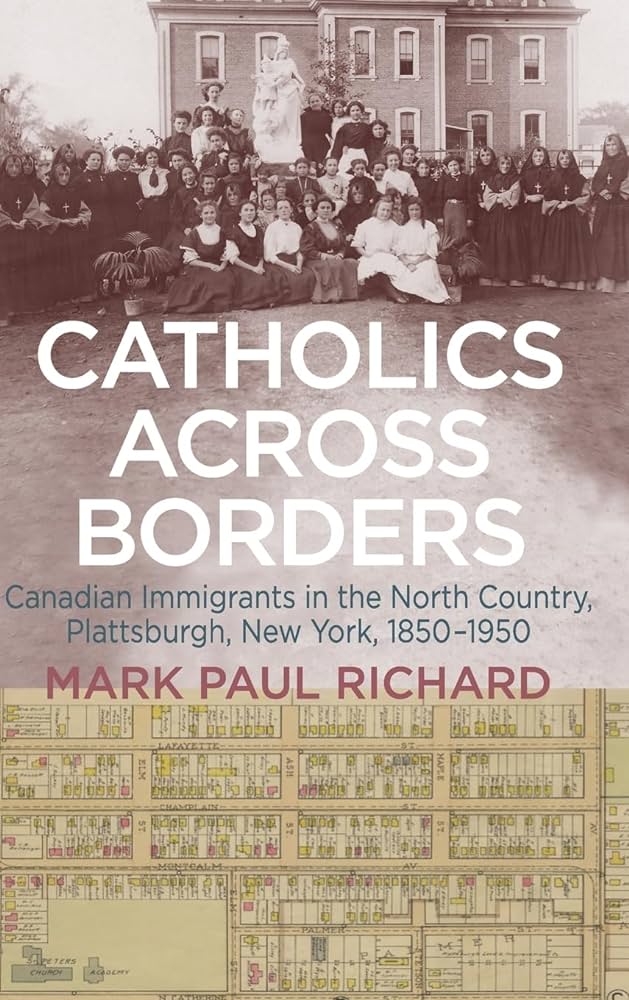
Mark Richard is Professor of History and Canadian Studies at the State University of New York at Plattsburgh. This interview is based on his new book, Catholics Across Borders: Canadian Immigrants in the North Country, Plattsburgh, New York, 1850-1950 (State University of New York Press, 2024).
JF: What led you to write Catholics Across Borders?
MR: My research focuses on French-Canadian migration to the United States and nativism directed against French-speaking immigrants in this country. My first book, Loyal but French: The Negotiation of Identity by French-Canadian Descendants in the United States (East Lansing: Michigan State University Press, 2008), used a community study to trace the process of acculturation and assimilation of French Canadians in a central Maine community. My second book, Not a Catholic Nation: The Ku Klux Klan Confronts New England in the 1920s (Amherst and Boston: University of Massachusetts Press, 2015), examined the nativist reactions of the Second Ku Klux Klan to French speakers in the six New England states during the twenties. Because few scholarly works (including my own monographs) have looked at French-Canadian migrations to New York State or to the borderlands region, I decided to investigate local sources in upstate New York where I live and work to see what we might learn about the French-Canadian experience outside of New England. As I dug into the sources and followed the leads, I uncovered so much information that it became clear there was a larger story to tell.
JF: In 2 sentences, what is the argument of Catholics Across Borders?
MR: Catholics Across Borders, a community study of Plattsburgh in the northern borderlands of New York, examines the evolution of a French-speaking population over a century of historical time, offering some fascinating contrasts with the more studied francophone textile mill centers of New England. Unlike them, it argues that interethnic cooperation rather than conflict served as the prevalent pattern of social interaction from the mid-nineteenth to the mid-twentieth century.
JF: Why do we need to read Catholics Across Borders?
MR: This community study demonstrates how international events between Canada and the United States played out at the local level, particularly those events that had bearing on French Catholic identity. It draws upon French-language newspapers and Catholic archives, major and untapped sources of information about immigrant populations. Many of the women and men religious who founded and managed Catholic institutions in Plattsburgh were transnational migrants from Canada and France. Transnational Catholic migrants helped shape local, regional, national, and even international history by their activities in Plattsburgh and beyond, forming part of the larger narrative of the U.S. immigrant experience. This study thus provides a historic perspective to aid in our understanding of the present.
JF: Why and when did you become an American historian?
MR: I had not planned to become a historian. My undergraduate degree was in Government and Legal Studies, and I spent the first decade of my career teaching social studies to students with specific learning disabilities at residential schools in Massachusetts and Vermont. To round out my background in social studies, I pursued my Master of Arts degree in History at the University of Maine. Under the mentorship of the late C. Stewart Doty, I became fascinated by the history and culture of North America’s French speakers. Although I initially resisted the urging of my professors to go on for a doctorate, I decided to attend Duke University to earn my Ph.D.in Canadian and U.S. History. I have so enjoyed the archival work I have been doing in sources largely untapped by scholars, and the finds I made that differed from other narratives, that I became a historian of a large, understudied U.S. immigrant group.
JF: What is your next project?
MR: I have been exploring the work of Wilfrid Beaulieu, a U.S.-born, Québec-educated journalist who founded the newspaper, Le Travailleur, in Worcester, Massachusetts, in 1931. Beaulieu went on to publish the French-language newspaper for nearly five decades, making it one of the most influential Franco-American periodicals. When it ceased publication in 1978, Le Travailleur was the last remaining Franco-American weekly newspaper in the United States.
JF: Thanks, Mark!