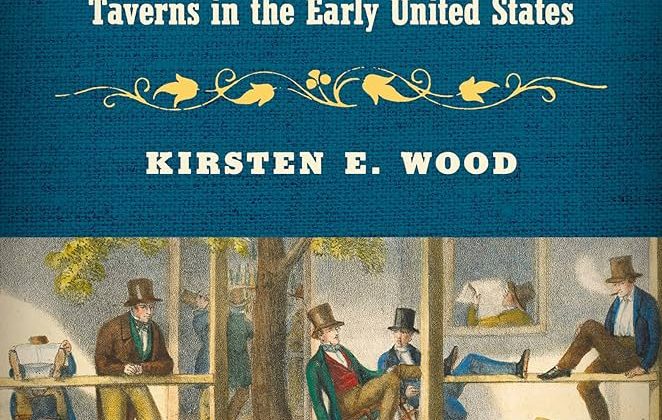

Kirsten Wood is Associate Professor of History at Florida International University. This interview is based on her new book, Accommodating the Republic: Taverns in the Early United States (University of North Carolina Press, 2023).
JF: What led you to write Accommodating the Republic?
KW: As someone who began her career as a women’s historian, my path to writing a book about taverns was winding. My first article, “‘One Woman so Dangerous to Public Morals’: Gender and Power in the Eaton Affair,” explored a political scandal that originated in the objections of Cabinet officials and their wives to the social elevation of a woman who, among other problems, was a tavern keeper’s daughter. While I did not explore the tavern angle in that article—and did not include Peggy Eaton in Accommodating the Republic—I remained curious about the role of taverns in the politics of the early republic. Meanwhile, in my first book, Masterful Women: Slaveholding Widows from the American Revolution through the Civil War, I became deeply invested in how place mattered in articulating political, economic, and social power. The richest widows could oversee many of their familial, agricultural, financial, and sometimes even legal affairs without leaving the big house, sometimes even from their bedrooms. Working from their own plantation homes offset much of the gendered disadvantage of being women in a society that did not automatically endorse their right to govern themselves and their property, whether human or otherwise. As I finished that book, I began again to wonder about taverns, a widespread institution throughout the early republic. Taverns provided temporary lodgings for travelers and long-term homes for keepers and their families: in these settings, could female travelers leverage domestic authority in conflicts with other travelers or their hosts? Did taverns’ legal, political, and public character make it impossible to treat the public house as a home? Such questions ultimately led me to argue that taverns witnessed the ongoing, everyday contestation of what it meant to be a citizen because they were a theatre for significant economic and political developments in the early republic.
JF: In 2 sentences, what is the argument of Accommodating the Republic?
KW: Accommodating the Republic argues that American taverns helped people, most of them adult white men, exercise the privileges and responsibilities associated formally and informally with citizenship by helping them acquire and dispose of property, make a living, travel in pursuit of that living, and discharge their public responsibilities as jurors, voters, taxpayers, militiamen, patriots, and, eventually, partisan or civic-minded associators. However, not everyone who worked in, visited, or relied on taverns was a white man or interpreted the citizen’s privileges in the same ways. When Americans contested what taverns should look like, what keepers should or should not sell (and to whom), and how any person or group should behave in taverns, as they did repeatedly throughout the early republic, they were at once contesting access to a valuable material resource—taverns themselves—and debating the boundaries of citizenship.
JF: Why do we need to read Accommodating the Republic?
KW: Some people may pick up Accommodating the Republic because they think they know what it will be about: boisterous tavern companies, rowdy fellowship, patriotic songs, and unfamiliar drinks such as flip, sangaree, and milk punch. I hope readers will pick up and finish the book because of what may be surprising: the existence of temperance taverns, the presence of anti-slavery activists, the improving and even feminizing trend not just in big-city establishments but in small-town and village taverns as well.
Why should people read this book? Historians of the early republic need to understand this significant yet strangely understudied institution that proliferated at the many literal crossroads of the early republic. It has been possible to take taverns for granted as the setting for many events (especially in the political and economic domain) without asking how specific taverns shaped these events or sufficiently appreciating how public accommodations contributed to underlying political and economic trends.
More broadly, anyone who wants to gain perspective on the interconnectedness of our freedoms to this very day would do well to read this book. In the twenty-first century United States, mobility, economic opportunity, and political rights remain intertwined and tied to citizenship in ways that far exceed the scope of this book: the challenges within and across these domains have become transnational in ways I do not examine. At the same time, Americans wrote a foundational chapter of this history in the early republic, as they lived, worked, transacted in, passed through, legislated for, complained about, and improved taverns. And while the overwhelming majority of the keepers, drinkers, and voters—and all of the legislators—were white men, this chapter of the nation’s history had many authors, for what taverns became between the 1780s and 1850s stemmed from the competing aspirations found not only among white men, but also among white women, Black men and women, and even, albeit more rarely, Indigenous people, all of whom might be present voluntarily or under varying degrees of constraint.
JF: Why and when did you become an American historian?
KW: I became a historian because of my experience with my senior thesis in college. At Princeton, everyone had to write a thesis, and as a history major, I fell in love with research and the challenge of pulling my research together into a story. I got the germ of my topic from my then-professor, Sean Wilentz, who mentioned in class one day that we needed a new understanding of the Peggy Eaton scandal. I was intrigued and—with the confidence of a twenty-year-old—certain that I could provide it. Falling in love with research and historical writing answered the pressing question of my senior year: law school or graduate school.
I became an American historian because I never seriously considered anything else. Like many history majors and doctoral students, I studied the history of many places and sometimes fantasized about concentrating on far-away places that would be fun to visit for research. Since I spoke and read French reasonably well then, I have wondered why I picked a specialization that takes me to Chapel Hill and Philadelphia instead of, say, Paris and Aix en Provence. Or, if I had to be a U.S. historian, why didn’t I capitalize on my Norwegian roots, build up my rudimentary command of the language, and specialize in immigration? Yet, I think the die was cast before I formulated the question. As an early reader, I had devoured many stories set in eighteenth or nineteenth-century Anglo-America. As a young adult, I learned from the bicentennial celebrations, Supreme Court originalism, and partisan politics that what people think about the early United States can profoundly influence our lives in the present. Although the same may be said about many other periods of history, the first generations of people who lived under the U.S. Constitution captured my imagination.
JF: What is your next project?
KW: I am working on a couple of projects concurrently. For starters, it turns out that I’m not entirely done with taverns. I’m taking a deeper look at how taverns helped New England’s itinerant and entrepreneurial types move themselves, information, goods, and services into and around the hinterland. I anticipate this work will entail learning how mapping software might illuminate the movements of dentists, genteel instructors, and patent holders, among others. I also want to use a particular eastern Massachusetts tavern keeper as the entering wedge into keepers’ politics. This keeper hosted anti-slavery gatherings at one point, later got in legal trouble for violating the state’s anti-liquor laws, and still later got involved in anti-temperance activism. This line of inquiry may eventually lead me beyond the northern states. While researching Accommodating the Republic, I found newspaper evidence suggesting that at least one anti-slavery society met occasionally in a Kentucky village tavern. I’m curious to know why and how often taverns and anti-slavery overlapped in the early nineteenth-century South. Thanks to other scholars, including, for example, Joshua Rothman, we already know that southern taverns did much to support slavery and the slave trade. I tell some stories about enslaved and free people putting taverns to liberatory use in my book, and I would like to find out if there are more and different stories yet to tell.
JF: Thanks, Kirsten!