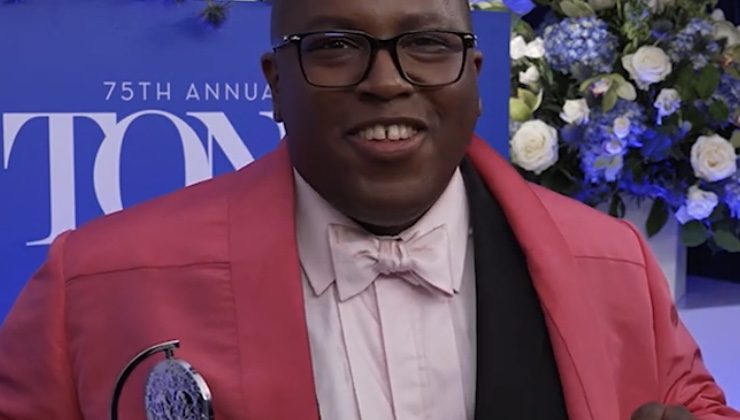

I just finished reading Thomas Chatterton Williams’s fascinating piece at The Atlantic on Pulitzer Prize-winning playwright Michael R. Jackson.
Here is a taste:
In the summer of 2020, the playwright Michael R. Jackson received an unusual message from a fan of A Strange Loop, his musical about a gay Black man’s path to creative self-awareness through the process of writing a musical about a gay Black man’s path to creative self-awareness. “Can I buy you a bulletproof vest?” the fan inquired over Instagram.
Jackson, who had just won a Pulitzer Prize for A Strange Loop and lived on a perfectly safe street in Upper Manhattan, had no more conceivable use for body armor or handouts than the next man. He told me about the proposal several months ago, over steak frites at Soho House, stressing its absurdity and presumptuousness. “Ur life matters so much. Ur writing matters so much. This is the most available and direct way I can think of protecting ur life and ur future plays,” the fan had explained.
In person, Jackson at first seems unassuming and even shy. He does not reflexively generate small talk. But he responds candidly and at length when asked a question about almost anything, and he is wickedly funny. In Jackson’s diagnosis, the fan in question was haplessly inspired by the racial reckoning then gripping the nation; he felt compelled to “show up” in the name of white allyship and anti-racism. Jackson compromised with his would-be savior: For the benefit of the latter’s conscience, he’d accept the vest’s cash value of $400. The man promptly sent this sum to Jackson via Venmo.
This bizarre exchange was emblematic of an entire constellation of assumptions, biases, and misunderstandings that has proliferated in recent years and altered the way Jackson thinks of himself, his work, and American society more broadly. “Once the pandemic and the protest began, I suddenly was like, Oh God. This is a test of all of our characters. This is the existential thing that none of us have actually lived through before,” he told me. He thinks the American elite failed that test, revealing the enormity of its disconnection from the real world.
Jackson can get animated when discussing the summer of 2020 and the way some artists, journalists, academics, and businesspeople exploited the killing of George Floyd to advance their career. “They’re like, ‘Oh, in the world where George Floyd is dead, we need to talk about our theater careers’—or academia, or whatever … It’s like, how can y’all just so casually use this man’s corpse to promote your bougie-ass class bullshit? It’s disgusting.” He found media coverage of this phenomenon to be particularly oblivious. “The New York Times theater section will say”—here he adopted a mock reporter’s voice—“ ‘Things changed after George Floyd was killed, and this artistic director was appointed to blah blah blah.’ ”
Jackson believes that social media, a gathering threat for many years, tore open our collective reality in 2020; it created “an alternate universe” in which identity-based suffering—or merely the claim to such, however implausible or vicarious—could be converted into social capital. “In the theater world in particular,” he said, “things got instantaneously even more dramatic because suddenly you had all these artists out of work. And all they had is the internet to do the most Shakespearean of performances about George Floyd and everything else. The number of people in the theater world who used George Floyd’s dead body to pivot to inequity in the theater world is the most hair-raising thing I’ve ever seen in my life.”
Many Black artists and thinkers, he said, live in this alternate universe: “They have made a home online where they can spread all of their influence and their clubbiness and cliquey-ness.” Here, the delusion that the lives of Black artists are urgently endangered can take on the false weight of conventional wisdom—and inspire a blessedly naive white man to believe that a Broadway writer is somehow in dire need of a bulletproof vest.
Jackson has long been preoccupied by questions of race and sexuality. He knows that he benefits from the interest generated by two of his identities, Black and gay. He also believes that the superficiality of that interest—the oversimplification of complex, ambiguous human reality—can create a stifling intellectual trap. The playwright Jeremy O. Harris told The New York Times in March that “theater is an act of community service.” But Jackson is wary of any social-justice consensus, which he believes encourages everyone “to look at art as a weapon to be used to get one’s way.”
Read the rest here.