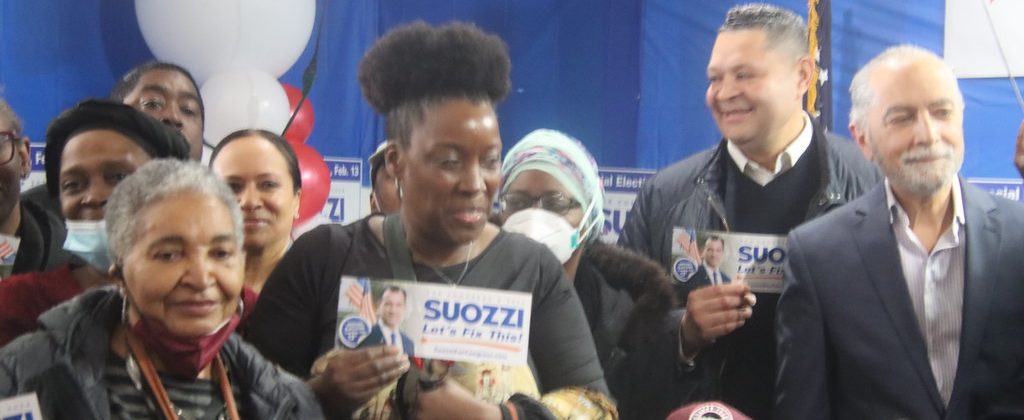

Yesterday I posted a piece on Tom Suozzi’s victory in the New York 3 special election to replace George Santos. During the campaign, Suozzi praised the recent Senate bipartisan border bill, calling it “the toughest and fairest set of reforms to secure the border that we’ve had in decades.” His GOP opponent, Mazi Philip, opposed the bill, calling it a “non-starter because it simply puts into law the invasion currently happening at our southern border.”
Today at The New York Times, David Leonhardt (check out Jim Cullen’s review of his new book on the American dream today at Current) connects Suozzi’s tough rhetoric on immigration to Robert F. Kennedy’s 1968 campaign.
Here is a taste:
Suozzi’s campaign offered an early glimpse of messages that Democrats plan to use against Donald Trump. And in those messages is a larger theme. It’s a theme with a rich history, including in Robert F. Kennedy’s 1968 presidential campaign. In today’s newsletter, I’ll explain.
A common lament from Democrats is: Why do so many Americans vote against their economic interests?
It’s an understandable question in many ways. Even though the Republican Party favors tax cuts for the rich and cuts in government programs that benefit most Americans, Republican candidates now win most working-class voters (defined as people without a bachelor’s degree).
But the question also exposes a lack of self-awareness on the political left. After all, many liberals vote against their economic interests, too. The country’s wealthiest suburbs, as well as vacation spots like the Hamptons, generally vote Democratic despite the party’s belief in taxing the rich.
These patterns are a reminder that Americans, across ideological groups, care about more than just economic policy — and voting on these other beliefs is not irrational. Climate change, for instance, matters enormously. So do abortion, guns, crime, education, immigration and foreign policy.
Robert Kennedy understood this reality better than many other Democrats.
Today, Kennedy is remembered as a progressive hero. No wonder: His economic policy was so populist that C.E.O.s disliked him more than any presidential candidate since F.D.R., as Fortune magazine wrote during the 1968 campaign. Kennedy also emphasized civil rights even when speaking to white audiences. A poll found him to be the most popular white politician among Black Americans.
But Kennedy believed that it was madness to tell voters to ignore social issues and focus only on economic ones. His main rival during the 1968 primaries, Eugene McCarthy, tried to do exactly this on the biggest social issue at the time. In the 1960s, crime was rising sharply, yet McCarthy avoided the topic. He refused to use the phrase “law and order,” because he considered it a racist dog whistle.
Kennedy took the opposite approach. He ran as the law-and-order Democrat, knowing that both Black and white voters worried about crime. He described himself as having been “the chief law enforcement officer of the United States” (as attorney general), and an aide joked that he sometimes seemed to be running for sheriff. If Democrats wouldn’t talk about crime, Kennedy believed, crime-wary voters would abandon them for Richard Nixon, the Republican nominee in 1968, or George Wallace, the segregationist running as an independent.
“We’re going to talk about what people will listen to,” Kennedy explained. “You have to get them listening by talking about what they’re interested in, before you can start trying to persuade them about other matters.”
Other liberals were aghast. The New Republic and The Village Voice criticized him. A New York Times headline announced, “Kennedy: Meet the Conservative.” (You can read that Times story in our archives, and I tell the story of the 1968 campaign in my recent book.)
Kennedy, however, recognized something vital. Working-class Americans tend to be more socially moderate than the affluent, highly educated Democrats who shape the party’s strategy.
It’s impossible to know what would have happened if Kennedy had not been assassinated in June 1968. He might not have won the presidency. But he was beating McCarthy in the primaries.
As I watched Suozzi’s campaign, I was struck by its Kennedy-esque approach — with immigration playing the role that crime did in 1968.
Read the entire piece here.