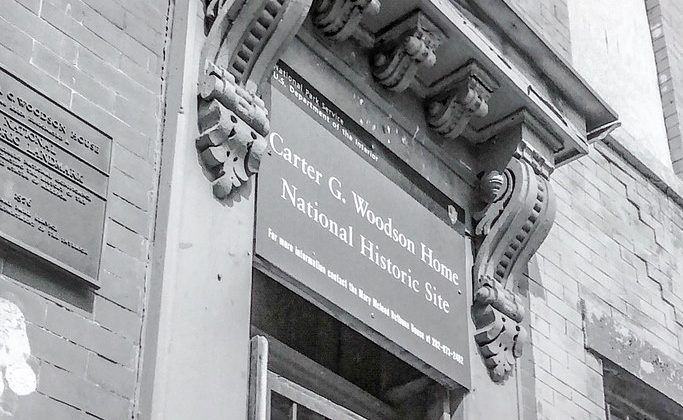

Over at The New York Times, Anna Kodé takes a deep dive into where Carter G. Woodson did his work. Readers who are interested in the workspaces of authors and intellectuals will find this piece absolutely fascinating.
Here is a taste:
The origins of Black History Month can be traced back nearly a hundred years to an unassuming, three-story brick rowhouse in Washington.
In 1922, Carter G. Woodson, known as “the father of Black history,” bought the home at 1538 Ninth Street for $8,000. The home served as the headquarters for the Association for the Study of Negro Life and History (which is now known as the Association for the Study of African American Life and History, or A.S.A.L.H.). It was where he ran the Associated Publishers, the publishing house focused on African American culture and history at a time when many other publishers wouldn’t accept works on the topic. It’s where The Journal of Negro History and The Negro History Bulletin were based, and it’s where he initiated the first Negro History Week — the precursor to Black History Month — in 1926.
“If a race has no history, if it has no worthwhile tradition, it becomes a negligible factor in the thought of the world, and it stands in danger of being exterminated,” Dr. Woodson famously wrote.
The site, owned by the National Park Service, is being restored and will likely be open to visitors starting this fall, a spokesperson for the Park Service said.
Though Dr. Woodson was the kind of neighbor who doted on children playing on the street and his stoop, even as other adults told them to behave, 1538 Ninth Street was more about his life’s work than serving as a traditional residence. It became known as Dr. Woodson’s “office home,” as Willie Leanna Miles, who was a managing director of the Associated Publishers, put it in her 1991 article “Dr. Carter Godwin Woodson as I Recall Him, 1943-1950.” The article was published in The Journal of Negro History, which was founded by Dr. Woodson and is still running as The Journal of African American History today.
Over the years, the office home became an important nexus point for the Black history movement, and stepping through its doors was a rite of passage for many Black scholars, writers and activists to seek Dr. Woodson’s mentorship, work there or at least pass through. Mary McLeod Bethune, Lorenzo J. Greene, Lawrence Dunbar Reddick, John Hope Franklin, Langston Hughes and many more all spent time in the home. Even after Dr. Woodson died in his bedroom on the third floor in 1950, A.S.A.L.H. remained based there until 1971.
In 1976, the same year that Negro History Week officially grew into Black History Month, the office home was designated as a National Historic Landmark. As the years went on, it fell into disrepair. In 2005, the National Park Service purchased it along with two neighboring houses for $1.3 million, and is now working on restoring the building and creating a welcome center.
Read the rest here.