
What should we call the decades of American history between 1800 and 1860? Edward Ayers proposes “The Era of the New Nation.” He and his wife Abby have been traveling the country exploring the way we commemorate these decades. He is describing his travels as the “American Journey.”
Here is a taste of his latest installment:
The decades of American history between 1800 and 1860 have no suitable name. Those years are often imagined, vaguely, as the era of “expansion” or, using even emptier language, as the “antebellum” era — a mere prequel. The absence of a coherent narrative for such a long and momentous period is striking because it was in those decades that the United States grew to its present boundaries, developed its two-party political system, and created its first distinctive literature, art, and music.
The most fitting name that I’ve come up with for this period is the Era of the New Nation. That phrase reminds us of all that was at stake, all to be determined, all that would forever shape the history that followed. The Constitution was a set of instructions for a nation to come; the first three generations of the 19th century saw those plans grow into a nation, even as the path forged then diverged from the founders’ highest hopes and expectations. As it expanded, the emerging United States unleashed a system of racial slavery across an expanse larger than the combined territories of the major countries of Europe. State and federal governments seized millions of acres from Indigenous peoples through fraud and violence, and millions more from the Republic of Mexico in an unprovoked war.
The moral failures of dispossession, enslavement, and war triggered deep critique and resistance even while they unfolded. Many Americans demanded that the nation live up to its founding principles, so recently enshrined, of equality, freedom, and justice. Those American voices did not prevail then, but their powerful words now stand as the embodiment of the nation’s ideals. In the 20th century, Frederick Douglass, Harriet Tubman, Henry David Thoreau, and other critics of the United States won veneration as brave heroes.
At the same time, heroes of previous generations have faded. Political leaders who oversaw the enslavement millions, drove the dispossessed from their homes, and provoked war have been diminished and denounced. Andrew Jackson, once the symbol of American democracy, is now disparaged by members of his own party as the embodiment of racist expansion. Presidents such as James K. Polk and John Tyler, who led the United States through the nation’s decades of greatest expansion, barely register in the national memory. Heroes of expansion such as Daniel Boone and Davy Crockett (“King of the Wild Frontier”), so familiar in the popular television, film, and song of the Cold War era, have faded. Bland processes — expansion, revivals, reform, and transportation and communication revolutions — seem to unfold naturally and inevitably in the nation’s textbooks.
There is no museum devoted to this era, no grand institutions that illuminate the era as the Museum of the American Revolution, the National Constitution Center, and the American Civil War Museum illuminate theirs. There is no one place where Americans can see how the pieces fit together, how the new nation made itself in struggles over the highest ideals of democracy and the degrading realities of slavery and dispossession. The Smithsonian’s brilliant and successful museums dedicated to African American history and American Indians dramatize essential elements of the era, but their stories do not conjoin. The National Museum of American History and the Smithsonian American Art Museum offer powerful exhibits about the technology, politics, war, and art of the New Nation, but there is no central place where visitors can learn about the era’s turbulent religious history or remarkable literary accomplishments, no place to hear its music or to sample its popular culture.
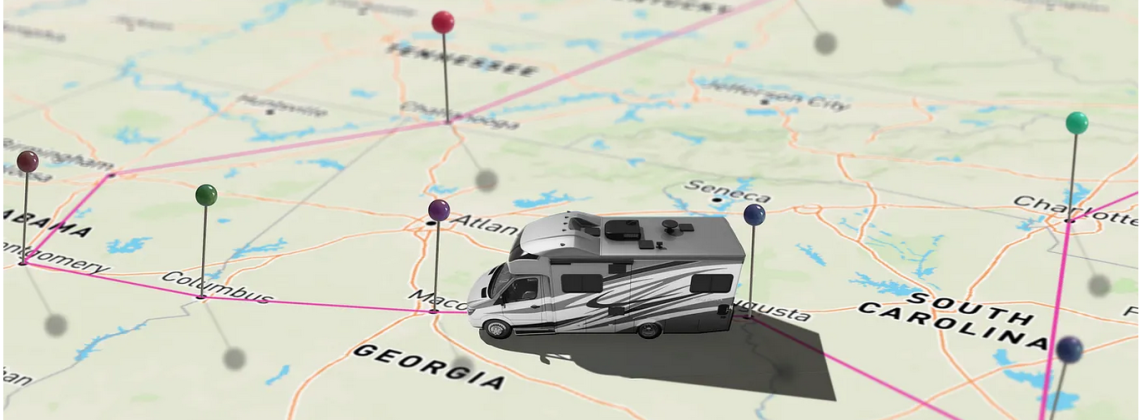
The pieces of the history of the United States in this critical era lie scattered across the continent in dozens of historic sites, museums, parks, and memorials. To see those pieces, and how the stories they tell have twisted and turned over the past two centuries, my wife Abby and I set off a couple of years ago on a series of trips from the Atlantic to the Rockies, from the Great Lakes to the Gulf of Mexico. Over six journeys in 2022 and 2023, we visited 60 places in 24 states. We drove about 15 thousand miles overall, most of it in a camper we called “Bertha.”
Read the rest here.