
Over the Christmas holiday, GOP presidential candidate and former South Carolina governor Nikki Haley got in hot water for this:
Over at The Guardian, Steve Phillips asks why we are still debating the cause of the Civil War. A taste:
This year’s election is, in fact, a continuation of the unresolved question of the civil war era: will the country continue to move towards fostering a multiracial democracy, or will it aggressively reject its growing diversity and attempt to make America white again?
Haley’s entire career has consisted of trying to walk the tightest of tightropes. She is a woman of color operating in a political party whose driving forces are white racial resentment and misogyny (and, increasingly, homophobia and transphobia). On the one hand, she is eagerly embraced as a high-profile party symbol who serves as a strong rebuttal to accusations of racism and sexism (“See, we’re not racist and sexist, we have a woman of color as our governor!”). On the other hand, white racial resentment serves as fuel for the Trump movement to the extent that no presidential candidate can hope to win the nomination without bending a knee to the Confederate cause.
This high-wire act was most prominently on display in 2015, when a white man who had proudly posed with pictures of the Confederate flag walked into the Emanuel African Methodist Episcopal church in South Carolina, declared, “You rape our women. And you’re taking over our country. And you have to go,” and proceeded to murder nine Black people. That tragedy was too much even for most defenders of the Confederate flag, and Haley and the state’s political leadership begrudgingly capitulated to years-long demands to stop flying that flag over statehouse grounds.
The current conundrum is important not just because of Haley, who is emerging as Trump’s strongest competitor in the Republican field, but because of what it reveals about politics in this country in general and in the Republican party in particular.
Boiled down to its essence, much of the country – and most of the Republican voters – are still fighting the cause of the civil war in ways both literal and figurative. The active and organized resistance to removing Confederate statues led a mob of white nationalists to march through the streets of Charlottesville, Virginia, in 2017 chanting “Jews will not replace us”; one Hitler-loving member of the crowd gunned his car into a group of counterprotesters, killing a woman, Heather Heyer, who had come to stand for racial tolerance and peace. That was the protest of which then president Trump observed: “There are good people on both sides.”
Read the rest here.
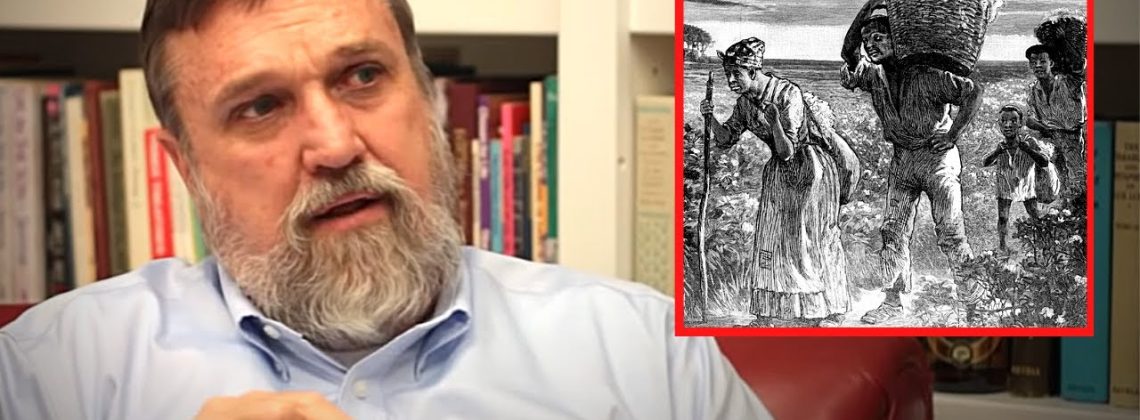
One of Nikki Haley’s defenders is Doug Wilson, the controversial pastor from Moscow, Idaho and the author of Southern Slavery, As It Was. In a reaction to a Stephen Colbert monologue on Haley, Wilson questions the view, dominant among American historians, that the Civil War was about slavery. Watch:
Nikki Haley made a mistake and tried to backtrack. Wilson, on the other hand, has built a lot of his cultural criticism on this view of American history.
So what caused the Civil War? I took a stab at this question a couple years ago:
The Confederacy did want states rights, specifically the right to uphold the institution of slavery.
In the above video I reference the work of my friend Scott Hancock. You can watch the video of Hancock at Gettysburg here.
I watched Wilson’s video today, Martin Luther King Jr. Day. I also read Gene Collier’s MLK Day reflection at The Pittsburgh Post-Gazette. Here is a taste:
...Not even the visionary King, classically educated and theologically inspired, could have imagined the cacophonous course of 21st century history, but one pretty prominent American near this end of the through line tried to lend it some clarity.
“If anyone had a right to question whether our democracy was worth redeeming, it was Dr. Martin Luther King Jr.,” he wrote. “Because in the face of billy clubs and lynchings, poll taxes and literacy tests, he never gave in to violence, never waved a traitorous flag or gave up on our country.”
That was Barack Obama, the living presidential perimeter of the through line, writing three weeks after rioters trashed the U.S. Capitol in support of his successor, some waving Confederate flags on Jan. 6, 2021. As straight as it can be drawn, then, there it is: Without King, and all that he enabled and ultimately gave his life for, there is no President Obama; without President Obama, and all that America’s first Black man in the White House signifies, there is no MAGA movement, no Trump-stoked blowback of conservative grievance, no Jan. 6, no up-to-the-minute insanity.
Stand at the right place in Washington, D.C., you can see the spot where King’s most famous words made a million hearts soar one August day in 1963, then turn and see the portion of Presidents Park known as The Ellipse, the spot where Donald Trump urged a mob to go the Capitol and fight like hell to flip an American election he lost four years ago.
King’s words that day and every day flowed eloquently from a foundational belief in non-violent reform, based largely on the teachings of Gandhi. What he inspired too often fractured in a decade of near unthinkable violence. President Kennedy was murdered not three months later, as were, subsequently, Malcolm X, Bobby Kennedy and King himself. Unlike the others, King was fairly certain of a bullet.
“We’ve got some difficult days ahead,” he told a crowd in Memphis the night before he died. “But it really doesn’t matter with me now, because I’ve been to the mountaintop . . . I’ve seen the Promised Land. I may not get there with you. Like anybody, I would like to live a long life – longevity has its place. But I’m not concerned about that now. I just want to do God’s will. . . And so I’m happy tonight. I’m not worried about anything. I’m not fearing any man. Mine eyes have seen the glory of the coming of the Lord.”
His legacy had taken root in countless souls in countless ways, many of them apolitical or not then attuned to the social narrative.
In Pittsburgh, a 20-year-old August Wilson, self-described in Patti Hartigan’s rich biography, “bedded down each night with my immortal self, the guns of social history and responsibility that went boom in the night and called the warriors to their stations went largely ignored.”
The legendary playwright of the Black experience, in Ms. Hartigan’s phrase, “was focused on becoming a poet, not a revolutionary.” But the waves of violence in this city after Dr. King’s assassination would inform Wilson’s full portfolio of landmark American theater, beginning with the launch in 1968 of Black Horizons Theater, soon after the Pittsburgh riots.
Though Wilson has a spot on the through line in a way that was perhaps unforeseen, the King legacy retains an immeasurable social, cultural and political impact at full momentum. Only last week, the young legislator Don Scott, once in a federal lockup, took the gavel as the first Black speaker of the Virginia House of Delegates.
“My first immediate emotion is just gratitude,” said the 26-year-old, wiping tears. “I know this is God’s favor. The historic nature of my speakership is not lost on me. Think of all the people who never got their rights heard by people right here in this chamber. Thank God the Commonwealth has turned the page. Thank God.”
One photo from that moment Wednesday showed something once virtually unimaginable in Richmond, the former capital of the Confederacy: a lieutenant governor, Senate president, and House speaker, all Black.
While thousands of African American thought leaders have joined the diversifying halls of American power, beginning with those from King’s inner circle in the late 1960s, the legacy through line still darts into the shadows.
In too many instances, it seems gone, still and forever gone. We just passed the one-year anniversary of the sentencing in Georgia – life in prison — of three white men who pursued 25-year-old Ahmaud Arbery, a Black man running in their neighborhood, and shot him dead. Only last month, a 26-year-old woman was detained in Atlanta after trying to set King’s boyhood home on fire.
When those kinds of events are fresh, it’s not hard to understand why Martin Luther King Jr. Day took 15 years to establish even though it was proposed in the weeks after his death, or that it took another 17 years to get put on the books of all 50 states.
Read the entire piece here.
A great illustration of why you don’t want to get your information about a topic from someone who–however intelligent they may be–is operating outside their lane. Wilson makes a nod in the direction of compensated emancipation as an alternative to the war. He appears to have no awareness this was suggested more than a dozen times (the last in 1862 when it was clear the institution’s days were numbered anyway) and it was rejected every time.
This article is nearly 50 years old now, but is still a fantastic read:
Betty L. Fladeland, “Compensated Emancipation: A Rejected Alternative,” The Journal of Southern History Vol. 42, No. 2 (May, 1976), pp. 169-186