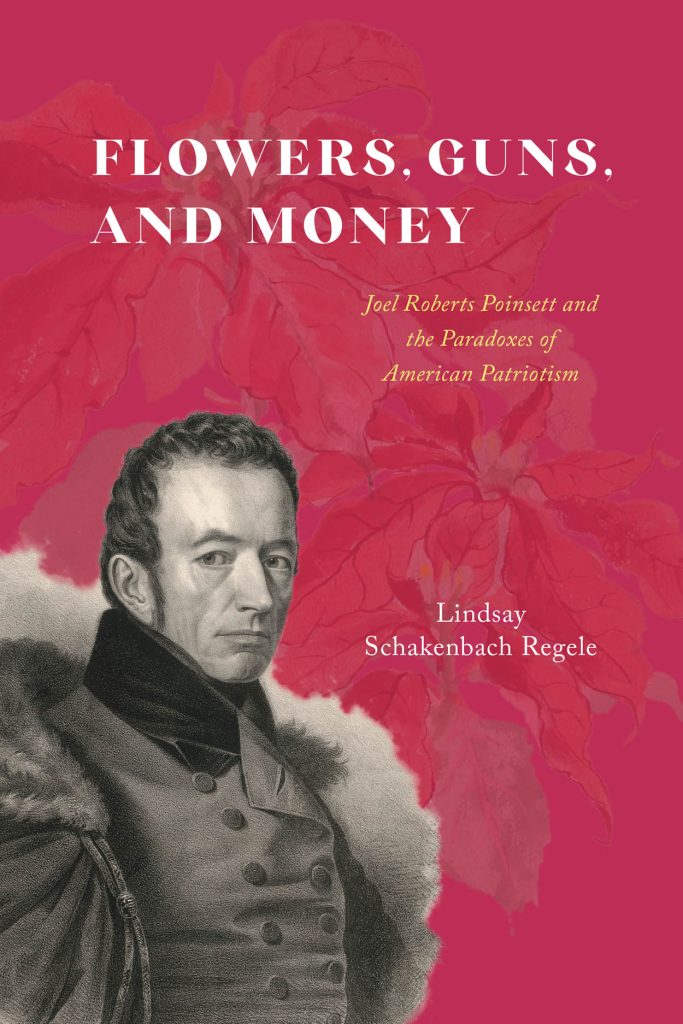
Lindsay Schakenbach Regele is Graduate Studies Director and Associate Professor of History at Miami University. This interview is based on her new book, Flowers, Guns, and Money: Joel Roberts Poinsett and the Paradoxes of American Patriotism (University of Chicago Press, 2023).
JF: What led you to write Flowers, Guns, and Money?
LSR: I became interested in Poinsett by accident, partly because I kept coming across his name while I was researching my first book Manufacturing Advantage: War, the State, and the Origins of American Industry. When I was on a postdoctoral fellowship at the Library Company for Manufacturing Advantage, another researcher suggested I go next door to the Historical Society of Pennsylvania to check out the papers of a few war department officials, Poinsett being one of them. There, I found a large collection of his personal papers, spanning five decades of his life, and realized I had already seen him while researching state department records from the 1810s and 1820s, when he was a secret diplomatic agent in South America and ambassador to Mexico. I became fascinated, and not because he was the namesake for the poinsettia. Without ever having been involved personally with manufacturing, Poinsett made appearances as the writer, recipient, or subject of countless documents that I consulted, because his career coincided with major changes in American economic, political, and military life.
Poinsett played a role in major events of the early nineteenth century, including Latin American Independence Wars, the nullification crisis, the Seminole War and the Trail of Tears, and the founding of the Smithsonian Institute. In his own time, Poinsett was known by foreign dignitaries and philosophers, US presidents, and average soldiers and newspaper readers, and yet today if anyone knows his name, it’s because of the poinsettia. When I realized that the last biographies of him were published more than fifty years ago, I decided that he needed a new book.
JF: In 2 sentences, what is the argument of Flowers, Guns, and Money?
LSR: Poinsett’s experience navigating the postcolonial transition to imperial nationhood at the state, national, and international levels exemplified the emergence of self-interested patriotism among U.S. officials following the American Revolution. Statesmen served the nation by serving themselves, which meant promoting economic prosperity and military security in ways that suited their own ambitions and financial interests.
JF: Why do we need to read Flowers, Guns, and Money?
LSR: Because you’ll learn interesting things like the fact that President Andrew Jackson secretly sent weapons in camouflaged boxes to Poinsett to use against the nullifiers during the nullification crisis in the early 1830s. Unlike many South Carolina elites, Poinsett was a unionist and served as Jackson’s point person on the ground in Charleston. He actually requested hand grenades to use against nullifiers “in a street fight.”
More generally, Poinsett’s life shows us that categories like southerner, Jacksonian democrat, and slaveholder didn’t always mean what we think they meant and often included a bigger range of more diverse beliefs and actions. His stance on a variety of issues was rooted in a political pragmatism that defied what one would expect from a typical “southerner,” “expansionist,” or “Democrat,” categories that he identified with throughout much of life. For example, he was a slave owner, who opposed states’ rights doctrine and the annexation of Texas. There were others like him, which suggests greater fluidity in political actions and ideologies than histories of US expansion, empire, and politics usually ascribe to individuals of the era.
JF: Why and when did you become an American historian?
LSR: My decision to become a historian started when I switched majors during college. I remember writing “history” on my new major form, and feeling a sense of purpose and contentment (I think partly because as a child I had loved historical fiction and my father was always reading history books and waxing poetic about various historical sites and events). At that point, though, I had no idea that I would end up teaching, writing, and researching for a living. After graduating, I spent a year working as a long-term substitute teacher and track coach, while taking secondary education classes. My plan was to pursue teaching certification, but I also wanted to continue research, so I applied for an M.A. in history. I started working on my M.A. the following fall, and fell in love with the research process. During my first semester, I wrote a seminar paper on U.S. involvement in Francisco de Miranda’s failed Venezuelan revolution in 1806 and became obsessed with researching this event as it played out in the U.S. newspapers and political rumors. I decided to turn this project into my thesis and to apply for PhD programs. I was fortunate to have wonderful professors and advisers in both college and graduate school who inspired and facilitated my transition to the historical profession.
JF: What is your next project?
LSR: My next project is actually a return to the master’s thesis on Miranda. Tentatively titled “The Miranda Affair: A Venezuelan Patriot and the United States,” it examines the roots of U.S.-Latin American commercial relations by focusing on the role of ordinary citizens and high-ranking federal officials in an attempted rebellion in the Spanish Empire in 1806. The outline of “The Miranda Affair” is as follows: In the fall of 1805, the Venezuelan creole Francisco de Miranda traveled to the United States, where he courted merchant investors and met with President Jefferson and Secretary of State James Madison about a proposed scheme to overthrow Spanish colonial power, and initiate free trade between the United States and Spain’s former colonies. That winter, Miranda and two hundred American citizens secretly set sail for Venezuela. After several disastrous encounters with Spanish coast guards, a number of American men were imprisoned and hanged, and Miranda eventually abandoned the mission. Despite the expedition’s failure, it sparked political and diplomatic controversy and led to other efforts to abolish trade restrictions in the hemisphere. Although it attracted major media attention in the nineteenth century, it has garnered minimal attention from historians in the twentieth and twenty-first centuries. My hope is that this project will fill a gap in the literature on U.S.-Latin American relations and will reveal how the United States negotiated economic exchange and military engagement overseas, at both the grassroots and governmental levels.
JF: Thanks, Lindsay!