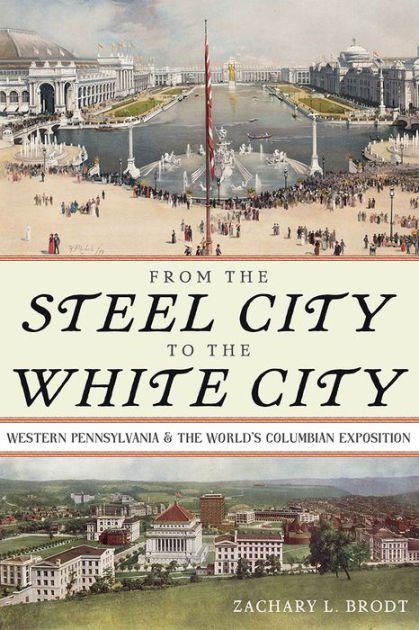
Zachary Brodt is the University Archivist and Records Manager for the University of Pittsburgh Library System. This interview is based on his new book, From the Steel City to the White City: Western Pennsylvania and the World’s Columbian Exposition (University of Pittsburgh Press, 2023).
JF: What led you to write From the Steel City to the White City?
ZB: I first learned about the Columbian Exposition when I was an undergraduate history major taking classes on Pittsburgh history and architecture. My professors described the 1893 World’s Fair as this ubiquitous force that seemed to touch just about everything that happened in Western Pennsylvania, and across the United States, at the turn of the century and it left me wanting to learn more. I was particularly interested in learning how Pittsburgh was represented at the exposition, both in the exhibits and as attendees, and how the ideas and influences of a fair in Chicago found their way to the region. At the time, I was concerned with graduating, getting through graduate school, finding a job, and starting a family, so I didn’t pursue any meaningful research on the topic for nearly a decade. Then one day at work I found a reference to a Chicago tower project in the collection guide to the Henry Clay Frick Business Papers held at our archives. Looking at the documents in the collection, I realized they described a project intended to be built at the Columbian Exposition. This discovery reignited my curiosity about the fair, and now armed with the necessary research skills, I dove into the relationship between Western Pennsylvania and the 1893 World’s Fair.
JF: In 2 sentences, what is the argument of From the Steel City to the White City?
ZB: The Columbian Exposition provided an opportunity for Western Pennsylvania to prove that Pittsburgh was more than simply America’s crucible—it was also a region of developing culture and innovation. The success of the region’s exhibits and the experiences of Pittsburghers at the exposition launched Western Pennsylvania into the twentieth century and helped reimagine the Steel City as a replica of the fair’s White City.
JF: Why do we need to read From the Steel City to the White City?
ZB: Today, just as in 1893, when people think of Pittsburgh images of blast furnaces, molten steel, and thick black smoke immediately come to mind. While those qualities are accurate, there was also much more happening in the region at the turn of the 20th century including scientific discoveries, cultural activities, and social movements. From the Steel City to the White City aims to shed light on these aspects of Western Pennsylvania through the lens of the Columbian Exposition. By exploring Pittsburgh’s evolving economy and society between the Civil War and World War I, this book explains why the region was so well represented in the fair’s displays, including George Westinghouse’s implementation of the largest use of alternating current electricity to that time and the debut of George Ferris’s Great Wheel. After the close of the exposition, its influence stretched across the country most prominently in the incorporation of the Beaux-Arts architectural style utilized in the fair’s Court of Honor buildings, but also in the experiences of fairgoers who encountered new products, people, and ideas in Chicago. Using Pittsburgh as an example, this book sheds light on how cities across the country incorporated elements of the world’s fair in urban planning projects, social movements, and the development of cultural institutions that pulled the nation out of the Gilded Age and into the Progressive Era.
JF: Why and when did you become an American historian?
ZB: I’ve always had an interest in history and dual majored in history and classics as an undergraduate. At the beginning of my senior year, I took a job at the university’s archives making a lot of photocopies for researchers but also organizing and describing collections about Pittsburgh and labor history. It was a revelation! Up to that point American history had been presented to me as wars and presidents, and so working with records of regular people doing extraordinary things opened a whole new world to me. As an archivist I now practice American history daily and work to educate myself on American history topics and participate in focused research projects like this book.
JF: What is your next project?
ZB: I am currently researching the life of Mary Croghan Schenley, a Pittsburgh heiress who as an infant inherited vast tracts of land around the city. When she was fifteen years old attending school in New Brighton, New York, she fell in love with a British government official, Edward Harrington Wyndham Schenley and they eloped in 1842. Two decades before the traditionally recognized beginning of the trend of titled Englishmen marrying wealthy American women, the Schenleys attempted to infiltrate English society while being supported by the money earned through Mary’s Pittsburgh land holdings. After the death of her husband, Mary took control of her inheritance and began to craft a legacy of philanthropy that endeared her to the people of Western Pennsylvania even to this day. Her role as an absentee landlord and subsequent gifts and land sales shaped urban development throughout much of Pittsburgh’s history, but her status as a woman with limited legal rights meant that she only gained control of her property once she was widowed. My studies hope to shed light into Mary’s experiences and her role in the development of Pittsburgh, as well as dispel popular misconceptions about her life and marriage.
JF: Thanks, Zachary!