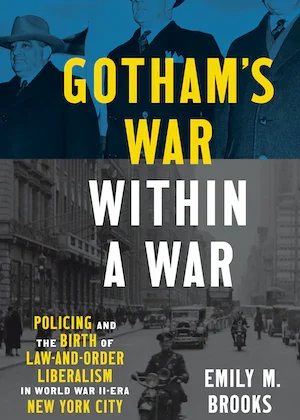
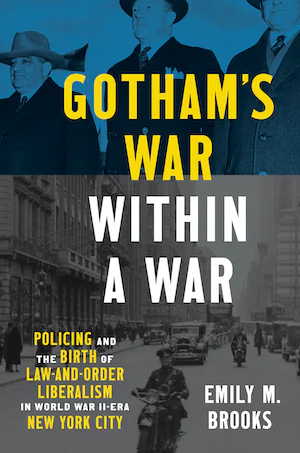
Emily Brooks is a Historian and Curriculum Writer at the New York Public Library’s Center for Educators and Schools. This interview is based on her new book, Gotham’s War within a War: Policing and the Birth of Law-and-Order Liberalism in World War II–Era New York City (University of North Carolina Press, 2023).
JF: What led you to write Gotham’s War within a War?
EB: I started writing Gotham’s War within a War because I was following a story and I wanted to know what happened next. I was interested in policing and criminalization, and I was reading wonderful histories on these themes in the late nineteenth and early twentieth centuries, but they all ended in the early 1930s. I wanted to know how practices of policing and criminalization changed and developed in the middle of the twentieth century, which was a time when American governance changed dramatically. I was initially drawn to the World War II years because I was surprised to find that New York City’s Mayor, Fiorello La Guardia, NYPD police commissioner Lewis Valentine, and other administrators and policy makers in New York City and elsewhere devoted a great deal of attention to crime and policing during the war. In New York, city leaders contended that during the war even low-level violations or crimes could endanger national security and undermine the war effort. As I delved more fully into the research, I realized that many of the policing practices that La Guardia and Valentine embraced during the war years were intensifications of policies that had been introduced earlier in the 1930s, so the book became about how and why these municipal leaders crafted these policies and how New Yorkers resisted, as well as how the war intervened in this process. When I started this project, I envisioned it as a social history of policing during these years, but the more I researched the more I saw that the story of policing could never really be separated from city politics and so the book ultimately became a political and social history of policing in 1930s and 1940s New York City.
JF: In 2 sentences, what is the argument of Gotham’s War within a War?
EB: Gotham’s War within a War argues that in the years from 1934-1945 reform Mayor Fiorello La Guardia and NYPD Commissioner Lewis Valentine crafted a new model of policing in New York City that they presented as non-partisan and equitable, but that in fact relied on the criminalization of large groups of New Yorkers based on their social identities including race, gender, class, and age. The mobilization for World War II intensified these practices of criminalization as La Guardia argued that policing New York City was now an issue of national security, and he received support for his policies from the military and the federal government.
JF: Why do we need to read Gotham’s War within a War?
EB: Gotham’s War within a War tells the origin story for our contemporary model of municipal policing. It explores the moment when the nation’s largest police department first became a non-partisan, professional, multi-racial, mixed-gender police department charged with intense surveillance of non-white and working-class communities as a means of crime prevention. Today, this is how most municipal police departments in the country operate, but prior to the 1930s policing served very different functions in American cities. Examining the emergence of the contemporary model of policing under a liberal reform mayor and tracing it through the World War II years reveals much about how and if contemporary policing practices can be altered to be less harmful, the damaging role that policing and criminalization played in mid-twentieth century liberal politics, and the connections between domestic policing and military mobilizations.
JF: Why and when did you become an American historian?
EB: For me, the stories came first. I wanted to read and write stories that connected to people’s lives today and in the past. As I studied, I realized I also wanted to understand my own present. I wanted to see how it had been shaped and structured by people and could, therefore, continue to be so in the future, so I became an American historian. I started graduate school in the wake of the 2009 recession and finished my PhD a few years into Donald Trump’s presidency. Historians like to divide years into specific periods to help us understand change over time, and in the years when I was finishing my degree I was very aware of the feeling that we were perhaps entering a new era that would be characterized as significantly different than the early 2000s. When the Covid-19 pandemic hit a year later these feelings were only intensified.
JF: What is your next project?
EB: I’m not quite sure yet. I continue to be interested in urban histories, in stories of women’s lives, and in histories of the carceral state. I’m considering experimenting with biography and perhaps telling the story of one or two people’s lives over time, rather than collecting experiences from many people in one place and moment, which is what I did for my first book. It is nice to sit in the uncertainty for a bit after finishing one major project.
JF: Thanks, Emily!