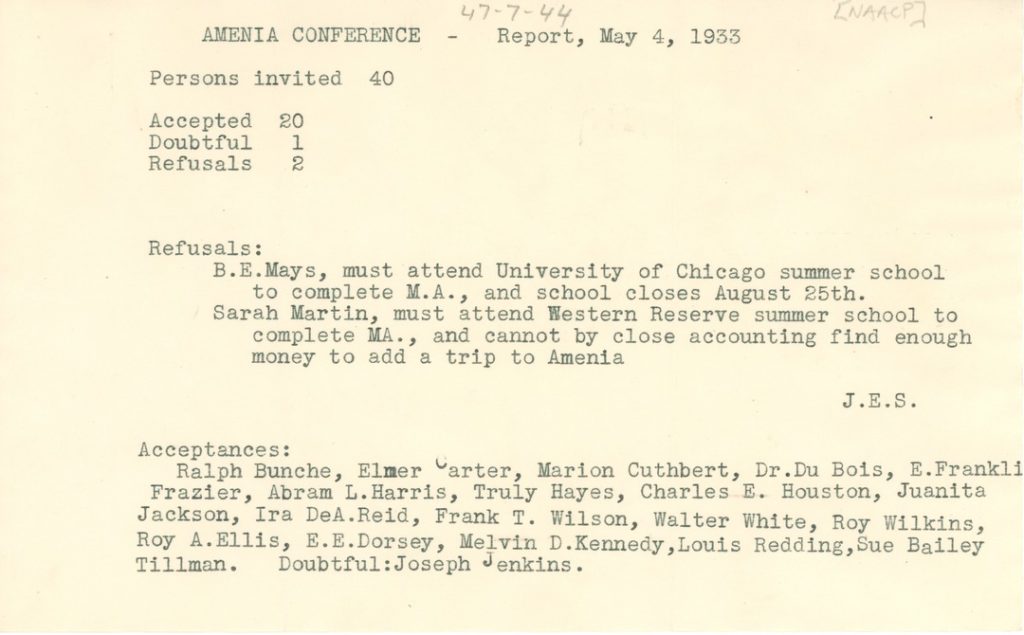
Over at Jacobin, historian Eben Miller tells the story of the 1933 Amenia conference. The National Association for the Advancement of Colored People (NAACP) hosted the event in Amenia, New York. W.E.B. Du Bois was co-organizer. Some of the country’s leading young (between 20-40 years old) black intellectuals and activists were invited to the conference and, according to Miller, “the more radical among them envisioned a mass-oriented approach aligned with the burgeoning labor movement, a departure from the traditional emphasis on racial uplift.” Learn more here.
A taste:
Du Bois was keen to bring [Abram] Harris to the conference because he offered a perspective that Du Bois considered crucial for the future of the civil rights movement. Abram Harris championed the creation of an interracial workers’ movement. He came to this view not as a union organizer but as a social scientist. After surveying conditions among West Virginia coal miners and black migrants in Pittsburgh and the Twin Cities during the 1920s, Harris believed that it was time to forge unity across — not to separate along — racial lines.
Harris acknowledged that the NAACP achieved laudable legal advances during the 1910s and 1920s. The Supreme Court’s Guinn v. United States decision in 1915, for instance, reflected its success in outlawing the “grandfather clause” that inhibited black voting rights in Oklahoma. But as he researched the NAACP’s record for his landmark 1931 book The Black Worker: The Negro and the Labor Movement (coauthored with social scientist Sterling Spero), he counted its lack of a labor program as its greatest shortcoming.
At Amenia, Harris insisted that it was time to rethink the “race question.” No transcript recorded his exact words, but he put it this way in The Black Worker: “Negro leadership of the past generation has put its stress on the element of race. Their people’s plight, they feel is the plight of race. They turn a deaf ear to those who say that the Negro’s plight is the plight of the working class in general.”
Harris strongly supported antilynching laws. He favored pragmatic politics, scrutiny of the New Deal, and overturning Plessy. But radical change, the young leftist argued, required building an interracial mass movement among black and white workers. Without economic equality, there would be no political or civil equality.
Harris summarized his argument in the Amenia Conference Findings Report, writing that “the welfare of white and black labor are one and inseparable.” His peers at the Amenia Conference tended to agree. The NAACP would do well to strengthen its economic program.
Read the entire piece here.