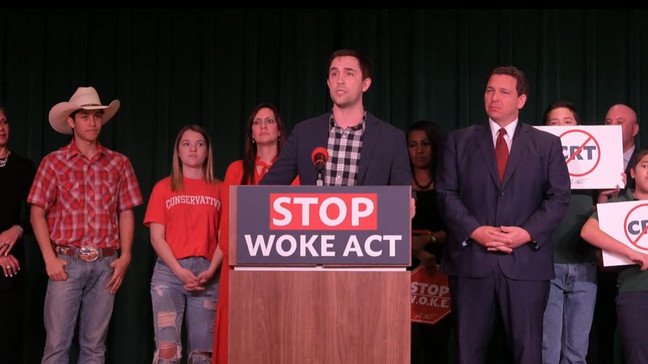
Chris Rufo is a conservative activist whose claim to fame is an appearance on the old Tucker Carlson show on Fox News. That appearance caught the attention of then president Donald Trump. Since then, Rufo has become Ron DeSantis’s point man in the governor’s attempt to turn New College-Florida into something akin to a southern Hillsdale College.
Rufo has a new book out. It is titled America’s Cultural Revolution: How the Radical Left Conquered Everything. The title should immediately tell potential readers that this book is not a work of intellectual history. (Though it appears Rufo would like it to be.) Why? Because good history requires nuance and complexity. The title alone suggests that this is a right-wing screed against something Rufo defines, I imagine quite broadly (I have not read the book), as the “radical Left.”
Over at The Chronicle of Education, writer Len Gutkin offers a review. Here is a taste:
Christopher Rufo, the architect of the conservative legislative campaign against perceived left-wing indoctrination in schools and colleges across the country and a member of the Board of Trustees of Florida’s revamped New College, Gov. Ron DeSantis’s experiment in the right-wing usurpation of higher education, has written a book. From its title on, America’s Cultural Revolution: How the Radical Left Conquered Everything is an ungainly blend of intellectual history and right-wing political propaganda. As intellectual history, the book is a sometimes useful and sometimes exasperating popular genealogy of the origins of contemporary activism in the radical politics of the ’60s and ’70s. As partisan propaganda, it is a sort of conspiracy theory about how the spirit of the Weathermen, the Black Panthers, and Herbert Marcuse has, after half a century of apparent quiescence, taken over not just the activist left but mainstream institutions from the universities to The New York Times. There is a genuine story to tell here, and Rufo knows enough to be able to tell it. But he cannot keep his inner propagandist quiet; the result is that the would-be intellectual historian is constantly degraded by the shrill ideological bully.
The book represents Rufo’s bid for intellectual seriousness. “Over the past two years,” Rufo announces in the Preface, “as I fought against left-wing ideologies in the political arena, I was also studying my adversaries through deeper research.” This sounds unpromisingly bug-eyed, but in fact each of the book’s four parts — on the lives and ideas of Marcuse, Angela Davis, Paulo Freire, and Derrick Bell — are well-researched and sometimes even sympathetic accounts of their subjects. It is common among academics on the left to dismiss Rufo and his allies as know-nothings. That’s incorrect. Although he tends to overstate the direct influence of thinkers like Marcuse on contemporary politics — an idealist tendency not unheard of in intellectual history — Rufo has done his homework, and he is not an ignoramus.
But Rufo the Intellectual mainly matters because of the other Rufos that precede and accompany him: Rufo the Muckraker, surfacing what he sees as the excesses of DEI-training programs in public and private institutions; Rufo the Exhorter, sermonizing apocalyptically on the terminal condition of the woke West; Rufo the Politician, joining forces with DeSantis to fire the leadership of New College and replace it with their own. The latter Rufo infamously, ridiculously, summarized this last achievement thus: “We are over the walls, and ready to transform higher education from within.”
Rufo the Exhorter often gets in the way of Rufo the Intellectual. Can anyone take him seriously when he insists that the Black radicals of the ’60s and ’70s “became even more dangerous after laying down their arms,” as he does in the section on Angela Davis? All too often, such menacing foreshadowing takes the place of a genuine sifting for continuities and lines of influence between the past and the present. That’s a shame, because the connections between ’60s radicalism and the protest movements of the last several years are not merely confections of Rufo’s intemperate imagination. They deserve a chronicler with a more just sense of proportion.
Read the rest here.
When we study the past for the primary purpose of advancing an activist or political agenda we end up with books like Rufo’s. We also end up with Howard Zinn and activist screeds from the Left.
Everyone has an axe to grind. The question is, can we admit it to ourselves or not?