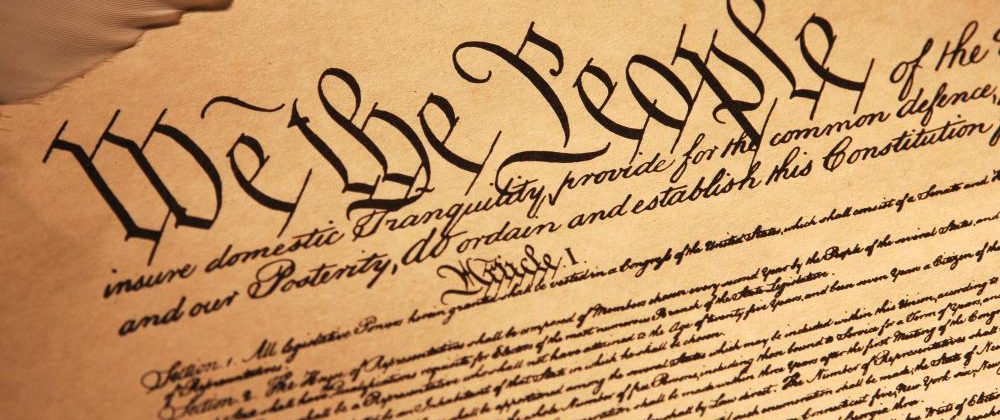

As Jeffrey Rosen of the National Constitution Center reminds us, the founding fathers anticipated “a demagogic challenge to the rule of law.” Here is a taste of his piece at The Wall Street Journal:
The allegations in the indictment of Donald Trump for conspiring to overturn the election of 2020 represent the American Founders’ nightmare. A key concern of James Madison and Alexander Hamilton was that demagogues would incite mobs and factions to defy the rule of law, overturn free and fair elections and undermine American democracy. “The only path to a subversion of the republican system of the Country is, by flattering the prejudices of the people, and exciting their jealousies and apprehensions, to throw affairs into confusion, and bring on civil commotion,” Alexander Hamilton wrote in 1790. “When a man unprincipled in private life, desperate in his fortune, bold in his temper…is seen to mount the hobby horse of popularity,” Hamilton warned, “he may ‘ride the storm and direct the whirlwind.’”
The Founders designed a constitutional system to prevent demagogues from sowing confusion and mob violence in precisely this way. The vast extent of the country, Madison said, would make it hard for local factions to coordinate any kind of mass mobilization. The horizontal separation of powers among the three branches of government would ensure that the House impeached and the Senate convicted corrupt presidents. The vertical division of powers between the states and the federal government would ensure that local officials ensured election integrity.
And norms about the peaceful transfer of power, strengthened by George Washington’s towering example of voluntarily stepping down from office after two terms, would ensure that no elected president could convert himself, like Caesar, into an unelected dictator. “The idea of introducing a monarchy or aristocracy into this Country,” Hamilton wrote, “is one of those visionary things, that none but madmen could meditate,” as long as the American people resisted “convulsions and disorders in consequence of the acts of popular demagogues.”
According to the federal indictment issued this week, President Trump attempted to overturn the results of the 2020 election by conspiring to spread such “convulsions and disorders” through a series of knowing lies. The indictment alleges that soon after election day, Trump “pursued unlawful means of discounting legitimate votes and subverting the election results,” perpetuating three separate criminal conspiracies: to impede the collection and counting of the ballots, Congress’s certification of the results on Jan. 6, 2021, and the right to vote itself.
The indictment alleges that all three conspiracies involved a concerted effort by Trump and his co-conspirators to subvert the election results using “knowingly false claims of election fraud.” In particular, Trump allegedly “organized fraudulent slates of electors in seven targeted states”; tried to use “the power and authority of the Justice Department to conduct sham election crime investigations”; tried to enlist Vice President Mike Pence “to fraudulently alter the election results”; and, as violence broke out on Jan. 6, redoubled his efforts to “convince Members of Congress to further delay the certification.”
Defenders of the indictment argue that special counsel Jack Smith was compelled to seek it in the face of such a grave threat to our democratic institutions. “I do not believe there is anything that approaches this in American history,” former U.S. Court of Appeals judge J. Michael Luttig told me. A respected conservative jurist, Luttig helped to persuade Vice President Pence that he had no power to overturn the election results. “These are the gravest offenses against the United States that an incumbent president could commit,” he said, “save possibly treason.”
Read the rest here.