Here is historian Bennett Parten at Zocalo Public Square:
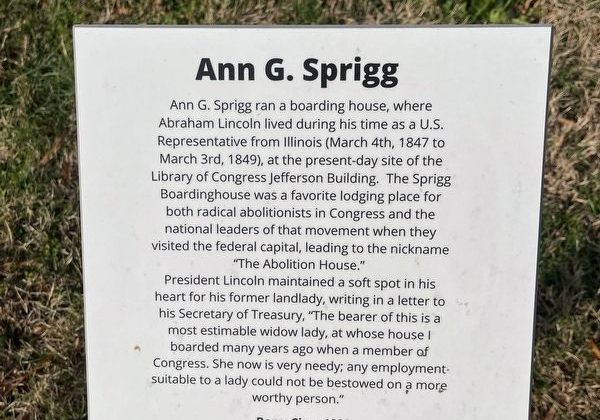
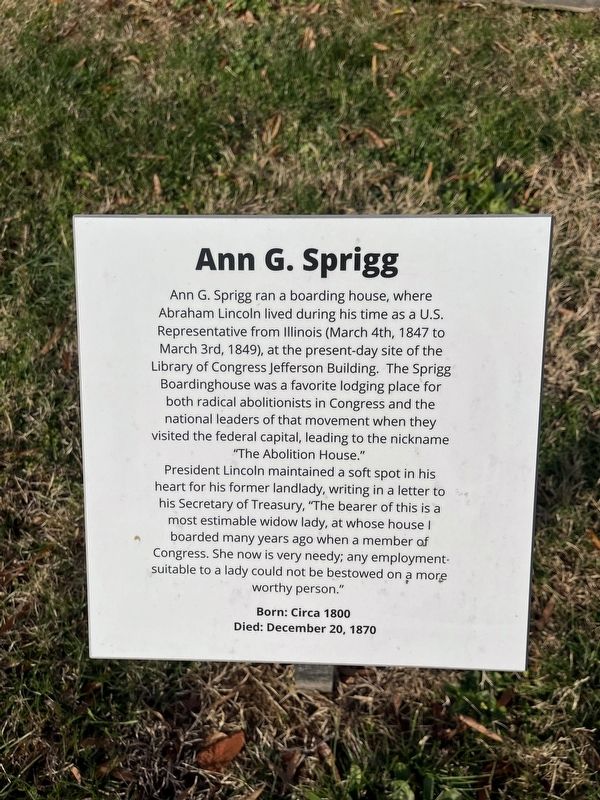
In the early 1840s, where the steps of the Library of Congress now stand, a group of American abolitionists gathered in a modest boardinghouse to plot the destruction of slavery.
The house belonged to a relatively obscure Washingtonian, a widow named Ann Sprigg. In those days, boardinghouses like Sprigg’s were fixtures of the capital landscape—where congressmen, senators, government officials, and the like tended to live during legislative sessions. Quarters were often cramped. Men rented a room—or just a bed, or even half of a bed—and communed in shared bathrooms and living spaces, with the day’s debates sometimes carrying over to the dinner table. Many houses developed reputations as being favored by certain factions, turning them into political clubs as much as living quarters.
In 1841, Ann Sprigg’s house came to be known as the “abolition house.” Three anti-slavery Whig congressmen—Seth M. Gates, a New Yorker, William Slade, a Vermonter, and Joshua Giddings, an Ohioan—moved in alongside two prominent abolitionists, Theodore Dwight Weld and Joshua Leavitt. Leavitt—a wealthy New Yorker who shared a Sprigg House bed with Weld—quickly set about convincing the representatives to work alongside the wider abolition movement as an anti-slavery lobby. The group became the brain trust behind the first significant congressional campaign to combat slavery from the nation’s capital.
The brain trust’s goal was straightforward: to develop a caucus within the legislature, a lobby to influence the legislature, or at the very least an argument that would challenge the power of slavery and slaveholders in the American government. But it was also radical, representing a major sea change in American history, and ultimately a turning point in slavery’s demise. Up until this point, the anti-slavery movement had largely eschewed politics. Led by William Lloyd Garrison and his followers, the early abolitionists focused strictly on changing hearts and minds—what they called “moralsuasion”—not changing votes. Garrison once even burned copies of the U.S. Constitution (which he called “a Covenant with Death and an Agreement with Hell!”) on stage—a flaming, charred reflection of the fact that he preferred challenging slaveholder power from outside the halls of power.
Read the rest here.