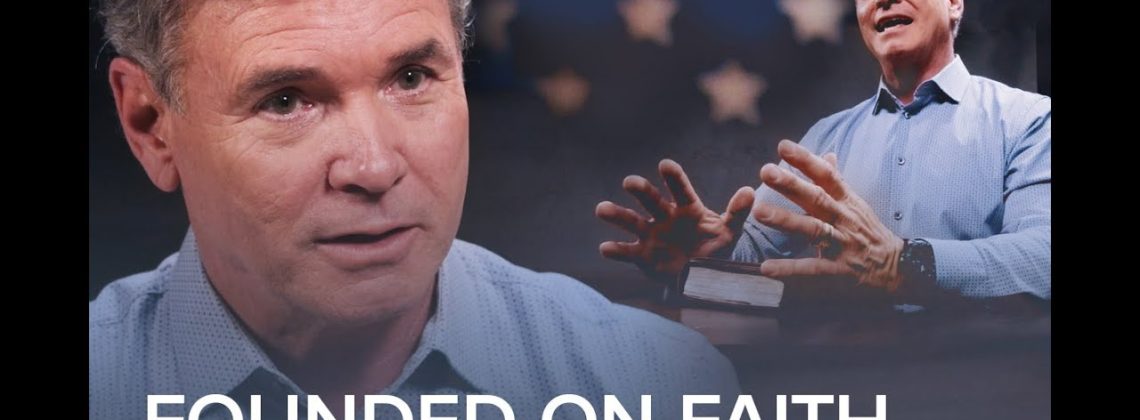

In this video, podcast the pastor of the Calvary Church-Chino Hill (CA) reveals just how the Christian Right manipulates the past to promote its political agenda. I can’t tell whether these pastors are just ignorant or they are deliberately lying. This is not the first time I corrected Hibbs’s misuse of Valley Forge history.
Watch:
Let’s break it down:
2:00ff: Hibbs says: “Beware of Wikipedia please. Beware of even some of the U.S. history that will question or cast doubt regarding things that remarkably are enshrined in granite or marble in our country….” I am assuming he is referring to people like me, an evangelical Christian historian who has spent two decades exposing bad history emanating from Hibbs and others. As for the “marble and granite” I assume he is referring to monuments that mention God. Are there monuments that mention God? Of course. But such monuments must be understood in historical context. Why were thy erected? When were they erected? Who was behind such monuments? But I am sure Hibbs will consider my suggestions about contextualization as little more than academic-speak from a person who wants to complicate the straight facts in service of a left-wing political agenda.
2:45ff: Hibbs warns his followers to be aware of websites that tell people that “it may or may not be true that George Washington fought this battle here or said this there, and it’s just demonic.” First, I don’t know of any historian, liberal or conservative, who is trying to suggest that George Washington didn’t fight at “this or that battle.” We have a pretty good record of these things. Second, to suggest that historians who have spent their entire lives pursuing the truth about the past are “demonic” may actually be a demomic thing to say.
3:35ff: Hibbs starts talking about the 1975 Arnold Friberg painting of George Washington praying in the snow at Valley Forge. He says he purchased this painting at Mount Vernon. It is worth noting that Mount Vernon no longer sells this painting because it does not depict actual history. (Actually, the earliest painting of Washington praying at Valley Forge was by Henry Brueckner in 1866).

4:00ff: Hibbs keeps refering to the artist of this painting as “Feinberg.” It’s is Arnold Friberg.
4:50ff: Hibbs claims that George Washington’s prayer, as depicted in the Friberg painting, is recorded. Actually, it is not. I challenge Hibbs to produce the transcript of that prayer. This is actually a hilarious claim. Hibbs seems to be suggesting that George Washington got off his horse at Valley Forge, knelt down in the snow, and prayed an audible prayer that someone wrote down word for word.
5:17ff: Here Hibbs says that Isaac Potts may have recorded the prayer. Potts must have had amazing hearing because he probably wasn’t even in Valley Forge at the time of the prayer.
7:40ff: Hibbs said that the “love of liberty” kept the soldiers alive during the Winter at Valley Forge. Maybe for a few. But if you read Wayne Bodle’s definitive history of Valley Forge you will learn that there was not much talk of “liberty” in the camp. In fact, Washington expected the troops would stage a mutiny. Virtually everything Hibbs says here about the troops at Valley Forge is either an exxageration or simply not true.
8:52ff: Hibbs says that Washington told the soldiers at Valley Forge to “fear God and trust in the Lord. Our cause is great.” In fact, he didn’t just tell them this once, but he kept “drilling it into their hearts and minds.” The way Hibbs talks one might wonder why Washington’s winter at Valley Forge did not qualify him for ordination in the Anglican (or perhaps Episcopal) church. I’d like to see the source Hibbs is quoting, because I am guessing that this quote comes from a 19th-century hagiographic work on Washington.
15:34ff: Some of you may have heard this story about shad and Valley Forge. Hibbs, as expected, puts a providential spin on this story. Here is Bodle in his book The Valley Forge Winter:
One of the more colorful Valley Forge traditions concerns the allegedly fortuituous revival of a large and providentially early run of shad in the Schuykill River, which at least one writer has credited with having terminated the army’s winter of famine…This episode is undocumented and chronologically implausible. The worst period of the army’s hunger ended in February, long before the shad run could have begun. The British did try to obstruct the mouth of the Schuykill at Philadelphia to block the shad run.
15:58: Hibbs asks, “How does a citizen army beat the greatest power on earth?” Of course he believes that God did it. He chalks it up to a spiritual version of American exceptionalism. My answer to Hibbs’s question is two fold. First: the Continental Army in the final years of the war were not as rag-tag as Hibbs makes them out to be. Second: France.
20:00: Hibbs says “if we were writing the Bible today, George Washington would be included.” That one I haven’t heard before.
Here is how I treated the Valley Forge prayer story in Was America Founded as a Christian Nation?: A Historical Introduction:
In the winter of 1777-1778 the Continental Army faced one of its lowest points in the Revolutionary War. British troops under the direction of General William Howe were in control of Philadelphia. George Washington’s soldiers were coming off major defeats at Brandywine and Germantown. Amid public criticism stemming from these military failures, Washington took his army to Valley Forge, Pennsylvania, eighteen miles northwest of Philadelphia. Here they would heal their wounds and prepare for the Spring campaign. The conditions at Valley Forge, as any elementary school student knows, were not good. The army lacked some of the basic necessities of life. It was cold. Washington, who managed to keep the army together during these trying times, praised the heroic determination of his soldiers: “To see Men without Cloathes to cover their nakedness, without Blankets to lay on, without Shoes, by which their Marches might be traced by the Blood from their feet…is a mark of Patience and obedience which in my opinion can scarce be parallel’d.
As the army struggled through the Valley Forge winter, a local man named Isaac Potts, the owner of the house where Washington was staying, walked through the woods near the encampment and heard a voice amid a bower of oak trees. He realized quickly that the voice he heard was Washington himself, who was kneeling on the ground praying to God. Potts was moved. As a Quaker he opposed this war, but his sympathies were with the British. Seeing Washington in prayer, however, changed everything. As Potts arrived back home he announced to his wife, Sarah: “I have this day seen what I never expected. Thee knows that I always thought the sword and the gospel utterly inconsistent; and that no man could be a soldier and a Christian at the same time. But George Washington has this day convinced me of my mistake.” Seeing Washington in prayer transformed Potts into a patriot: “If George Washington be not a man of God does not, through him, work out a great salvation for America.”
Versions of Potts’s account of Washington praying at Valley Forge appeared in dozens of nineteenth-century school textbooks, including William Holmes McGuffey’s well-known Eclectic Reader series. In 1866 Henry Brueckner recaptured this event in a painting, The Prayer at Valley Forge. It portrays Washington on his knees in the snow making supplication to God, supposedly on behalf of his army and the American cause. Brueckner’s painting has become a well-known piece of Americana. Visitors to the Washington Memorial Chapel at Valley Forge and the prayer chapel in the U.S. Capitol can find a stained-glass rendering of the image. In 1928 it appeared on a U.S. postage stamp.
There is one major problem with Pott’s story of Washington praying at Valley Forge–it almost certainly did not happen. While it is likely that Washington prayed while he was with his army at Valley Forge in the winter of 1777-1778, it is unlikely that the story reported by Potts, memorialized in painting and read to millions of schoolchildren, is anything more than legend. It was first told in the seventeenth edition (1816) of Mason Locke Weems’s Life of Washington. Weems claimed to have heard it directly from Potts, his “good old FRIEND.” Potts may have owned the house where Washington stayed at Valley Forge, but his aunt Deborah Potts Hewes was living there alone at the time. Indeed, Potts was probably not even residing in Valley Forge during the encampment. And he was definitely not married. It would be another twenty-five years before he wed Sarah, making a conversation with her in the wake of the supposed Washington prayer impossible. Another version of the story, which appeared in the diary of Reverend Nathaniel Randolph Snowden, claims that it was John Potts, Isaac’s brother, who heard Washington praying. These discrepancies, coupled with the fact that Weems was known for writing stories about Washington based on scanty evidence, have led historians to discredit it.
Hibbs needs to have a Dudley Rutherford moment.
Example of the Scandal of the Evangelical Mind.
Yes. Someone on my Twitter feed noted that the Calvary Chapel movement represents some of the worst forms of this kind of scandal. Few of them have broad liberal arts training. This leads them straight into the arms of the David Bartons of the world. Many of these guys attended Chuck Smith’s Bible colleges.