Here is Holland Cotter at The New York Times:
In Charleston Harbor, where the initiating shots of the Civil War were fired — Fort Sumter is distantly visible — I’m on the site of a former shipping pier known as Gadsden’s Wharf. Here, in the 18th and early 19th centuries, ships carrying tens of thousands of enslaved Africans deposited their human cargo, a population that would, through unthinkable adversity and creative perseverance, utterly transform what “America” meant, and means.
On this spot now, looking a bit like a ship itself, stands the eagerly awaited and long-delayed new International African American Museum. After an almost quarter-century journey hampered by political squalls, economic doldrums, sometimes mutinous crews, and last-minute fogs, this cultural vessel has securely, and handsomely, come to berth here, opening to the public on Tuesday.
The new museum is very much what this place is about: the original forced infusion of Black cultural energy into America, and the consequences of that for the present. It’s the first major new museum of African American history in the country to bring the whole Afro-Atlantic world, including Africa itself, fully into the picture.
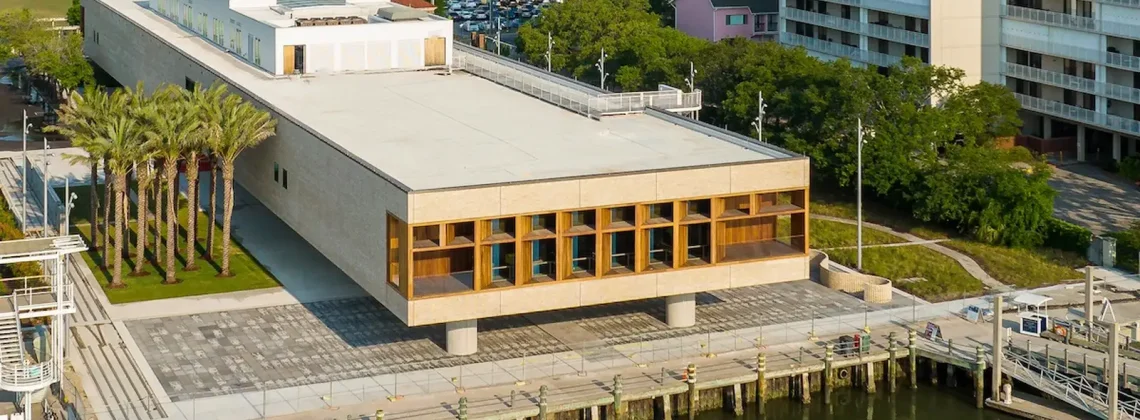
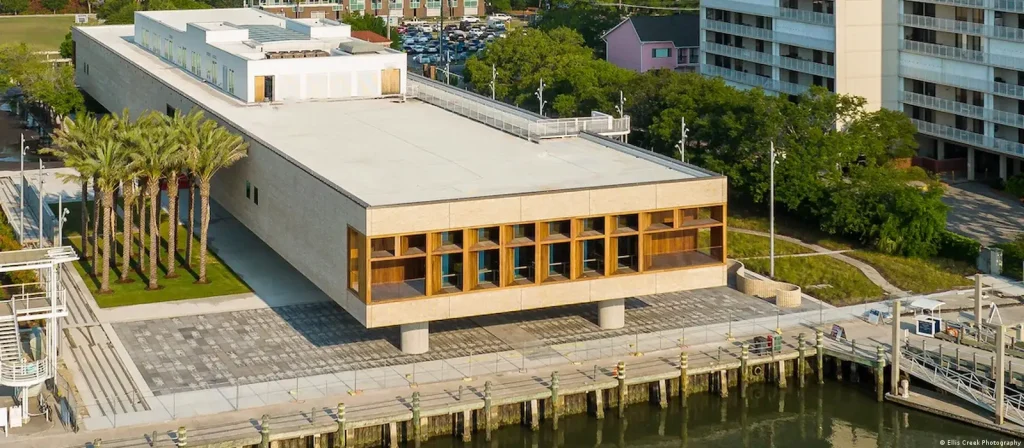
The museum’s architecture, designed by Henry N. Cobb (1926-2020) with Curt Moody of Moody Nolan, is responsive to the institution’s complex global-local agenda. A long horizontal block of sand-beige brick raised high on stout pilings, it conjures the image of a boat in dry dock. But it also suggests a kind of Afro-futurist spacecraft, hovering, set for liftoff.
Beneath and around it is a public park that the museum has named the African Ancestors Memorial Garden. It’s clearly conceived as a tribute to victims of the torturous Atlantic Ocean crossing known as the Middle Passage, and specifically to those who arrived, dead or alive, at this very spot. Ghostly images — life-size silhouettes of bodies packed together, shoulder to shoulder, as if in a ship’s hold — appear to be carved into the garden’s pavement. Yet surrounding, and softening, this sepulchral frieze are signs of new life and growth in the form of plantings, designed by the landscape artist Walter J. Hood, of lush vegetation: palm trees native to Africa, sweet grass native to South Carolina.
So even from the outside, this history museum set in a former slave port announces itself as being about something more than slavery. It’s a monument to survival and continuance. It situates Gadsden’s Wharf, and Charleston, on a wide map still being explored and expanded.
Read the rest here.