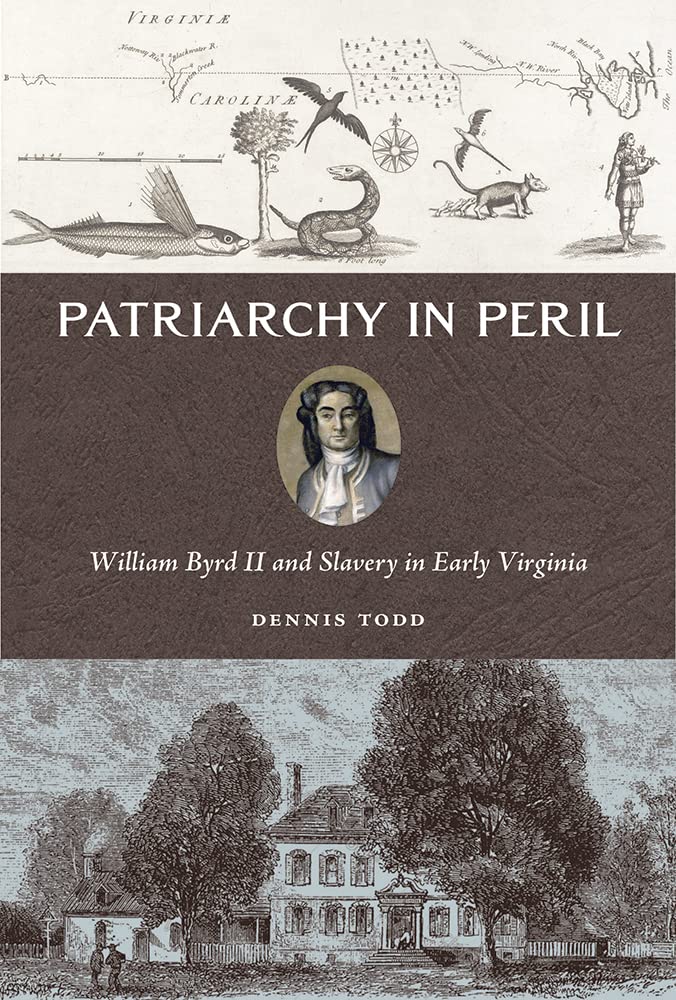
Dennis Todd is Professor Emeritus of English at Georgetown University. This interview is based on his new book, Patriarchy in Peril: William Byrd II and Slavery in Early Virginia (University of Tennessee Press, 2023).
JF: What led you to write Patriarchy in Peril?
DT: Patriarchy in Peril is the result of the confluence of two unrelated interests of mine. For many years, in my course on Colonial American literature I taught William Byrd’s The Secret History of the Line, his account of his surveying the boundary line between North Carolina and Virginia. I was fascinated by how he portrayed himself as the very exemplar of the ideal patriarch. At the same time, I was writing a book about how the novels of Daniel Defoe that were set in the New World portrayed indentured servitude and slavery. As I became more and more acquainted with the facts of slavery in the Chesapeake, it became increasingly clear to me that the patriarchal ideals that Byrd espoused were incompatible with the ways he and other Virginia slave owners of the time managed and treated their slaves. I wrote this book in order to understand the nature and consequences of this incompatibility.
JF: In two sentences, what is the argument of Patriarchy in Peril?
DT: Patriarchy in Peril analyzes how William Byrd II treated his slaves and what he thought about slavery. It argues that the patriarchal principles by which Byrd justified and sought to manage his slaves were incompatible with a slave economy.
JF: Why do we need to read Patriarchy in Peril?
DT: The early stages of the formation of slavery in colonial America and patriarchalism, the ideology that rationalized the enslavement of fellow human beings, have not been extensively studied. Patriarchy in Peril seeks to explore both topics more fully. Because of its emphasis on unswerving obedience and strict discipline, we tend to think that patriarchal principles justified slavery and the management of slaves by means of coercion and violence. But patriarchalism, though it did insist that subordinates obey their masters, also placed obligations on masters themselves, mandating that they avoid treating their subordinates severely or despotically. In the end, slavery and patriarchalism were fundamentally incompatible. Slavery was a coercive, not a voluntary system of labor, and the brutal realities of slavery led Byrd to act in ways that directly contradicted the ways he thought a true patriarch should act, undercutting the notion of reciprocal duties and obligations that was at the core of patriarchalism, undermining the ideal of a patriarch as a Christian and a good-natured man, and sabotaging the central tenets a patriarch was supposed to govern his subordinates by: self-restraint, kindness, and fair and equitable treatment. As a result, Byrd was never able to reconcile his patriarchal ideals with the ruthlessness of slavery. Patriarchal ideals did not disappear after Byrd died but were handed down to succeeding generations, transformed into an ideology we have come to call paternalism. Paternalism sought to resolve those very contradictions that so bedeviled Byrd, and it was able to do so, but only by fantasizing slavery as a voluntary system of labor.
JF: Why and when did you become an American historian?
DT: As a scholar of English and American literature, I’ve always believed that a work of literature is best understood within its historical context. Everything I have written has had a strong historical slant, and so I feel it was a natural evolution that I finally wrote a book that is “pure” history.
JF: What is your next project?
DT: I write to solve a problem that baffles me. At the moment I have no new project at hand, but now that I am retired and have time to read a wide range of works by other historians, I’m sure I’ll stumble across some new puzzle.
JF: Thanks, Dennis!