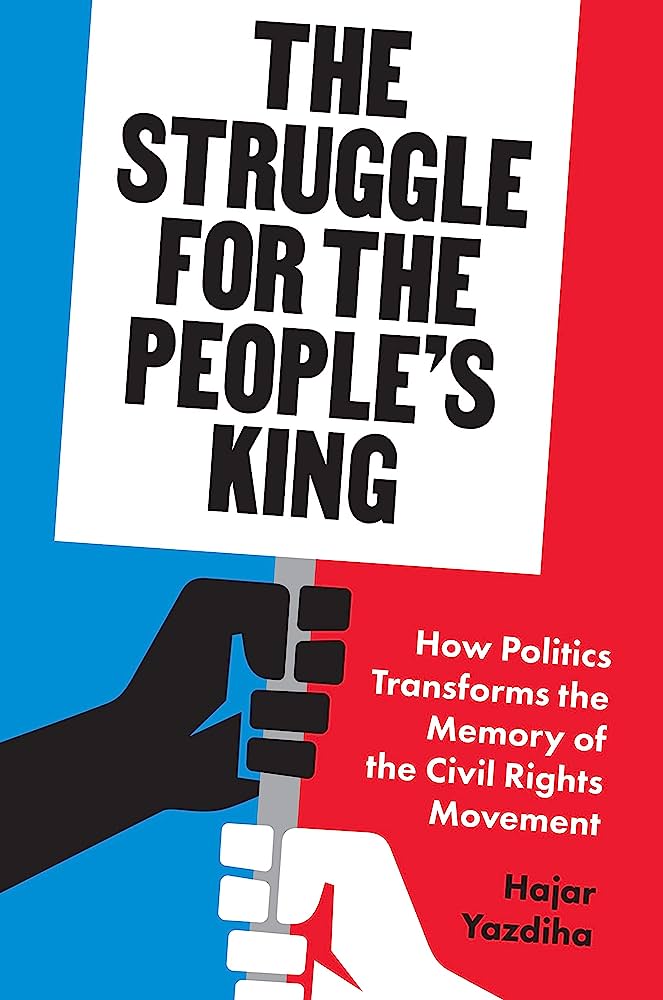
Hajar Yazdiha is Assistant Professor of Sociology at the University of Southern California. This interview is based on her new book, The Struggle for the People’s King: How Politics Transforms the Memory of the Civil Rights Movement (Princeton University Press, 2023).
JF: What led you to write The Struggle for the People’s King?
HY: The Struggle for the People’s King initially emerged out of the news that was capturing my attention in graduate school, in particular the case of Abigail Fisher, a young white woman who was rejected from the University of Texas at Austin and took her case to the Supreme Court in a fight to repeal Affirmative Action. In the Fisher case, the legal argument rested on the notion that affirmative action was a form of reverse racism against White people. As a scholar of race and social movements, I found the co-optation of civil rights discourse appalling, and I wanted to understand how the language and legal tools of civil rights could be turned on their head so explicitly. After I began digging deeper into this phenomenon, I came to find that in all these legal cases, there was a larger cultural pattern of misusing the meanings and the memory of Dr. King and the Civil Rights Movement. From here I embarked on a multi-year effort of collecting all the data I could to systematically examine the uses and misuses of Dr. King and the Civil Rights Movement from 1980 to 2020.
JF: In 2 sentences, what is the argument of The Struggle for the People’s King?
HY: The Struggle for the People’s King argues that as powerful groups remake the collective memory of Dr. King and the Civil Rights Movement toward competing political ends, they generate offshoots of remembrance that distort history and threaten the very foundations of multicultural democracy. These oppositional uses of memory fracture our collective understanding of who we are, how we got here, and where we go next.
JF: Why do we need to read The Struggle for the People’s King?
HY: In The Struggle for the People’s King, I show how the rollback of American democracy has been enabled through a revisionist history that willfully evades the reality of racism and the roots of racial inequality. When we evade social reality, we do not act in meaningful ways that change the unequal system. Worse yet, ignoring social reality means we reproduce and strengthen the system of inequality. This book is a call to action for scholars, activists, educators, and policymakers alike.
JF: Why and when did you become an American historian?
HY: Though I am a sociologist, I see a strong congruence between the work of historians and the work of sociologists whose foundational notions of the sociological imagination rest on understanding how our lives are shaped by sociohistorical contexts. My own passion for history is rooted in my experience as a child of immigrants, where it was in learning the history of Black struggle that I came to contextualize my own experiences of racism and exclusion and began to understand our interconnectedness in a larger social system. As someone who is fascinated by imagined futures, specifically our capacity to speculate on more liberatory futures, I am convinced that messy reckonings with the past are the way to brighter futures.
JF: What is your next project?
HY: I have a number of current projects ranging from an examination of the impacts of Voter ID laws on immigrant organizations to a project examining Gen Z student activism in the wake of COVID-19. I am also in the exciting early stages of embarking on my second book project. I will be exploring the vast array of ways everyday people are working to create social change, from social media influencers to social entrepreneurs to psychedelic retreats.
JF: Thanks, Hajar!