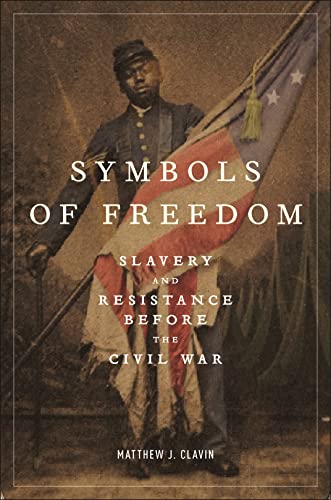
Matthew J. Clavin is Professor of American and Atlantic History at the University of Houston. This interview is based on his new book, Symbols of Freedom: Slavery and Resistance Before the Civil War (NYU Press, 2023).
JF: What led you to write Symbols of Freedom?
MC: Years ago, I learned of a large group on enslaved men in southern Maryland who attempted to escape to Pennsylvania and freedom over the Fourth of July weekend in 1845. Since then, I have come across dozens of incidents of enslaved people rebelling, running away, and committing all other types of resistance on Independence Day. I have also discovered countless instances of enslaved people and their abolitionist allies taking great inspiration from other symbols of American freedom and in turn fighting for freedom. This is a truly incredible story of the deep impact of revolutionary nationalism on slavery’s enemies before the Civil War.
JF: In 2 sentences, what is the argument of Symbols of Freedom?
MC: The argument is that in the antebellum era the language and symbols of freedom meant a great deal to enslaved people and their allies. Indeed, in the decades before the Civil War, they inspired forceful and even violent resistance to slavery.
JF: Why do we need to read Symbols of Freedom?
MC: For a book that focuses exclusively on the early-to-mid-nineteenth century, it carries great resonance for contemporary debates on race, rights, and the nation. With existential threats to freedom and democracy growing daily, it is useful to consider how Black and White Americans once found strength and solace in the United States’ radical egalitarian tradition.
JF: Why and when did you become an American historian?
MC: I have loved history my entire life, though a couple of Middle School teachers, Dennis O’Brien and Doug Cooper in particular, put me on a path toward a career in history. They made history come alive through a series of field trips and historical reenactments, all of which entirely changed the way I viewed the past. In Mr. Cooper’s class, we literally built a chariot and participated in a chariot race. I am sure you could not do that today! There is no chance I would be where I am today without their influence.
JF: What is your next project?
MC: Having researched and written about slave and antislavery resistance for years, one thing has become clear: the United States’ gun culture is not a new phenomenon. It existed in the antebellum era and had a profound effect on slavery. My next book project explores the role that guns played in shaping both the oppression and resistance of enslaved people.
JF: Thanks, Matthew!