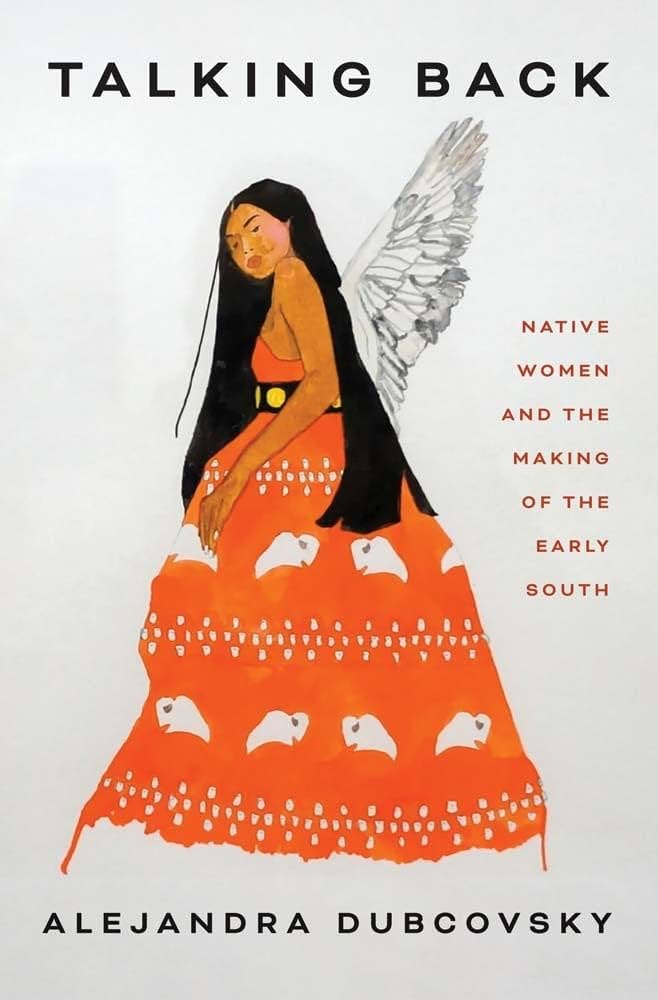
Alejandra Dubcovsky is Associate Professor of History at the University of California, Riverside. This interview is based on her new book, Talking Back: Native Women and the Making of the Early South (Yale University Press, 2023).
JF: What led you to write Talking Back?
AD: I knew there were women in the Early South, for surely there had to be. I was familiar with the long catalog of responsibilities and obligations used to describe women in the colonial era: women farmed, made pottery, prepared meals, mended clothes, raised children, weaved baskets, and so much more. To me, the “women list,” as I called these enumerated tasks, was never more than a quick acknowledgement of women’s presence and just as quick a dismissal of their importance. I had never bothered to look for women beyond the “women list,” until I was reviewing a set of documents I thought I knew quite well. This was a one-thousand-page legajo (bundle) that dealt with the 1702 English siege of San Agustín, the main Spanish colonial hub in Florida. These handwritten materials were all about war and women had no part in that story, of that I was certain. But as I went through the legajo again, I found, to my utter shock, that women were there; they were in every page. They were even in the Juntas de Guerra (War Councils)! Women were not so much “hidden in plain sight,” as they were plainly in sight. I knew I wanted to tell their stories.
JF: In 2 sentences, what is the argument of Talking Back?
AD: Native women had power in shaping the world they inhabited– a power that was both expected and accepted. By focusing on when Native women enter into colonial stories and accounts, how they record their experiences, and most importantly, why they choose to do so, helps interrogate the very content and structures that make them legible.
JF: Why do we need to read Talking Back?
AD: The stories! There are so many, powerful, devastating, and hilarious archival stories this book weaves together. But also, by centering women in the story of early America, this book offers more than new voices and perspectives. It challenges what is unknown and unknowable in the past, transforming both established colonial narratives and entrenched colonial archival practices by arguing that Native women were a central force in the making and unmaking of early America.
JF: Tell us about the kinds of sources that you used to write this book.
AD: Talking Back draws on a broad range of sources, including official reports, letters, personal papers, surveys, interrogations, court records, contemporary published accounts, and on interviews, oral histories, and stories of Indigenous people. This work relies on archival documentation in Spanish, English as well as Timucua, providing some of the first translations of these Native language works. By analyzing these multi-archival and multilanguage sources alongside Native-made and preserved oral histories and evidence, I am able to give a closer look at the lives, experiences, and struggles of women in the Early South.
JF: What is your next project?
AD: In 2021 I received a New Directions Mellon Fellowship to work with archival materials, linguists, and Native communities to learn the Timucua language (a Native language spoken in Florida). This ongoing effort to translate materials and work with ancestral communities can be found on our public-facing website: Hebuano (https://hebuano.com/).
JF: Thanks, Alejandra!