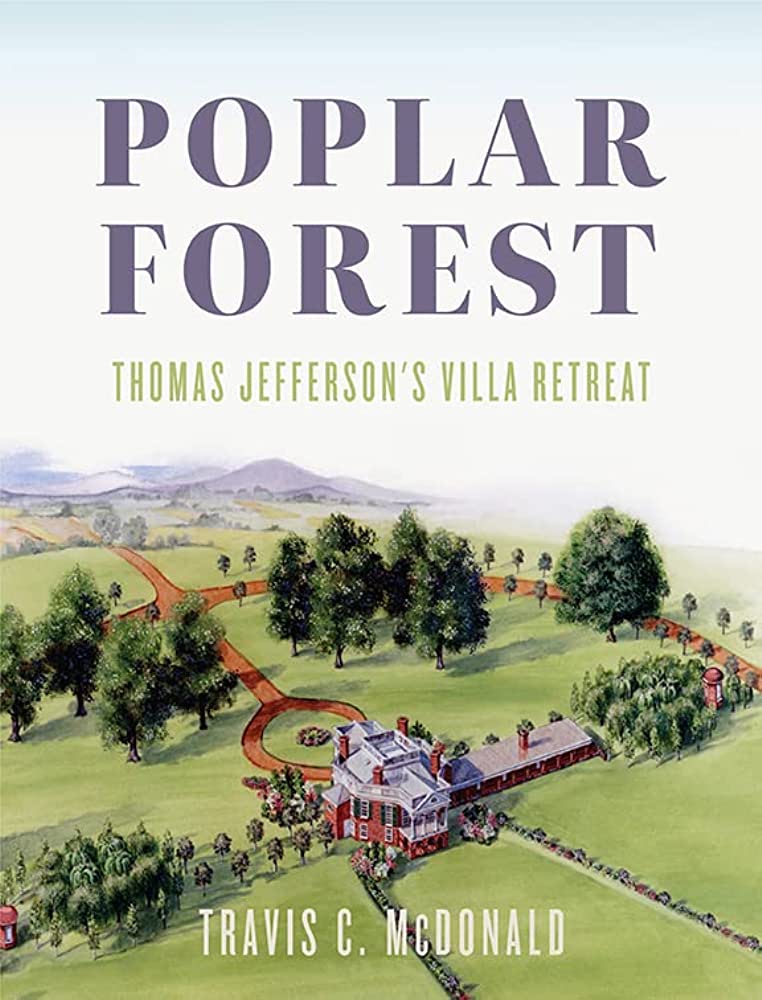
Travis McDonald is Director of Architectural Restoration at Thomas Jefferson’s Poplar Forest. This interview is based on his new book, Poplar Forest: Thomas Jefferson’s Villa Retreat (University of Virginia Press, 2023).
JF: What led you to write Poplar Forest?
TM: For the past 34 years I have been directing the research, investigation, and restoration of Thomas Jefferson’s retirement retreat. I’ve thought about Thomas Jefferson in this context almost every day for that length of time, first wondering what he designed and built, and then gaining insight on how it was built and by whom. Why did a significant portion of Jefferson’s life in retirement (14 years) disappear? The answer was that few people knew about Jefferson’s most intimate home to begin with. It went out of the Jefferson family in 1828 and lived in until 1979, so few people knew about it. I was also interested in why someone would create a very perfect work of architecture and not invite any friends to see it. The story of how Poplar Forest fit into Jefferson’s life as an architect and builder, how he used it, who built it, were the questions that led me to write this book.
JF: In 2 sentences, what is the argument of Poplar Forest?
TM: This is the unknown story of a large part of Thomas Jefferson’s life in retirement at his most intimate home and one of his most important architectural works that helps us understand what he accomplished before and afterwards as an architect and builder. The other unknown story is that of the Hemings family of enslaved house joiners (finish carpenters) who spent ten years crafting Jefferson’s special place, in particular John Hemings and his three nephew apprentices, who happened to be Jefferson’s bi-racial sons.
JF: Why do we need to read Poplar Forest?
TM: Anyone interested in Jefferson’s lifelong skills as an amateur architect and accomplished builder will want to see how Poplar Forest fits into that history. It is an interesting story of prolonged and challenging construction, especially the enslaved craftsmen who came to have a special relationship with Jefferson, carrying on a correspondence with Jefferson. It is also the unknown story of Jefferson the grandfather who started taking his two teenage granddaughters with him to his retreat. It is the story of Jefferson “recharging” his intellectual batteries in retirement and using that last retreat, in his lifetime of using them, to accomplish his last magnum opus, the University of Virginia. It is also the story of Jefferson, the first landscape architect in the U.S. This was the last home of a founding father to be rescued; this is the 40th anniversary of that rescue.
JF: Why and when did you become an American historian?
TM: I studied early American history at the University of Texas Austin in the 1970s and was turned on to architectural history in my last semester. After working for the Chief Historical Architect of the National Park Service in Washington, D.C. I returned to school at the University of Virginia for a masters degree in Architectural History. I got my museum restoration experience working at Colonial Williamsburg in the 1980s and was then hired to start the restoration of Poplar Forest in 1989.
JF: What is your next project?
TM: The book I’ve just written can really be considered the final volume: what the research and restoration of Jefferson’s retreat means. My next book will be the rich thirty-four year story of how we discovered what Jefferson had designed and built, and the story of putting it back together in the same way that Jefferson first built it using the same materials, the same techniques, and even the same historical sequence of construction.
JF: Thanks, Travis!