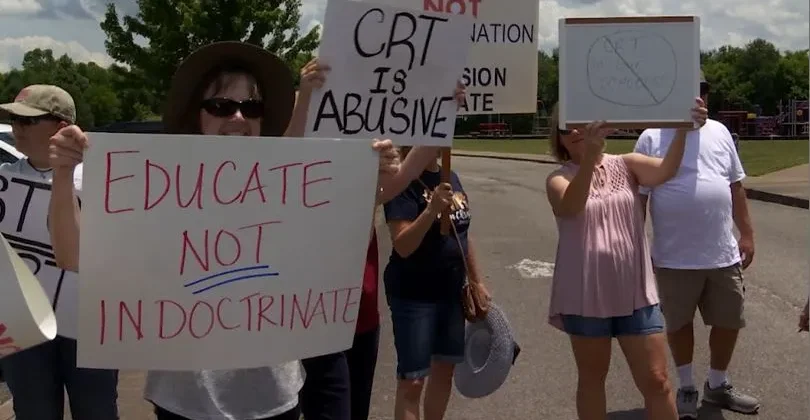
I think it’s fair to say we are in the midst of another round of history wars. Today’s so-called “activist historians” invoke a usable past to preach political and social agendas, while more traditional historians (of all political persuasions–from Trotskyite to conservative) warn against the dangers of superimposing such agendas on the “foreign country” of the past. Many activist historians recoil when people like Ron DeSantis tries to remove “wokeness” from Florida’s history curriculum or David Barton advances his Christian nationalist views of history by carefully cherry-picking quotes from the past, but often-times activists on the left are just as guilty of using the past for political posturing in the present. We can debate whether there is a moral equivalency between these two activist approaches to the past (is Howard Zinn or the 1619 Project as bad as DeSantis or Barton?), but let’s not pretend that it doesn’t happen–often times in egregious ways that do not do justice to the historical record–on both sides. At a time when we need historians to think deeply about the complexity of the human experience as it has unfolded through time, we are too often left with activism that fuels the culture wars, contributes to ongoing polarization, and does little to promote democratic debate and discourse.
Today over at Perspectives on History, historian Megan Threlkeld reminds us that these wars over history are not new. She writes about a regular course she teaches at Denison University on the history of the history wars. Here is a taste:
…For the past eight years, I have taught a course on the history wars for first-year undergraduates. At Denison University, located outside Columbus, Ohio, first-year seminars serve primarily as an introduction to college-level writing, but instructors choose the class’s focus. I thought the history wars would be an engaging topic for students to read and think about as they wrestled with genre, argument, revision, and other elements of first-year composition.
It turned out to be much more. Teaching the history wars, I’ve discovered, is a fantastic way to introduce students both to the contingent and contested nature of historical practice and to current efforts to restrict the history they and their peers can learn.
Because most of my students have never heard of the history wars (every year a few think they’ve registered for a class on wars in history), my first task is always to explain what they are. We start with some introductory readings. I’ve had great success with Alia Wong’s “History Class and the Fictions about Race in America” and Michael Conway’s “The Problem with History Classes,” both published in 2015 in the Atlantic; David W. Blight’s “The Fog of History Wars” (New Yorker, 2021); and the introduction to Sam Wineburg’s Why Learn History (When It’s Already on Your Phone) (Univ. of Chicago Press, 2018). My simple goal is to help students understand that the past is contested terrain. There is no “one true story,” both knowable and unchanging, of what happened long ago—hence the seemingly endless battles over what students should learn.
To reinforce this idea, we turn to textbooks. In 20 years of teaching, I’ve found comparing textbooks is the most direct and effective way to show students the contingent and contested nature of the past. And textbook exercises can be adapted for different grade levels and integrated into lessons on related content.
I use Kyle Ward’s History in the Making: An Absorbing Look at How American History Has Changed in the Telling over the Last 200 Years (New Press, 2007) to identify both topics and specific excerpts. My students read chapters of Ward’s book, but I also dig up some of the originals. Many textbooks out of copyright are available open access on HathiTrust, and more recent ones have been digitized by the Internet Archive. I also haul in a box of old textbooks I’ve found online for a few dollars each; students love digging through them and sharing what they find. Slavery, for instance, is always a conversation starter. We compare short passages from books published in 1889, 1933, 1974, and 1995, discussing how and why treatments of slavery have changed over time and what a textbook’s publication date can tell us.
This exercise never fails to open students’ eyes. “I always thought history was one singular story,” Mark reflected. “I didn’t realize it was so chaotic and messy.” Another student came to the class thinking “everyone learned a similar history, so finding out just how different they are was super fascinating.” And they’re even more shocked to learn how widely current textbooks can vary. We read a 2020 New York Times article comparing different versions of the same book used in California and Texas and discuss how politics and state standards shape textbook content. “How can the same book look so different with so many little changes?” Carrie exclaimed. “You’re learning different versions of history depending on where you live. That’s bizarre.”
We devote the remaining units of the class to discussing specific skirmishes. In the past, I’ve used the 1990s-era controversies over the National History Standards and the Smithsonian’s Enola Gay exhibit, the debates over social studies standards and textbooks waged in Texas throughout the 2010s, and the 2014–15 revisions to the AP US History framework. In fall 2022, we focused on the 1619 Project and the spread of educational gag orders, including “divisive concepts” bills. (I’m grateful to my fall 2022 students for allowing me to share their experiences. The syllabus for this iteration of the course is available on my website.)
Read the entire piece here.