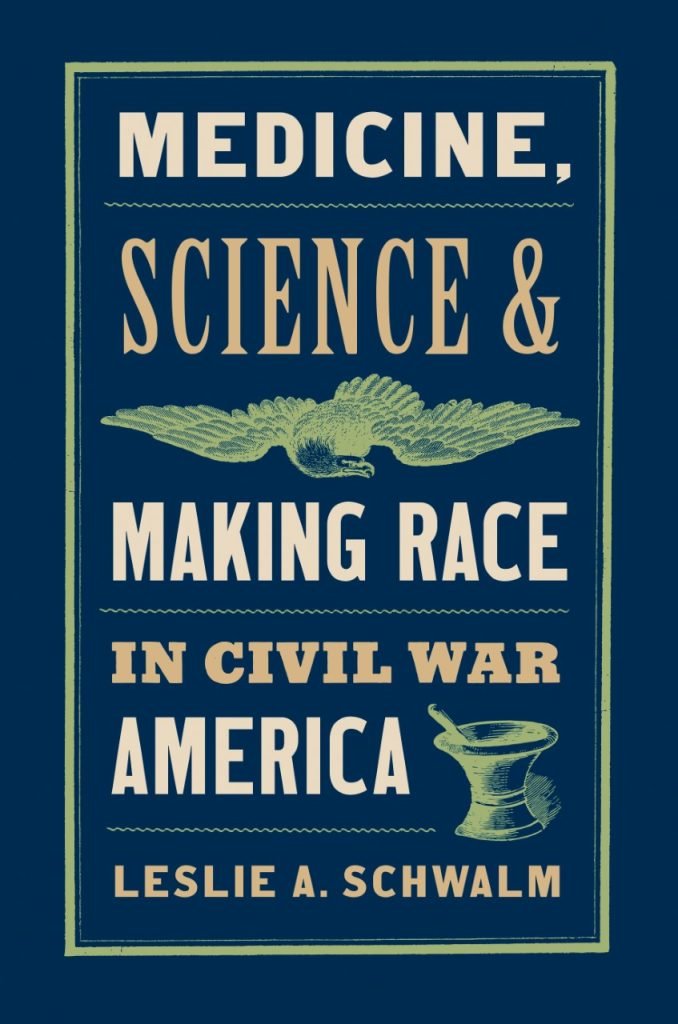
Leslie A. Schwalm is Professor Emeritus of History and Gender, Women’s, and Sexuality Studies at the University of Iowa. This interview is based on her new book, Medicine, Science, and Making Race in Civil War America (University of North Carolina Press, 2023).
JF: What led you to write Medicine, Science, and Making Race in Civil War America?
LS: I knew from a previous research project that Black soldiers (in this case, Iowa’s 60th USCI) experienced poor treatment at the hands of white regimental surgeons and were sometimes averse to hospitalization because of it. I had also come across records of poor medical care of refugees from slavery in contraband camps. These struck me as part of the unacknowledged cost of the war and wartime emancipation. When I first began research for this book, I thought I might focus on these aspects of medical mistreatment but what I found in the archives led me in a different direction.
JF: In 2 sentences, what is the argument of Medicine, Science, and Making Race in Civil War America?
LS: Medicine, Science & Making Race in Civil War America argues that the U.S. Sanitary Commission and Army medical personnel conducted wartime research aimed at proving Black medical and biological inferiority. I show that with unprecedented and unconstrained access to living and deceased Black soldiers and civilian refugees from slavery, Northern white civilian and military medical men attempted to create authoritative biomedical and scientific mastery over Black bodies, and to prove Black inferiority in a way that even the destruction of slavery could not undo.
JF: Why do we need to read Medicine, Science, and Making Race in Civil War America?
LS: Anyone interested in the history of medicine and science during the war will find much to engage with in this book. But it is also a book about how and why white Unionists, many of them opposed to slavery, energetically pursued indisputable “proof” that Black people were by nature different from and inferior to whites. This aspect of Civil War history was part of a much longer and long-lasting historical trajectory of white medical and scientific racism, and I argue that it must inform any assessment of the war’s achievements, as well as our assessments of the war’s violence. The “race project” of the Civil War became the supporting framework for more than 150 years of institutionalized medical racism that continues to plague research as well as medical screening, diagnosis, and treatment of people of African descent. In other words, the medical and scientific racism that was fueled during the Civil War lives with us today.
JF: Why and when did you become an American historian?
LS: I became an American historian for one reason: because Gerda Lerner created the nation’s first PhD. Program in women’s history. This was why I applied to graduate school, and it always fueled my research and teaching interests.
JF: What is your next project?
LS: Since I recently retired, I’m not thinking of a new book project—I’m enjoying retirement too much for that! But I continue working with the Iowa Colored Conventions Project—a group of faculty, graduate students, and community researchers interested in researching and publicizing Iowa’s long 19th century history of Black political organizing and activism. We have uncovered 20 conventions so far, the most documented in any state!
JF: Thanks, Leslie!