The historian and his wife Abby recently toured “the quiet farmlands and serene towns along the Erie Canal” once known as the “burned-over district.” As Ayers writes in this piece at Bunk: “Religious revivals, reform movements, and political conflict had blazed across the landscape from the 1820s through the 1850s, shaping American history in ways both immediate and lasting.”
Here is a taste of his piece:
We became alert to brown signs, the indicators of parks, museums, and markers devoted to history. These markers trace a network of historical interpretation across the country, sending signals to those attuned to the frequencies of the past. We were unable to follow all the leads that seemed promising. But we did go out of our way to visit one site that ended up returning little reward for the trouble.
The Quakers in this region played starring roles in many of the movements I recently wrote about, so I was eager to see the 1816 Quaker Meeting House in the town of Farmington. When we finally arrived, we discovered what was essentially a huge cube with no windows, with no visitors allowed inside. It turns out the building was in the midst of a federally funded restoration project, and had been covered with metal sheeting.
Because history is always under destruction, construction, and revision, we missed out on other places I was eager to see but no longer existed. Rochester had been important to Frederick Douglass. From 1847 to 1872 — 25 critical years of the nation’s history — he published his newspaper from the booming canal city, and in 1852, delivered his famous speech, “What to the Slave is the Fourth of July,” at Rochester’s resplendent Corinthian Hall. From Rochester, too, Douglass worked with Harriet Tubman and others to aid fugitive enslaved people escaping the U.S. for Canada.
The places Douglass lived and worked, however, no longer stand. In their absence, Rochester has created a tour of 13 sites, marked by statues and QR codes, that commemorate important landmarks of Douglass’s time in the city. The tour is an ingenious way to trace a path of memory now invisible on the landscape.
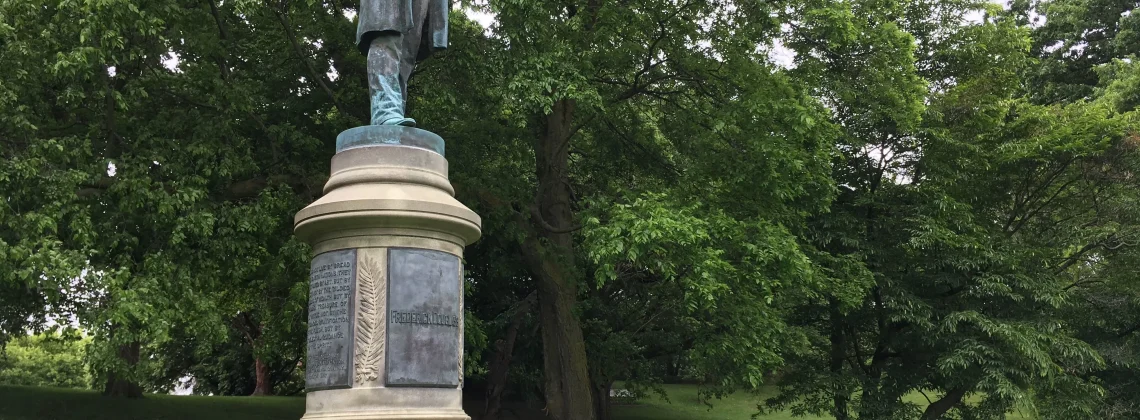
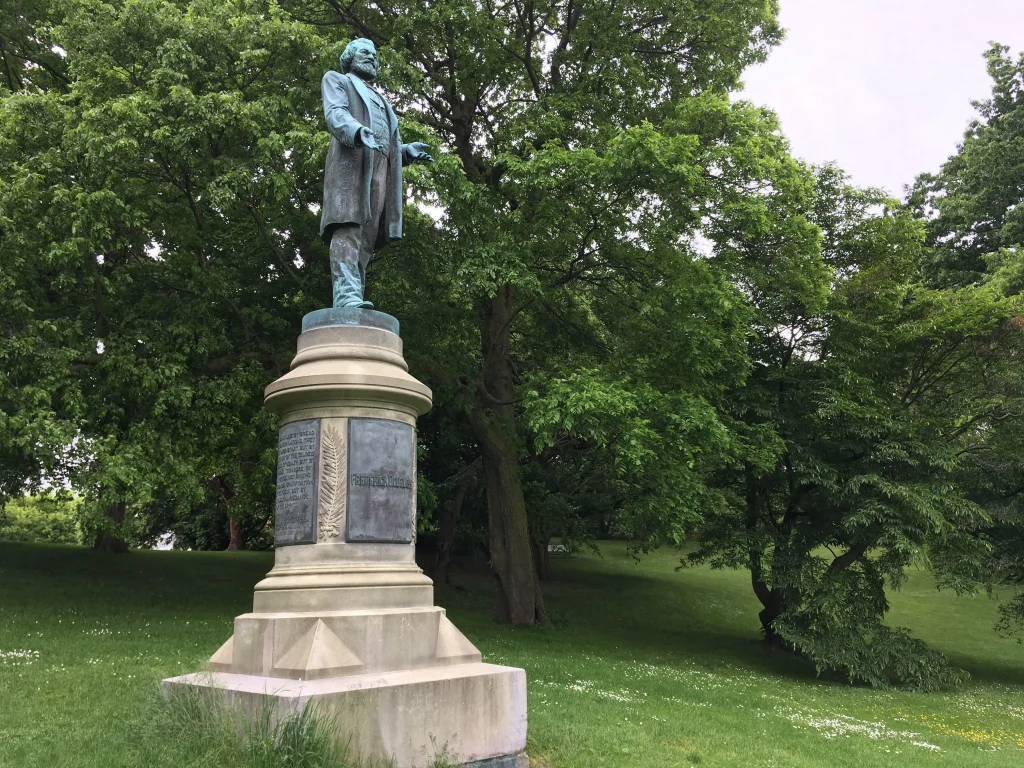
Rochester’s most powerful reminder of Douglass is a large statue in Highland Park. Sculpted in 1899, the statue was the first to be dedicated to a Black American individual. Moved several times over the decades and now in a lovely spot near an amphitheater, the work retains its power. Douglass’s figure is larger than life — eight-feet-tall atop a nine-foot granite base. Eloquent quotations from Douglass appear around its base.
Read the entire piece here.