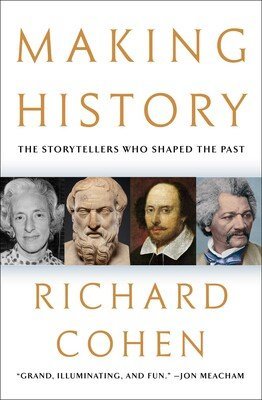
Over at Inside Higher Ed, historian Steven Mintz reflects on Richard Cohen’s Making History: The Storytellers Who Shaped the Past. The entire piece is definitely worth your time. Here is a taste:
In 1879, Albion W. Tourgée anonymously published a novel entitled A Fool’s Errand, By One of the Fools. Today, Tourgée is best remembered as the lead attorney for Homer Plessy in the notorious 1896 case that legally sanctioned the “separate but equal” doctrine that underpinned racial segregation. He was also the first figure to call for justice to be “color blind.”
Tourgée’s novel drew upon the Ohio-born author’s experience as a Union soldier – who had fought in the first battle of Bull Run and at Chickamauga and Chattanooga and was held as a prisoner of war in the Confederacy’s notorious Libby Prison – and who subsequently moved to North Carolina, where he served as a judge and a delegate to the state’s 1868 and 1875 constitutional conventions.
Why did Tourgée – an outspoken opponent of lynching, segregation, disfranchisement, white supremacy, and scientific racism — described his efforts for racial justice as a “fool’s errand”?
In his view, Reconstruction failed because it proved unable to surmount the political and cultural barriers to racial justice:
- The refusal of the federal government to intervene sufficiently to suppress anti-Black violence and enforce African Americans’ civil rights.
- The persistence of racism in the North as well as the South, which had the practical effect of making Black migration northward largely impossible.
- The privileging of sectional reconciliation above racial justice.
I’m certainly no Albion W. Tourgée, and I fully recognize that whatever I do as a professor pales in comparison to Tourgée’s valiant quest to make this society more equal and just. But fool that I am, I continue to believe that a fuller account of the past can contribute to a fairer and more empathetic and compassionate society and give our students a sense of their own agency.
We ultimately teach history not to indoctrinate or propagandize or excuse or render judgment, but to nurture understanding. Our students need to grasp the complexities of human character, the diversity that lies across time and space, the dynamics of social change, the costs and benefits of progress, and the exotic nature of the present. They need to learn, as Marx wrote in The Eighteenth Brumaire of Louis Bonaparte that human beings “make their own history, but they do not make it just as they please; they do not make it under circumstances chosen by themselves, but under circumstances directly encountered, given and transmitted from the past. The tradition of all the dead generations weighs like a nightmare on the brain of the living.”
Only then can they begin to consider themselves educated beings.
Read the entire piece here.